


- Featured
B2B Edition
Advanced B2B features for enterprise plans.Catalyst
NewCreate stunning, high-performing storefronts that captivate and convert.Feedonomics
Omnichannel feed and data transformation.Multi-Storefront
Manage multiple unique stores from one account.International
Grow your brand across the globe.

- Launch Services
Overview
Chart your path to success with specialized services.Implementation Project Management
Experts to ensure you launch on time and under budget.Solution Architecture
Seasoned advisors to help you best design your store.Data Migration & Optimization
Expertise on a clean and clear path to migrating your data.Enterprise Launch Package
Personal training on how to set up and launch your BigCommerce Store.

Professional Services Blog Series
Get to know our teams and how they support your success in this Q&A series.

The Global B2B Buyer Behavior Report
This in-depth report provides actionable strategies to help you sell more online.
Create your new website.
See if the BigCommerce platform is a good fit for your business.
No credit card required.
Top ERP Integrations for BigCommerce B2B Brands

Written by
Ramanathan Ramakrishnamurthy12/15/2025

Top ERP Integrations for BigCommerce B2B Brands
Get The Print Version
Tired of scrolling? Download a PDF version for easier offline reading and sharing with coworkers.
A link to download the PDF will arrive in your inbox shortly.
What you'll learn:
Real-time ERP integration is the foundation of B2B accuracy, preventing hidden costs from pricing errors, inventory mismatches, and manual data issues that can lead to 2–5% revenue loss.
Connecting BigCommerce with your ERP aligns storefront and back office logic, enabling contract pricing, customer-specific terms, and synchronized stock across warehouses.
Without integration, errors scale fast, causing overselling, wrong prices, slow fulfillment, and finance discrepancies that raise operational costs and reduce buyer trust.
Top ERPs for BigCommerce B2B include NetSuite, Dynamics 365, SAP, Acumatica, Sage, and Odoo, each supporting complex pricing, order automation, and multi-location inventory.
A successful ERP integration strengthens the buyer experience and internal operations, delivering accurate pricing, faster fulfillment, cleaner reporting, and long-term scalability.
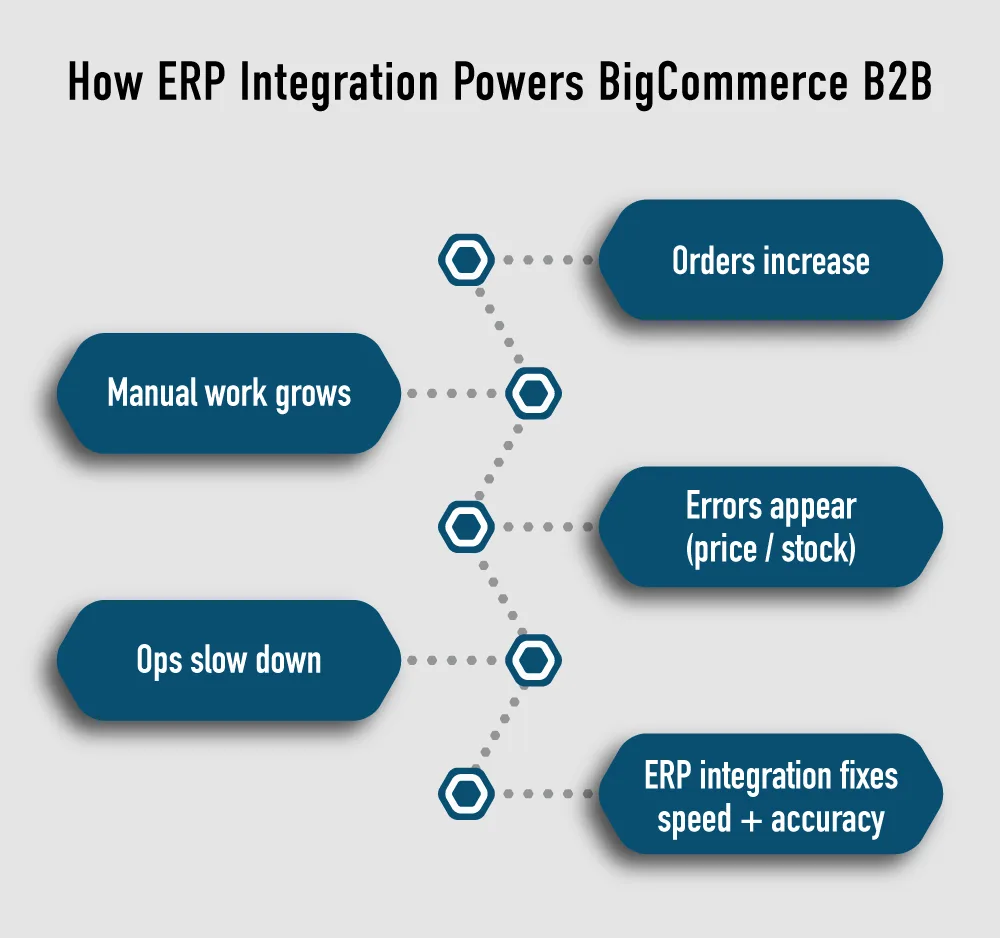
Every time your inventory or pricing sync lags, the error rate compounds across thousands of buyers, becoming one of the highest hidden costs in B2B commerce. These errors spread quickly because many buyers are online at the same time. This quietly increases your costs, contributing to 30–40% of project time spent fixing data issues and to a 2–5% revenue loss caused by pricing mismatches.
Feedonomics says more than 50% of price and stock issues happen because the data sync is late. Buyers expect accurate pricing, real-time stock availability, and quick order confirmation. When these fail, trust drops fast, and the business feels the impact.
For BigCommerce B2B brands, ERP integration has become a basic requirement. It helps prevent these issues before buyers see them. BigCommerce supports complex catalogs and account-based buying, with real-time ERP updates keeping data consistent across systems. A strong sync reduces manual work and keeps daily operations stable. Real-time sync is not an extra feature. It is the foundation that supports growth.
Why does ERP integration matter for B2B on BigCommerce?
ERP integration matters because the ERP holds the main record for pricing, customer rules, and stock levels. Many brands place this inside their ecommerce integration work. They do this to keep the storefront and the back office aligned. When BigCommerce and the ERP stay in sync, order mistakes drop fast. Support tickets also go down and buyers get a smoother experience.
The ERP controls the back office logic, including contract pricing and approval levels, as well as tax rules and warehouse stock. BigCommerce handles the buying experience. If these systems run alone, teams end up with different versions of the truth and errors climb fast.
As order volume grows, manual checks slow fulfilment and increase processing costs. Wrong prices, old stock, and mismatched terms are the most common reasons for ticket escalation. Integration removes these friction points by updating data at once.
To stop errors from growing and protect the buyer experience, your first step is to set up real time sync between your ERP and your storefront.
What happens when ERP and BigCommerce are not connected?
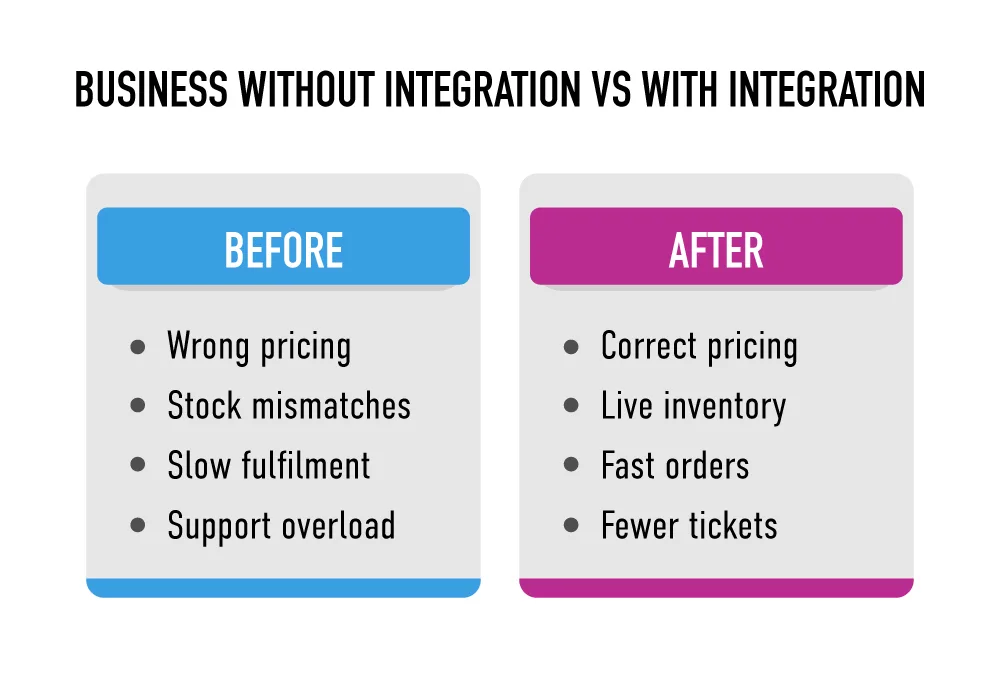
When ERP and BigCommerce run independently, the system quickly loses consistency. Buyers see the wrong price. The warehouse uses outdated stock numbers. The support team spends long hours correcting simple mistakes. This break in the data slows fulfilment and increases operating costs across every team.
Delayed inventory updates create stockouts or overselling. Brands that skip BigCommerce integration services could see these issues more often as orders rise. Manual order entry becomes a bottleneck that no one wants to admit. Finance teams deal with mismatched invoices and wrong credit terms, which can lead to more disputes. The longer the data stays out of sync, the higher the risk for the business.
Quick impact table.
Disconnected system problem | Operational result |
Wrong pricing shown to logged-in buyers | Lost trust and abandoned orders |
Inventory delays | Stockouts and overselling |
Manual order entry | Slow fulfilment and increased labor |
Inconsistent financial data | Higher support and reconciliation workload |
To stop rising costs and protect your brand's credibility, you must synchronize your ERP and the BigCommerce platform to create a single, reliable operational reality.
What should ERP integration cover for B2B brands?
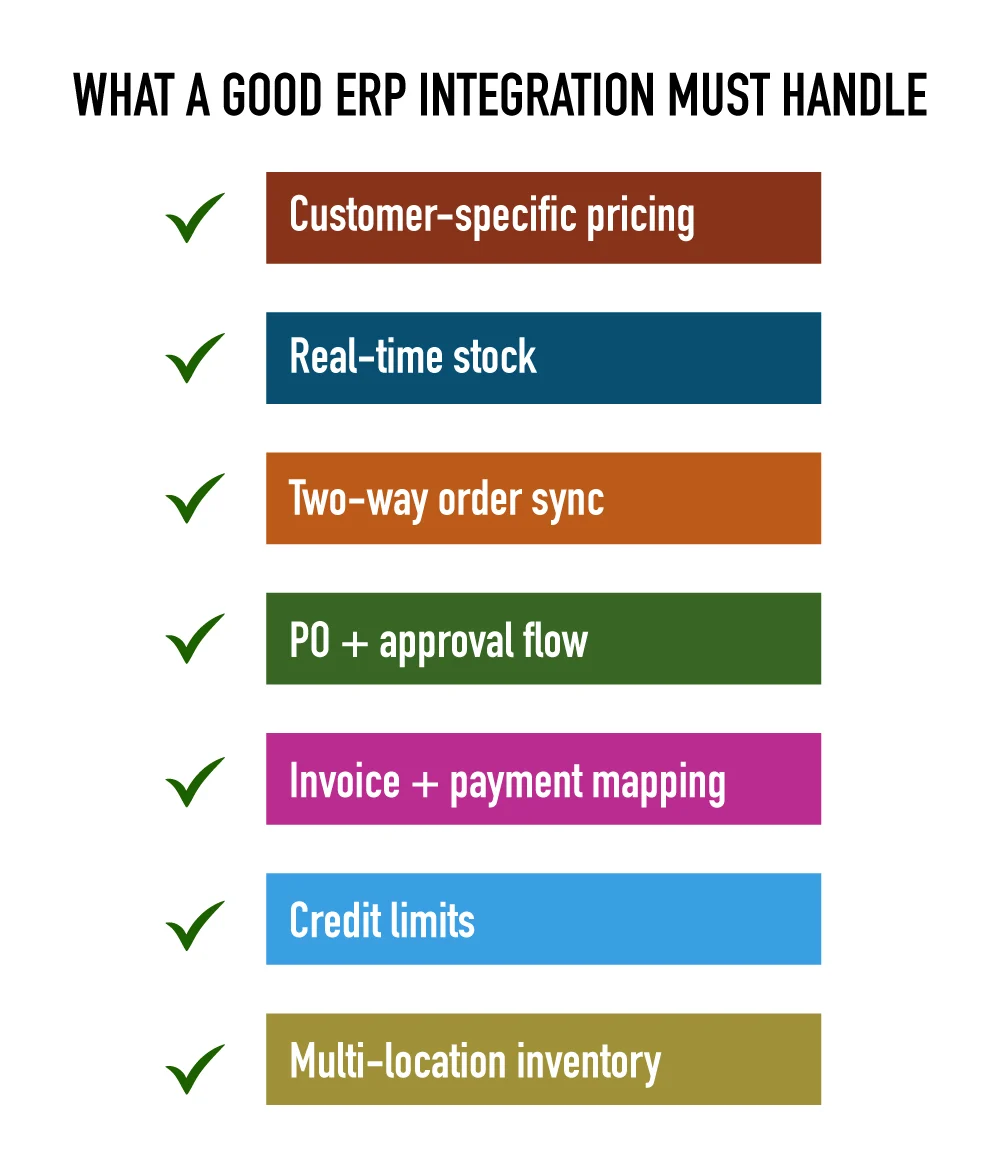
A complete integration should cover pricing and inventory. It should also cover ordering and financial alignment. Brands that use strong ERP integration services tend to benefit from smoother, more efficient workflows. They can also face fewer fulfilment errors. B2B brands need customer-specific pricing and contract-based discounts. They need real-time stock and fast syncing of quotes, orders, and invoices. Without these parts in place, the buyer experience becomes weak. Teams also slow down.
A robust ERP integration supports purchase order processing and multi-warehouse operations. It also promotes approval-based buying. This keeps every team on the same data. Brands that integrate end-to-end gain better accuracy. They also get transparent reporting and faster decisions.
Key capabilities checklist:
Customer-specific pricing and discount rules
Real-time stock visibility across all locations
Purchase order support and approval-based buying
Two-way order sync across sales, warehouse, and finance
Accurate invoicing, payments, and credit validation
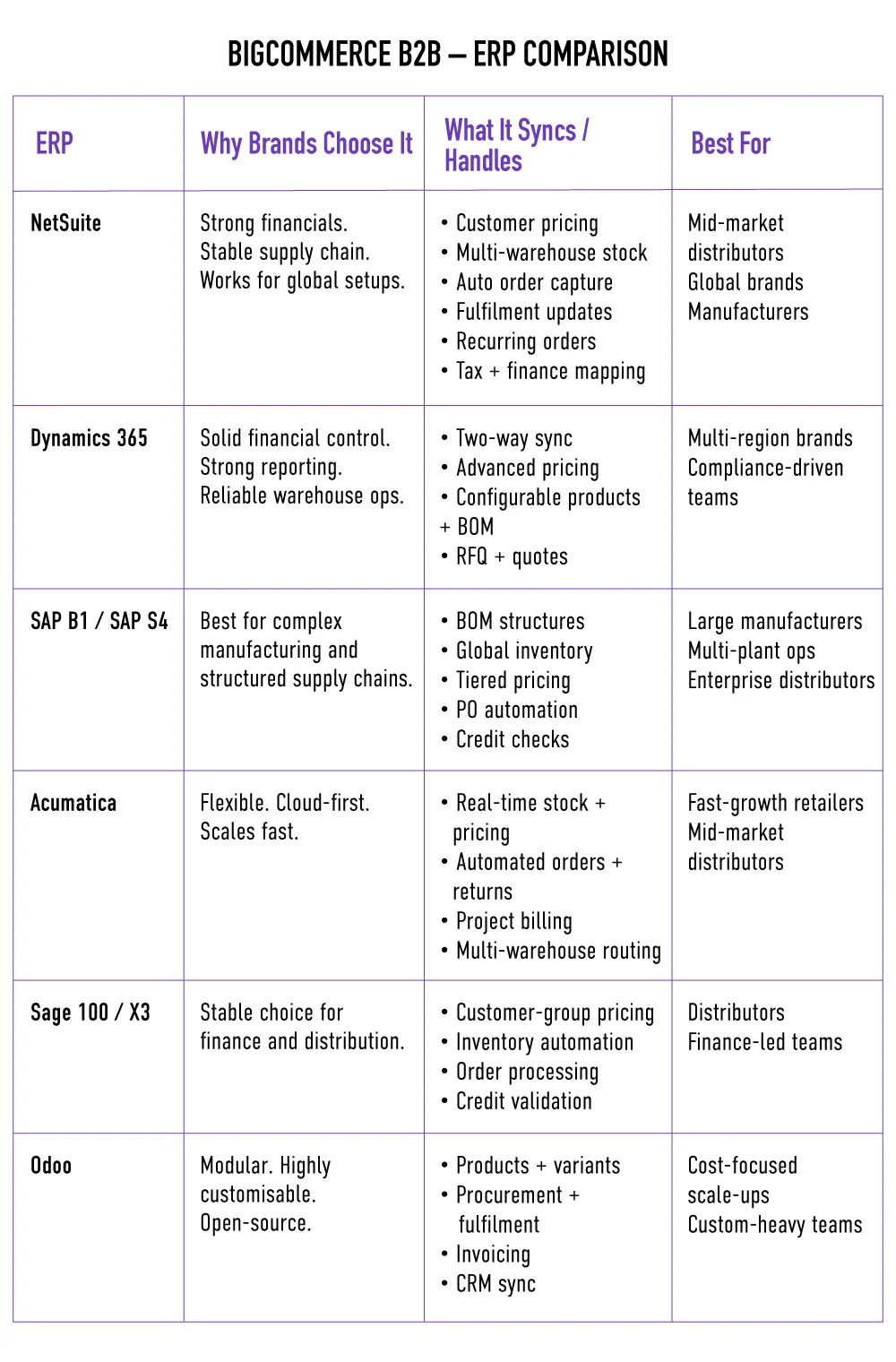
Top ERP integrations used by BigCommerce B2B merchants
B2B brands on BigCommerce choose ERPs that can manage complex pricing, inventory, approvals, and multi-location operations. Working with expert BigCommerce development service helps ensure the integration handles these workflows smoothly.
The proper integration creates a stable workflow where orders move smoothly from the storefront to fulfilment and finance without manual intervention.
Below is a clear breakdown of the most used ERP options and why brands rely on them.
NetSuite.
Why it works well for B2B: NetSuite is known for strong financials, stable supply chain modules, and powerful support for contract-driven pricing. It handles multi-entity setups and global operations with consistency.
Customer-specific pricing sync
Multi-warehouse inventory
Automated order capture in NetSuite
Fulfilment and shipment updates back to BigCommerce
Support for subscription and recurring orders
Real-time tax and financial mapping
Mid-market distributors
Global B2B brands
Manufacturers using advanced supply chain features
Microsoft Dynamics 365.
Why it works well for B2B: Dynamics 365 offers strong financial control, deep reporting, and reliable warehouse automation. It is preferred by brands operating across multiple regions.
Two-way sync for orders, invoices, and inventory
Advanced pricing and customer group management
Configurable products and BOM mapping
Support for RFQ and quote workflows
Established B2B brands with global operations
Teams that need strict compliance and audit-ready reporting
SAP, Acumatica, Sage, and Odoo.
These platforms support B2B brands in different ways. When BigCommerce integration services are set up correctly, the ERP can automatically sync pricing and orders. SAP is used by brands in heavy manufacturing. Acumatica fits fast-growing teams that want flexible cloud tools. Sage is familiar among older distributors. Odoo is picked by teams that want more freedom to customize their system.
SAP Business One and SAP S4HANA.
Why it works well for B2B: SAP supports complex manufacturing, procurement, and distribution. It is designed for companies with structured processes and deep supply chain requirements.
Complex product structures and BOM
Global inventory sync
Tiered B2B pricing and contract rules
Purchase order automation
Credit limits and financial validation
Large manufacturers
Multi-plant operations
Enterprise-grade distribution networks
Acumatica.
Why it works well for B2B: Acumatica delivers flexibility, modern UI, and cost-efficient licensing. It scales quickly without extensive customization.
Real-time stock and pricing updates
Automated workflows for quotes, orders, and returns
Project-based billing support
Multi-warehouse routing
Fast-growing B2B retailers
Mid-market manufacturers and distributors
Sage 100 and Sage X3.
Why it works well for B2B: Sage has deep roots in finance and distribution. It is stable for brands with well-defined processes.
Pricing tied to customer groups
Inventory and reorder automation
Sales order processing
Payment terms and credit validation
Distributors and wholesalers
Brands with established finance teams
Odoo ERP.
Why it works well for B2B: Odoo offers open-source flexibility and modular design. It fits brands that want control over custom workflows.
Sync product catalogues and variants
Map procurement and fulfilment
Manage invoicing and payment terms
Connect CRM for sales teams
Cost-conscious B2B scale-ups
Teams requiring heavy customization
Impact of ERP integration on the B2B buyer experience
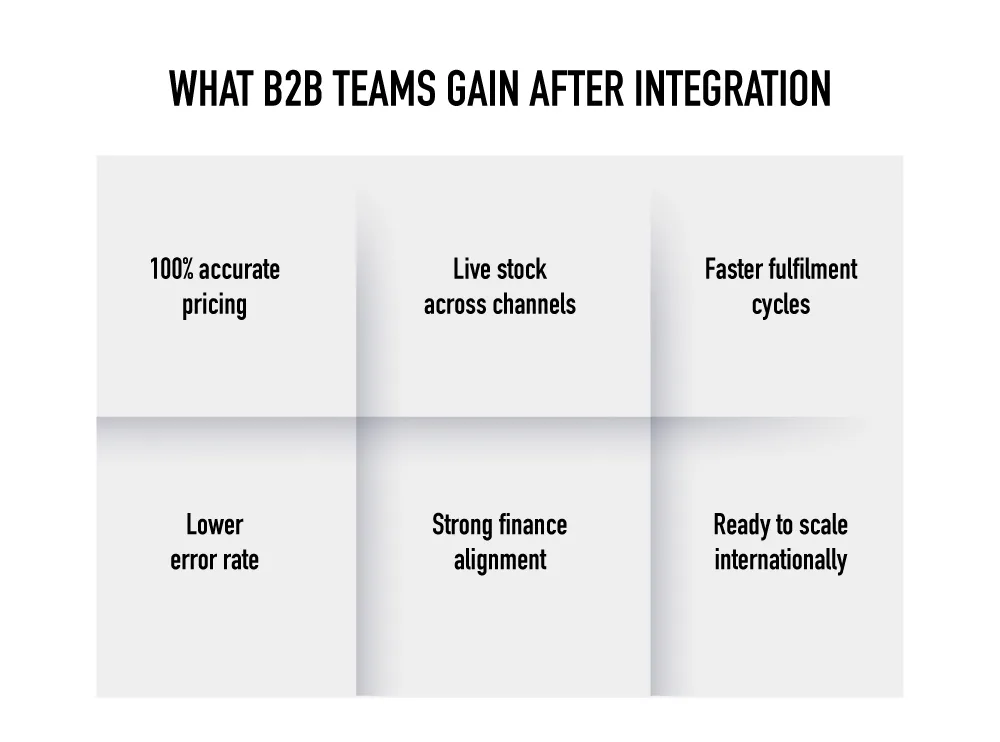
A connected ERP creates a smoother buying process by keeping every detail consistent. This includes from login to checkout. This level of accuracy is driven by well-planned ecommerce integration services that keep all touchpoints aligned. Buyers see accurate contract pricing, real-time stock and cleaner order history. This reduces guesswork and allows them to make decisions faster, especially when managing repeat or bulk purchases.
A fully integrated setup also improves how buyers handle quotes and approvals. They get more apparent timelines, fewer errors, and better visibility into order status. As a result, trust can increase and repeat purchase rates can improve.
Buyer experience improvements:
Accurate pricing every time a buyer logs in
Real-time inventory for confident purchasing
Faster order processing and fulfilment
Clear order history for easier reordering
Smoother quote and approval steps
Operational benefits for internal teams.
Sometimes the problems in a B2B system are not the big ones everyone talks about. They often start as small gaps that go unnoticed during the day. ERP integration is one of those gaps. When teams enter data by hand or repeat the same checks, it’s easy for small mistakes to slip in. One mistake feels tiny. But as orders build throughout the day, that little mistake becomes a bigger issue. A connected ERP helps because updates move together. The warehouse sees the right stock. Finance works with clean numbers. Everyone is looking at the same data so fulfilment moves without confusion.
Planning gets smoother, too. When sales, supply chain, and finance review the exact details, they respond sooner. Leaders get a better idea of what may happen next. They don’t waste time waiting for a late report. With this shared view, each team stays aligned, and the workflow holds together.
Internal team benefits:
Less manual entry and duplication
Lower error rates across orders and invoices
Better warehouse coordination
Stronger financial and inventory visibility
Unified reporting for leadership
Automate manual entry and reconciliation to free your teams from repetitive tasks, allowing them to focus on strategic growth and planning.
How do B2B brands choose the proper ERP integration?
Brands choose an ERP for many different reasons. Some need help with complex pricing. Some need clear rules for each customer group. Others care more about how their warehouses operate or how many steps are in their approval flow. The “right” ERP shifts based on how many regions they sell to and how often they change their catalog. It also depends on whether they use RFQs, POs, or multi-level approvals inside the buying path.
Most B2B teams also check how well the ERP integrates with the tools they already use. This includes CRM, WMS, and procurement systems. Strong BigCommerce development services help make this easier by mapping these systems before the build starts. A good ERP should grow with the business without forcing big rebuilds. When the system sends clean data and updates without problems, brands avoid future breakdowns.
Selection factors checklist:
Level of pricing and contract complexity
Number of warehouses and delivery regions
Requirement for quotes, POs or approval chains
Compatibility with CRM, WMS or procurement tools
Long-term scalability and upgrade path
What challenges appear during ERP integration?
Problems usually show up in strange places. Data mapping is one of them. Catalog cleanup is another. Older ERPs have their own rules, and some of those rules don’t play well with new systems. Good ecommerce integration work helps slow things down less, and it keeps the sync from fighting itself. When product data is messy, everything drags. Some teams also take time to adjust because the new workflow feels different from what they're used to.
Most companies end up rolling out in steps, but it is safer. It keeps mistakes small and lets teams test prices, stock, and orders in short cycles. Most of the trouble usually comes from the data, not the platform. Once the data behaves, the rest feels simple.
Common issues table.
Integration challenge | Why it happens |
Data mapping errors | Different naming or attribute structures |
Legacy customisations | Old workflows that conflict with new sync rules |
Catalog cleanup gaps | Missing variants or incorrect hierarchy |
Team adoption delays | Users adjusting to new processes |
Phased rollout needs | Reducing risk during high-order volume |
A successful integration depends not on avoiding challenges, but on planning for them. Begin with a dedicated data cleanup phase and a phased rollout to ensure a smooth transition.
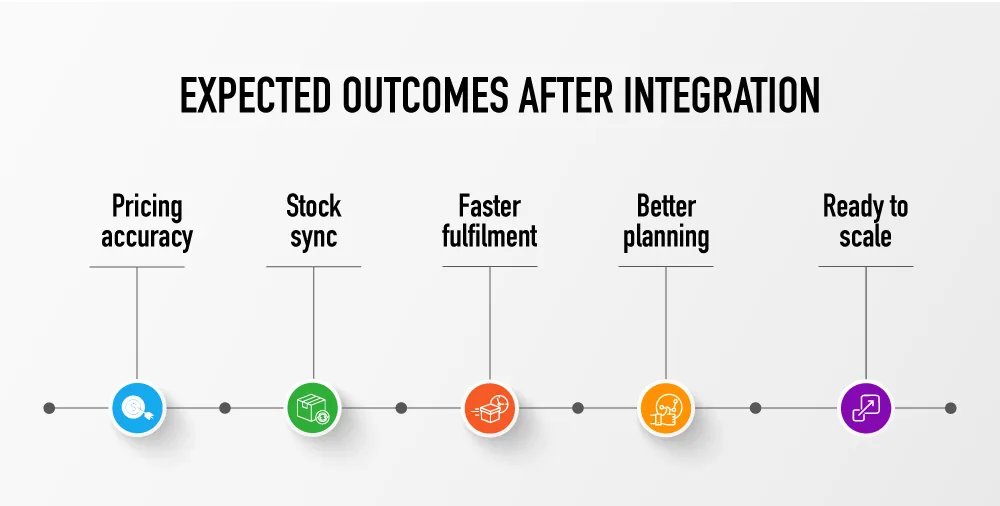
What outcomes can B2B brands expect after a successful ERP integration?
A successful integration delivers faster fulfilment and stronger reporting. With stable Bigcommerce integration services, brands gain smoother scaling. Every buyer touchpoint becomes more reliable. This is because the data flows cleanly between BigCommerce and the ERP. Teams spend less time correcting mistakes and more time improving the customer experience.
With synced financials and data, leadership gains precise forecasting. This helps the brand become ready to scale without fear of system breakdowns. The entire operation becomes more predictable and more stable.
Expected outcomes summary:
Accurate pricing and inventory across all touchpoints
Faster fulfilment and smoother buyer experience
More substantial financial alignment between commerce and ERP
Better forecasting and planning accuracy
Readiness to scale digital revenue confidently
The final word
As order volumes grow and digital transactions become more complex, B2B brands must ensure that every system in the commerce stack works together smoothly. A well planned ERP integration gives BigCommerce stores the structure they need to scale, with reliable financial data, consistent product information, and efficient fulfillment across teams and warehouses.
The companies that gain the most from digital commerce are not just the ones adding more features. They are the ones strengthening their operational foundation. When BigCommerce and the ERP function as one system, leaders can plan with confidence, forecast with clarity and expand without the fear of operational disruption.