


- Featured
B2B Edition
Advanced B2B features for enterprise plans.Catalyst
NewCreate stunning, high-performing storefronts that captivate and convert.Feedonomics
Omnichannel feed and data transformation.Multi-Storefront
Manage multiple unique stores from one account.International
Grow your brand across the globe.

- Launch Services
Overview
Chart your path to success with specialized services.Implementation Project Management
Experts to ensure you launch on time and under budget.Solution Architecture
Seasoned advisors to help you best design your store.Data Migration & Optimization
Expertise on a clean and clear path to migrating your data.Enterprise Launch Package
Personal training on how to set up and launch your BigCommerce Store.

Professional Services Blog Series
Get to know our teams and how they support your success in this Q&A series.

The Global B2B Buyer Behavior Report
This in-depth report provides actionable strategies to help you sell more online.
Create your new website.
See if the BigCommerce platform is a good fit for your business.
No credit card required.
Introducing Maximum Discount Value: More Control Over Promotions, More Predictable Outcomes

Written by
Just Way Koay01/16/2026

Introducing Maximum Discount Value: More Control Over Promotions, More Predictable Outcomes
Get The Print Version
Tired of scrolling? Download a PDF version for easier offline reading and sharing with coworkers.
A link to download the PDF will arrive in your inbox shortly.
Discounts are one of the fastest ways to lift conversion, but they are also one of the fastest ways to create unexpected margin exposure when a promotion scales further than intended.
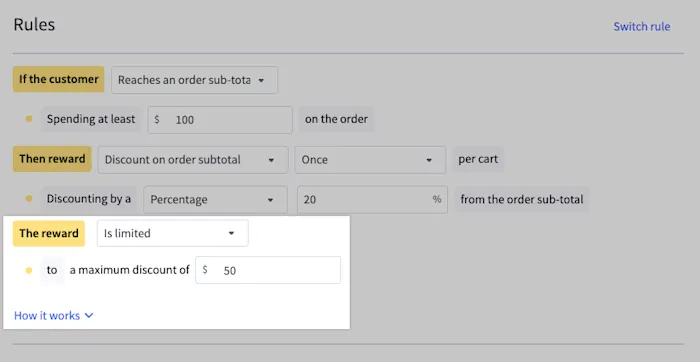
That is why we have introduced Maximum Discount Value, a new capability that lets you cap the total discount a promotional reward can apply. It is designed for teams who want flexibility in offer design with clearer boundaries on discount liability.
What Maximum Discount Value does
Maximum Discount Value adds an optional ceiling to a reward's total discount amount. You can now choose to keep a reward uncapped ("no limit") or switch it to capped ("is limited") and enter a maximum value.
This feature supports the following reward types:
Discount on products (percentage or flat amount)
Discount on order subtotal (percentage or flat amount)
Why this matters
Maximum Discount Value helps you run stronger campaigns without giving up predictability, by providing a tool for alignment between Merchandising and Finance.
Protect margins on high-performing promos - Percentage discounts can scale quickly on large carts. A cap protects your profit margins.
Increase forecastability during peak trading - You can model worst-case discount liability more reliably, even when cart sizes vary.
Enable safer stacking and more creative rules - When promotions include repeatable qualifications or multiple rewards, caps help keep the total discount within acceptable limits.
Reduce internal friction - Merchandising can move faster when finance and operations know there is a clear ceiling.
How it works
A maximum discount value acts as a hard limit. Once the discount reaches that limit, adding more eligible items or spend does not increase the discount further.
Promotion Type | How the Cap Works | Example |
Standard Percentage Off | The cap applies to the total calculated discount. | Offer: 20% off order, capped at $50. Outcome: A $100 order gets $20 off. A $250+ order is capped at $50 off. |
Repeatable Conditions (e.g. "for every 2 items purchased”) | The cap applies per qualification of the condition. | Offer: For every $100 spent, get 50% off Item X, capped at $50. Outcome: A $100 order can get $50 off Item X. A $150 order is capped at $50 off Item X. A $200 order can get $100 off Item X. If the customer qualifies twice, the reward (and the cap) applies twice. |
Note that on repeatable conditions and qualifications, the reward can apply multiple times as the cart grows. In these cases, Maximum Discount Value behaves like a cap per application of the reward, not one cap for the entire order. If a customer qualifies twice, the maximum discount value effectively doubles.
Set clear shopper expectations
Shoppers will not receive an explicit notification when they have hit the maximum discount value. In practice, a customer may add more eligible items expecting the discount to continue increasing, but the discount does not change once the cap has been reached.
Plan your storefront messaging accordingly:
Use promotional banners or store messaging to set expectations early before checkout.
State the maximum discount clearly, for example "20% off, up to $50".
Summary
Maximum Discount Value is a control point for promotion design. You choose when a reward should be unlimited and when it should have a clear maximum. Used well, it supports better offers for shoppers and more predictable outcomes for the business. See our documentation in the Help Center to learn more about Maximum Discount Value and other tools for building robust promotions.

There's a lot to love ❤️
Watch a demo to see the BigCommerce platform in action.