


- Featured
B2B Edition
Advanced B2B features for enterprise plans.Catalyst
NewCreate stunning, high-performing storefronts that captivate and convert.Feedonomics
Omnichannel feed and data transformation.Multi-Storefront
Manage multiple unique stores from one account.International
Grow your brand across the globe.

- Launch Services
Overview
Chart your path to success with specialized services.Implementation Project Management
Experts to ensure you launch on time and under budget.Solution Architecture
Seasoned advisors to help you best design your store.Data Migration & Optimization
Expertise on a clean and clear path to migrating your data.Enterprise Launch Package
Personal training on how to set up and launch your BigCommerce Store.

Professional Services Blog Series
Get to know our teams and how they support your success in this Q&A series.

The Global B2B Buyer Behavior Report
This in-depth report provides actionable strategies to help you sell more online.
Create your new website.
See if the BigCommerce platform is a good fit for your business.
No credit card required.
Universal Commerce Protocol: Future-Proofing the Checkout Experience

Written by
Sydney Bonner02/11/2026

Key highlights:
Shopping is moving into conversations: AI is no longer just helping shoppers decide, it’s helping them buy in real-time.
Being discoverable isn’t enough anymore: Universal Commerce Protocol makes your business buyable at the moment of intent, not after it passes.
Control doesn’t have to be the tradeoff: With UCP, you keep ownership of checkout, customer data, and brand experience as commerce moves into AI.
Build once. Scale everywhere. One open standard replaces dozens of custom integrations across AI platforms and surfaces.
Checkout is becoming invisible: UCP future-proofs the most critical part of commerce by letting it evolve wherever buying happens next.
Nearly 60% of consumers report having used AI to help them shop, making AI a trusted advisor for product discovery and decision-making before purchase.
The era of endless browsing is over.
The next generation of shoppers no longer want to search website after website to figure out what to buy. They want AI to understand their needs, surface the right options, and help them purchase without friction. Commerce is shifting from exploration to execution.
Universal Commerce Protocol (UCP) changes the rules. It creates a standardized way for AI systems to buy directly from your business without forcing you into closed platforms or custom integrations. You remain the merchant of record. You own the customer relationship. Universal Commerce Protocol simply makes your commerce stack ready for what buying looks like next.
In a world where AI completes the purchase, who controls your checkout?
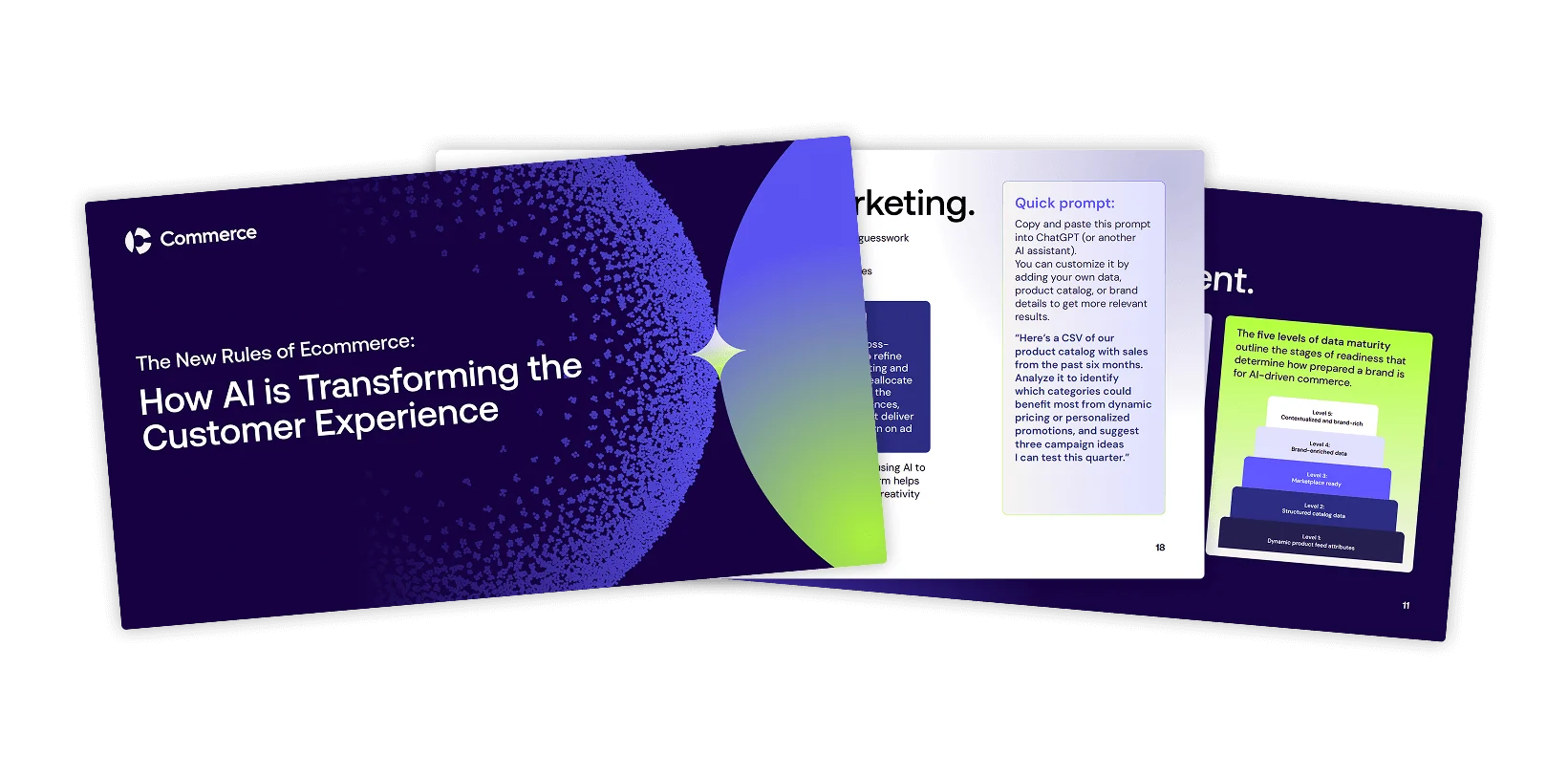
Discover How AI is Transforming the Customer Experience
AI is quickly reshaping the landscape of ecommerce. Learn how you can prepare for the next wave of AI commerce.
What is Universal Commerce Protocol?
We see UCP as the open-connective-tissue modern commerce has been missing: an open standard, developed by Google and industry partners, that replaces fragmented, custom integrations with a shared protocol built for the future of checkout.
UCP is designed to let AI agents interact directly with merchant systems, enabling end-to-end commerce actions, from discovery and cart creation to checkout, payment, and post-purchase across search, chat, and voice interfaces.
Our point of view is clear: commerce shouldn’t be trapped inside channels or stitched together with one-off solutions.
The future of commerce isn’t built inside closed platforms — it’s built on open systems that work everywhere. Universal Commerce Protocol is how we help make that future real: by giving brands a flexible, interoperable foundation that’s ready for AI-native shopping at scale.
Opportunity in an open ecosystem
Universal Commerce Protocol takes what could be a messy, fragmented future and turns it into something scalable, open, and actually usable in the real world.
As the shopping journey shifts from clicks and links to conversations and AI-driven decisions, retailers need more than visibility, they need a dependable way to turn intent into action, wherever it shows up.
That’s exactly what UCP delivers. It reinforces what we’ve believed all along: open-sources win, and commerce works best when businesses aren’t boxed into closed, single-surface experiences. With Feedonomics making product data structured, enriched, and ready for AI, and BigCommerce executing checkout at enterprise, UCP lets brands build once and sell everywhere AI-powered buying happens without sacrificing control.
The result? Businesses stay firmly in charge of their checkout, customer relationships, and data. It creates a future where AI doesn’t just help shoppers decide, it happily handles the “add to cart.”
“AI is rapidly reshaping commerce. Merchants need to make it easy
for shoppers to go from discovery to purchase, or they risk losing sales.”
— Sharon Gee, Senior Vice President of Product for AI, Commerce
How UCP works with Commerce
Think of Universal Commerce Protocol as the translator that helps AI and commerce speak the same language, and Commerce is the team making sure something happens once they agree.
Instead of trying to standardize how the shopping journey looks, UCP focuses on what shopping does: discovering products, building carts, calculating totals, completing checkout, and handling what comes after. That’s a big deal, because AI doesn’t care about buttons or page layouts, it cares about core capabilities.
This is where Commerce shines.
Feedonomics structures and enriches product data so it’s clean, accurate, and ready for AI to understand and act on. Google provides AI-driven surfaces where discovery and buying are converging. And BigCommerce steps in as the execution layer, powering checkout, payments, and order management for retailers, with SDKs that make it easier to implement and extend across existing systems.
UCP supports multiple ways for systems to communicate, whether that’s APIs, agent2agent (A2A) interactions, agent payments protocol, or model context protocols (MCP). SDKs and standardized interfaces help simplify adoption, while built-in user consent and authorization ensure trust is part of the experience from the start, not added later.
The best part? None of this requires ripping and replacing your existing commerce stack. UCP is designed to layer neatly on top of the systems you already use, connecting them to AI-driven buying experiences without disrupting how they operate today.
Build once, plug in, and scale everywhere — exactly how modern digital commerce should work.
A look at how product listings are transformed with Feedonomics.
Drive more value for your store
AI is changing how customers buy, but it doesn’t have to change who leads the sale. Universal Commerce Protocol lets your business meet the next generation of shoppers at the moment of intent, wherever that moment happens, without handing over checkout, customer data, or margins. Instead of chasing every new AI platform with custom integrations, you enable one standard that adapts as the shopping journey evolves. The real value is simple: more opportunities to convert, less complexity to manage, and a commerce foundation built to keep your business in control.
Stay in control as commerce moves into AI.
With UCP, you remain the merchant of record. Your business logic, pricing rules, branding, and customer relationships stay yours. Commerce and its partners ensure AI-driven purchases route through your systems, not a third-party marketplace or black-box checkout.
Create shopping experiences that feel effortless to customers.
UCP enables faster, more intuitive buying journeys by allowing AI to guide customers from question to purchase in one flow. Deliver personalized, low-friction experiences while keeping ownership of the transaction and customer relationship. Research shows that 58% of consumers prefer AI-powered search.
Be buyable at the moment of intent.
As shopping shifts into search, chat, and conversational AI, UCP allows retail customers to move from question to purchase in one flow. Connect your product data, inventory, and checkout so buying can happen immediately, without sending shoppers elsewhere or losing momentum.
Build once, scale everywhere.
Instead of creating custom integrations for every AI surface and vertical, UCP provides a single, standardized connection. Implement that connection once, then extend it across AI platforms as they emerge. This reduces technical overhead and future-proofs your commerce stack.
Turn data quality into a competitive advantage.
AI-driven commerce depends on accurate, structured, and enriched product data. With Feedonomics, your product information is optimized to be AI-readable and executable. That improves discoverability, eligibility, and conversion as AI becomes a primary shopping interface.
Increase efficiency without sacrificing flexibility.
UCP allows AI agents to automate repetitive commerce actions like product discovery, cart building, and order management. We integrate these core capabilities into your existing extensible architecture, so you gain efficiency without replatforming or locking into rigid systems.
Where UCP shows up in the real world
These are practical, already-emerging ways Google’s Universal Commerce Protocol shows up in everyday shopping experiences.
Buying directly inside AI search and chat.
Shoppers can discover products, compare options, and complete purchases within AI-driven search and conversational interfaces. UCP allows these transactions to happen in one flow, while still routing checkout through your commerce system.
Conversational AI completing transactions.
AI assistants can answer questions, configure products, apply discounts, and complete purchases on behalf of shoppers. UCP provides the standardized actions needed to execute those transactions securely and consistently.
Embedded AI checkout experiences.
When additional input is required, such as shipping selection or identity verification, UCP enables a seamless handoff to embedded or native checkout experiences. Shoppers continue exactly where the AI left off with ease.
Voice-based shopping with secure checkout.
From smart speakers to in-car assistants, UCP supports voice-initiated purchases that connect directly to merchant checkout systems, ensuring security and continuity. Among shoppers, best use cases include answering product questions (44%) and finding great deals (34%).
How to apply UCP to your workflow
These applications highlight how UCP can be applied across business models, channels, and operational workflows.
Autonomous product sourcing and replenishment.
AI agents can monitor usage, sync their inventory in a merchant center, and automatically place orders based on predefined rules and permissions, especially useful for B2B and repeat-purchase scenarios.
Intelligent price and availability comparison.
UCP allows AI systems to evaluate products, pricing, and inventory across businesses and act on those insights, enabling faster and more confident purchasing decisions.
Inventory balancing across channels and platforms.
AI agents can help route demand to the right fulfillment source based on availability, location, or cost, improving efficiency and reducing stock issues.
Intelligent affiliate and partner ecosystems.
UCP enables cleaner, standardized commerce interactions between businesses and partners. AI agents can route transactions dynamically without requiring custom integrations for every relationship.
Conversational agents completing transactions.
Conversational agents are moving beyond answering questions to completing purchases on behalf of shoppers. As generative AI becomes better at understanding intent, context, and preferences, UCP gives these systems a standardized way to take action, not just offer advice.
How it shows up in practice:
A shopper asks an AI assistant to find the best running shoes for marathon training. The agent compares options, confirms size and availability, applies a promotion, and completes the purchase in one conversation.
A B2B buyer tells an AI assistant to reorder office supplies. The agent verifies pricing and contract terms, places the order, and schedules delivery without manual intervention.
A customer configures a complex product through conversation, such as selecting materials, add-ons, or service options, and completes checkout without leaving the chat.
Why it matters for your business:
Faster conversions by removing steps between decision and purchase
Consistent, secure execution of transactions across AI platforms
Full control over checkout, pricing rules, and customer data
What Universal Commerce Protocol unlocks, by audience
For merchants: stay in control as shopping leaves the site
AI is becoming the place where buying decisions are made. Universal Commerce Protocol makes sure your business doesn’t get cut out of the transaction when that happens.
Remain the merchant of record, with full ownership of checkout, business logic, customer data, and relationships.
Stay in control of pricing, branding, fulfillment, and policies — even when purchases happen inside AI experiences.
Avoid building and maintaining custom integrations for every new AI platform.
Participate in generative AI shopping without becoming a marketplace seller.
Reduce technical overhead as agentic commerce scales.
The result: you gain reach and speed without giving up control.
For platforms, developers, and AI providers: build once, scale everywhere
Agentic commerce only works if systems share a common language and a consistent set of functional primitives. UCP trades one-off integrations for standardized schemas that let commerce actions finally stop getting lost in translation.
One protocol replaces dozens of bespoke commerce connections.
Merchants onboard faster in real time, with fewer edge cases to manage.
Permissions, payments, and responsibilities are clearly defined within the schema.
Commerce interactions become more consistent, predictable, and secure.
Teams focus on building new experiences instead of routine maintenance.
The result: quick innovation with less complexity.
For shoppers: buying without the busywork
Shoppers don’t want to browse. They want answers, confidence, and the ability to act.
AI assistants help shoppers move from question to purchase in one flow.
Customers can shop across multiple businesses in a single experience.
Recommendations feel more relevant and contextual, not generic.
Fewer tabs, fewer steps, and less friction along the way.
The result: shopping feels faster, simpler, and more human.
The final word
Checkout used to be a page, then it became a flow. Now? It’s defining the future of commerce.
As buying moves into AI-driven conversations, voice assistants, and embedded experiences, the mechanics of checkout can no longer be tied to a single surface or interface. Universal Commerce Protocol future-proofs checkout by separating how customers buy from where buying happens. Your checkout logic, rules, and controls stay intact — even as new shopping experiences continue to shift and change.
The result is a checkout experience that doesn’t need to be rebuilt every time commerce evolves, because it was designed to evolve with it. Commerce no longer happens after the search. It happens inside the answer.
To find more answers on how UCP can transform your checkout, chat with one of our advisors.
FAQs about Universal Commerce Protocol
How do I start using Universal Commerce Protocol?
Getting started with Universal Commerce Protocol doesn’t require ripping and replacing your existing commerce stack. It starts with understanding where AI-driven buying can create the most value for your business, then enabling it in a deliberate, scalable way.
Start by reviewing the official Universal Commerce Protocol documentation to understand what UCP supports today and how it fits into your current architecture. From there, assess whether your commerce platform or key partners already support UCP, or are actively building toward it. Many organizations can adopt UCP as an extension of their existing systems, not a rebuild.
Next, decide which commerce actions matter most to your business right now. That might be product discovery inside AI search, conversational checkout, or post-purchase interactions. Starting with a focused use case allows teams to move faster while minimizing risk.
Work with your ecommerce platform or development team to implement UCP-compatible endpoints, then roll out support across a limited set of AI surfaces before expanding.
How is Universal Commerce Protocol different from traditional ecommerce APIs?
Traditional ecommerce APIs were built for websites and apps driven by humans. They assume a shopper is clicking through pages, filling out forms, and manually completing checkout. Google’s Universal Commerce Protocol is built for a different reality, one where AI agents actively participate in the buying process.
Instead of exposing a collection of custom endpoints that vary by platform, UCP standardizes commerce intent. It defines what actions are possible, such as discovering products, building a cart, completing checkout, or managing orders, in a way AI systems can understand and execute consistently across businesses. This allows AI to move from recommendation to transaction without brittle, one-off integrations.
For enterprise teams, the impact is significant. UCP reduces the need to build and maintain separate integrations for every AI platform, creates clearer boundaries for permissions and payments, and enables more reliable commerce interactions as AI-driven shopping scales. In short, traditional APIs connect systems. Universal Commerce Protocol makes commerce executable by AI.
Does Universal Commerce Protocol replace existing ecommerce platforms?
No. Universal Commerce Protocol is designed to work with your existing ecommerce tech stack, not replace it. UCP operates as a layer on top of your current commerce infrastructure, allowing AI systems to interact with your business without changing how your core operations run.
You continue using your existing storefronts, checkout flows, payment providers, and fulfillment systems. There’s no requirement to replatform, rebuild, or disrupt what already works. Instead, UCP extends your current setup so it can support AI-driven buying experiences alongside the functionality of traditional channels.
For enterprise teams, this means you can experiment with AI-driven commerce in a controlled way. You add new buying capabilities without introducing operational risk, and you future-proof your commerce stack without sacrificing stability or control.
How does Universal Commerce Protocol handle user intent and consent?
Universal Commerce Protocol is built with trust at the core. It requires explicit user authorization before any commerce action takes place, ensuring AI systems act only with clear permission and within defined boundaries.
Rather than granting broad access, UCP scopes AI permissions to specific actions, such as product discovery, cart creation, or checkout. This gives users transparency and control, while allowing businesses to confidently enable AI-driven buying without opening unnecessary risk. Payment methods are handled through clearly defined payment handlers, with approvals and confirmations flowing through secure, verifiable processes that protect both the customer and the business.
For enterprise teams, this creates a foundation of accountability. Every interaction is auditable, permissions are clearly defined, and responsibility is shared across users, AI agents, and merchants. The result is AI-driven commerce that earns trust, rather than asking for it.
When will Universal Commerce Protocol be available?
Universal Commerce Protocol is already moving from concept to execution. While specific rollout dates will vary by platform and use case, teams across the ecosystem are actively building to UCP now so businesses can take advantage of it as availability expands.
Buying directly inside Google’s AI experiences is coming soon. Google plans to enable checkout within AI Mode in Search, Gemini on the web, and the Gemini app, allowing shoppers to purchase while they’re still researching. Early access and phased rollouts mean enterprise teams can start preparing today, rather than waiting to react later.
The key takeaway is this: UCP isn’t a distant roadmap item; it’s a foundation being put in place now, so industry leaders that prepare early are ready to participate as AI-driven buying becomes mainstream in this new era.
Discover How AI is Transforming the Customer Experience
AI is quickly reshaping the landscape of ecommerce. Learn how you can prepare for the next wave of AI commerce.