




Written by
John Shieldsmith
Alcohol Ecommerce
Get The Print Version
Tired of scrolling? Download a PDF version for easier offline reading and sharing with coworkers.
A link to download the PDF will arrive in your inbox shortly.
Key highlights:
Alcohol ecommerce is the online sale of beer, wine, and spirits through compliant digital storefronts and regulated fulfillment channels.
Alcohol ecommerce has matured into an $86+ billion global market, with sustained growth expected through 2030.
A direct-to-consumer (DTC) model lowers overhead, strengthens brand control, and expands distribution reach.
Navigating state-by-state regulations requires compliant shipping, age verification, and trusted delivery partners.
Omnichannel strategies and personalized digital experiences drive higher conversions and long-term loyalty.
To say alcohol ecommerce has had an interesting journey would be an understatement.
The alcohol industry is hailed as many things: recession proof, regulated, colossal, scandalous. Rife with red tape and controversy, alcohol was never thought of as a prime candidate for ecommerce.
But today, the alcohol ecommerce industry is valued at $86.56 billion and set to reach $161.4 billion by 2030.
Selling alcohol online is no longer a pipe dream, nor something that only happens illegally on the local marketplace. It’s a viable practice being utilized by an immeasurable number of online retailers. (Truly, there’s no official number.)
With the right approach, you can join this thriving industry, successfully operate an online liquor store, and even safely navigate age verification and other hurdles.
How D2C is changing the alcohol industry and ecommerce
With the direct-to-consumer (D2C or DTC) model, you can give consumers real-time access to goods they typically had to purchase from a brick-and-mortar or third-party seller.
While the DTC approach isn’t new, with brands like Dollar Shave Club and Warby Parker bringing it into the mainstream, it’s continuing to gain momentum in other industries — from CBD to specialized healthcare at home.
In the midst of the COVID-19 pandemic, many states relaxed their liquor laws. Now, alcohol gets to join in the wave of DTC success.
But, why DTC?
1. Lower entry barriers.
When it comes to ecommerce, the barriers to entry are quite low. The same is true for alcohol companies, where DTC allows you to forgo:
Needing a brick-and-mortar location
Having to hire staff for operating said location
Being limited to alcohol brands in your area
Paying the utilities associated with a physical store
You still need to set up an online store and the right platform for online ordering, but this is far cheaper than securing a physical location. You can even partner with an authorized alcohol shipper, which can reduce the regulatory hurdles early in your journey and further lower barriers.
The availability of flexible SaaS platforms reduces upfront infrastructure costs while supporting complex product catalogs and compliance integrations, further lowering barriers.
2. Easier to control the customer experience.
Customer satisfaction is key for long-term success, whether you’re running a brick-and-mortar or online store.
With a physical liquor store, you’ll inevitably have challenging interactions that are out of your control. Online, you can tailor the customer experience from the beginning.
A thoughtful digital marketing approach increases the chance your brand is perceived the way you want, while automation can help you personalize a customer’s shopping experience in real-time. With 64% of people expecting more personalized experiences, this is crucial to the customer experience.
The right ecommerce platform will centralize customer data, making this level of personalization scalable, even across multiple storefronts or regions.
For example, Instacart personalizes what a customer sees while shopping, basing the order of items on their shopping habits and even dietary preferences.
3. Optimized distribution and increased access.
A brick-and-mortar store is limited to its surrounding market. The DTC approach truly shines here, giving online stores a number of distribution advantages:
Access to a larger market, meaning more potential revenue
An increase in alcohol delivery services, enabling retailers to optimize distribution costs
Real-time tracking and analytics that empowers retailers to focus on highest-profit markets
Note: Many states have differing liquor laws, limiting some markets. By working with a professional alcohol delivery service, you can focus your efforts on the right markets and avoid costly legal mishaps.
Find your favorite features.
Explore all of the capabilities of the BigCommerce platform.
Delivery and shipping for your alcohol ecommerce business
Some things never change, and that includes legal complexities facing alcohol retailers.
Every state in the U.S. has its own laws, making an alcohol ecommerce store more difficult than one selling clothing or pet rocks.
Despite the legal minefield alcohol retailers have to run through, there are a number of ways retailers can safely ship and deliver their goods to thirsty customers.
1. Interstate shipping.
Every state has their own guidelines, but more and more are allowing online alcohol retailers to ship across state lines using carriers like UPS and FedEx. But, there are a few caveats:
Regulations for both the shipping and receiving states apply
A twenty-one-year-old adult needs to sign for the package
State limits can control how much alcohol can be shipped in a single order
Again, working with a reputable alcohol distributor and importer can take much of the legal load off your shoulders, allowing you to focus on online alcohol sales and delivering the best customer experience possible.
Tip: Stay current with the alcohol shipping and delivery laws in each state to avoid legal mishaps.
2. Local on-demand delivery.
Having access to much of the country is a major perk for alcohol ecommerce, but this doesn’t mean you should neglect your immediate market.
With local on-demand delivery, locals can liberally order your libations, having it delivered right to their door.
Partnering with alcohol delivery apps like Uber Eats (Formerly Drizly) and Saucey can give you access to your immediate market, while giving your customers a convenient way to get their cocktails.
An added perk? Upwards of 78% of U.S. consumers say food delivery is a form of self-care. By selling alcohol online, you’re playing a role in that.
3. Curbside pickup.
Curbside pickup, similar to the Buy Online, pickup in store (BOPIS) model, has gone from niche to daily habit for many consumers. Today, over 10% of U.S. retail ecommerce sales are done via the BOPIS (also known as click-and-collect) method.
With curbside pickup, customers can order online at their convenience, then get their order at the curb of the designated pickup location.
For ecommerce retailers, this option can increase conversions for those wanting faster, local access. Your customer satisfaction goes up, you get a sale, and everyone wins. And, there’s no shipping costs to deal with.
There's a lot to love ❤️
Watch a demo to see the BigCommerce platform in action.
Alcohol ecommerce trends
Alcohol ecommerce trends reflect a permanent shift in consumer buying behavior, accelerated by pandemic-era regulatory changes and sustained by digital convenience. Retailers using scalable ecommerce platforms are capitalizing on rising online adoption while balancing compliance and personalization demands.
1. Online alcohol sales stabilize.
Physical stores were once the traditional way to buy alcohol, save a handful of wine ecommerce providers. For many markets, they were the only way. It’s little surprise then, that in 2019, only 1% of alcohol sales were via ecommerce, per research compiled by Statista.
Today, alcohol ecommerce has found solid ground:
Ecommerce accounts for 3.5% of alcohol sales
Alcohol ecommerce CAGR is projected at 13.85%, putting it on-par with certain healthtech industries and above the software market as a whole
Several years ago, it was easy to write off online alcohol sales as a fleeting moment tied to the pandemic. Now, with online alcohol sales higher than pre-pandemic levels, it’s safe to say it’s not a trend.
2. Omnichannel becomes increasingly popular.
With an omnichannel approach, a retailer bridges the gap between a traditional brick-and-mortar experience, and their online store.
The omnichannel approach is increasingly popular, as it delivers customers the trust they’ve come to expect with in-person shopping, and the convenience of ecommerce.
In fact, 91% of shoppers are now in the omnichannel shopper category.
Omnichannel doesn’t mean offering in-person and online retail experiences. With a true omnichannel experience, your brand should extend across your social media, digital marketing, brick-and-mortar, and online presence.
A seamless omnichannel strategy ensures branding, inventory, and customer data remain consistent across every touchpoint.
3. Consumers expect a tailored experience.
Physical alcohol retailers are used to delivering a concierge-level experience, from free samples to tasting rooms to catering to a shopper’s taste. Now, the same tailored experience is expected online.
In the U.S., 83% of shoppers want a personalized experience. Using AI and automation, alcohol ecommerce businesses can deliver exactly this, from tailoring product recommendations to hyper targeting social media ads.
For companies who provide this tailored experience, they’ll be ultimately delivering a better customer experience.
The best part? Centralized customer data and API-driven integrations make this level of personalization achievable at scale.
Alcohol ecommerce challenges
Despite strong growth, alcohol ecommerce presents operational and regulatory challenges that require careful planning and reliable technology infrastructure. Retailers must balance compliance, logistics, and customer experience to scale sustainably.
1. Licensing protocols.
Licensing, a word that can haunt the dreams of any alcohol provider.
It is essential that you understand the full breadth of licensing before undertaking online shopping, ensuring you can answer the following:
Are you able to sell alcohol online?
What does it take to sell in your state?
What brands are allowing online sales, and where are they able to be sold?
While the above aren’t fun questions to answer, they’re essential to operating legally and avoiding costly fines.
2. Shipping alcohol.
Many states have loosened shipping regulations in recent years, making it possible to ship alcohol across some state lines. Still, there are individual state regulations that can complicate the shipping process.
When planning to sell alcohol online, it’s important to know:
What kind of shipping partners are available in your area?
Does your state have shipping limits, and how will this impact your potential ROI?
Which shipping services can you use, and do they ship to every state?
Lastly, while not a legal matter, packaging is important when shipping alcohol. Factor in the costs of proper alcohol shipping materials when planning, as a broken bottle of bordeaux will lead to a sad customer and a ding to your reputation.
3. Underage purchases.
As an online alcohol retailer, few problems are greater than having your products wind up in the hands of someone underage — intentional on the buyer’s part or not.
Kids can play with Mom or Dad’s phone, ordering everything from Robux to rum. Age verification acts as the first line of defense between an underage buyer and your products.
It’s equally important your shipper requires the signature of someone 21 or older upon receipt. The last thing you want is a shipper dropping a box of alcohol off while those of legal age aren’t around to sign for it.
No matter how it happens, your products winding up with underage drinkers can result in hefty fines, jail time, and the revoking of your license to operate.
How to boost your alcohol ecommerce sales
Increasing alcohol ecommerce sales requires a combination of regulatory awareness, frictionless technology, and data-driven strategy. Retailers using flexible ecommerce platforms can adapt quickly to shifting consumer expectations while maintaining compliance.
1. Understand regulations.
It bears repeating: All alcohol ecommerce businesses need to understand local and national regulations through and through.
Beyond reading up on every state’s alcohol regulations, there are tools at your disposal to help you stay compliant:
The Alcohol Policy Information System offers a searchable database on the latest laws.
Alcohol-to-Consumer makes integration with ShipCompliant a breeze, simplifying compliance delivery.
The Alcohol and Tobacco Tax and Trade Bureau hosts a number of resources on compliance.
If and when your business grows, remember to keep your staff current on all regulations. Like a great beer, you don’t want a single spill ruining the party.
2. Provide a frictionless purchase experience.
People often turn to ecommerce for the convenience it can provide. This means delivering a frictionless purchasing experience, otherwise you risk joining the 76.99% of carts that are abandoned.
There are a few ways you can get started with delivering the frictionless purchasing experience customers crave:
Make account creation optional, giving people the option to check out as a guest.
Use an ecommerce platform that supports a diverse number of payment options.
Optimize the experience for desktop and mobile, delivering a smooth experience on both.
Avoid surprise fees, making prices as clear as possible from the beginning.
Provide clear post-purchase details, including confirmation, emailed receipt, and tracking.
Keep in mind this frictionless experience should carry over to any physical retail, especially if you’re embracing the omnichannel approach.
Psst. Learn more about delivering a truly frictionless shopping experience with our holiday guide.
3. Leverage all the data.
One of the greatest perks of ecommerce is the treasure trove of customer data at your disposal. From day one, you should be capturing the right data. And then — using it.
Track purchasing habits to forecast which products will be in highest demand and when.
Use site traffic to gauge whether your marketing efforts are driving people to your business.
Monitor cart abandonment rates to determine whether your checkout process is too laborious.
Look for trends in pricing and sales to find that profitable sweet spot.
Review repeat customer data to figure out who your ideal shopper is, then market to them!
There’s a near-limitless amount of data in the ecommerce world, and a near-limitless number of ways to use it. Start small to avoid getting overwhelmed or falling prey to analysis paralysis.
Or better yet, read our guide on ecommerce analytics.
4. Pivot to omnichannel.
Like data, it’s easy to bite off more than you can chew. Once you’ve got your footing as an alcohol ecommerce business, begin the pivot to omnichannel.
Use the aforementioned data to determine which segments make up your overall audience. Then, dig into their shopping habits — where they shop, which marketing channels will best reach them, and so on.
Equipped with your data, you can map out a customer journey, develop a digital marketing plan, and begin crafting an ecosystem that seamlessly delivers your brand across all fronts.
Read our full guide on omnichannel retail in 2026 to establish a foundation for long-term success.
5. Stay current with consumer trends.
Consumer trends are always on the move, and as an ecommerce brand, you have the agility to keep up.
Embrace current consumer trends, meeting shoppers where they’re at and providing the kind of experience they expect. This includes:
Providing a hyper-personalized shopping experience, from product suggestions to marketing and beyond.
Utilizing social media marketing, focusing on curating an authentic experience. With 41% of Gen Z getting their information from social media, this is increasingly important.
Be transparent about data use and personalization. Only 39% of consumers feel companies are responsible with their information.
Many consumers are shifting expenses, focusing less on food deliveries, and more on non-negotiables. Focus your efforts as much as possible across trends and audience segments, spending less on chasing sales where there are none to be found.
How BigCommerce simplifies alcohol ecommerce
Those in alcohol ecommerce have pretty full plates, from state-specific legal complexities to an increasing customer desire for an omnichannel experience. The last thing you need is an unstable ecommerce platform that gets in the way, or a costly shipping solution that eats into profits.
BigCommerce can’t change the laws that complicate the liquor industry, but we can simplify the process. Just take:
Two ounces of a versatile ecommerce platform
One twist of support from a network, backed by those like Groove Commerce
Garnish with a shipping solution, like ShipperHQ
Don’t take our word for it. See how our unique cocktail helped two players in the alcohol ecommerce space find success.
Moore Brothers Wine Company.
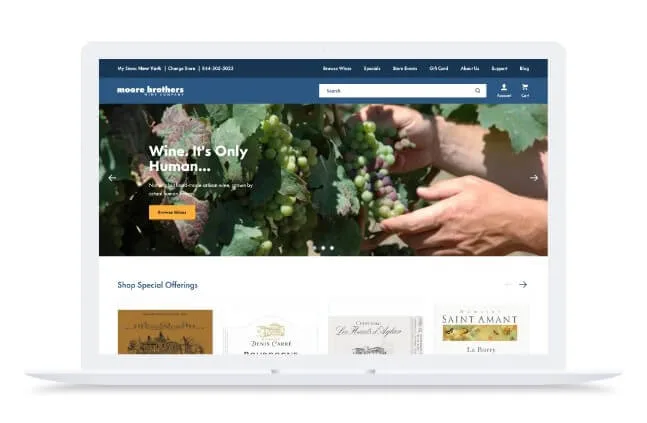
Case Study: The Moore Brothers Wine Company
The Moore Brothers Wine Company is a vintage, tracing its roots back to 1996. Founded in New Jersey by David and Greg Moore, Moore Brothers quickly established a reputation for delivering a personalized experience.
Upon expanding to New York and Delaware, and then the ecommerce scene in 2014, the brothers discovered a problem: their tailor-made website couldn’t handle the increasing load of a growing audience.
After partnering with BigCommerce, the Moore Brothers Wine Company was able to continue expanding, realizing a 16% increase in orders and 16% increase in revenue to match.
With a new, more versatile site, they were able to continue offering a personalized shopping experience, too.
“When we create a product page, it’s all wrapped up via API, so it goes up with all of our custom fields and has the tasting notes, the growers’ background, the maps, the label — all of this happens automatically.”
- David Moore, Co-Founder, Moore Brothers Wine Company
Woodland Hills Wine Company.
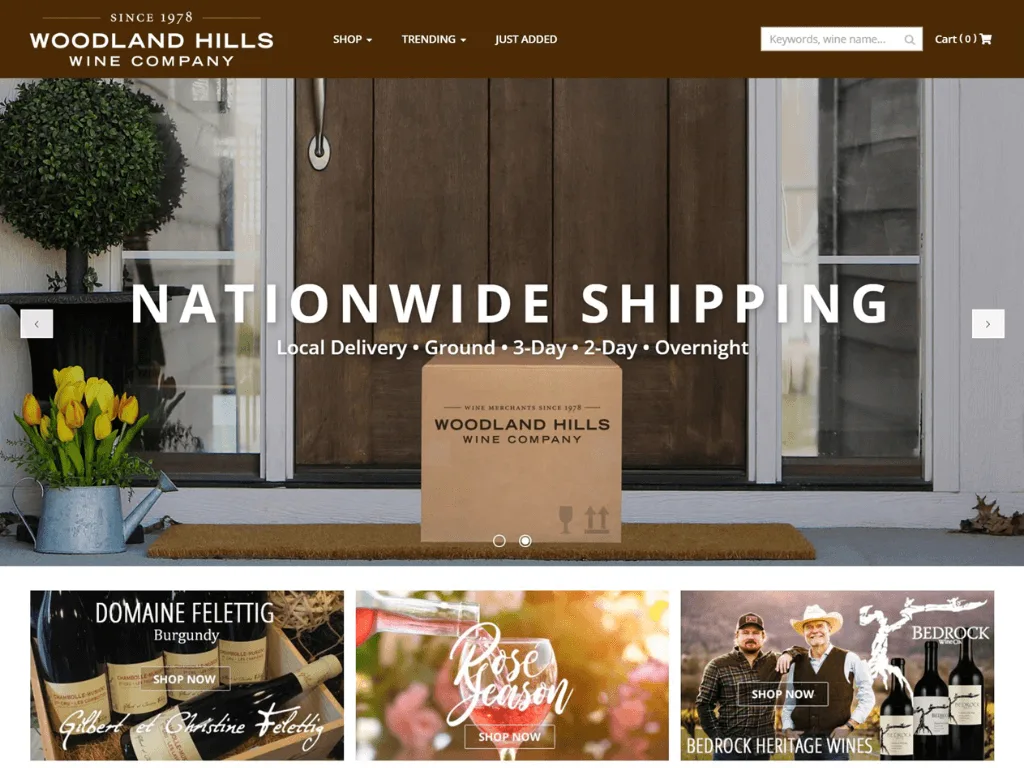
Case Study: Woodland Hills Wine Company
Dating back to 1998, the Woodland Hills Wine Company has a knack for quality and a reputation to match. So much so, they have “more people that want to buy a $3,000 bottle of wine than there are bottles available,” according to Jon Morgan, their IT Project Manager.
Unfortunately, the quality was falling short where the software and web experience was concerned. The company wanted to drop PCI compliance and software maintenance, and ultimately open the door to great customizability with their platform.
That’s where BigCommerce came in.
After partnering with BigCommerce, Woodland Hills Wine Company saw a 190% increase in organic traffic and an 82% increase in revenue, among other benefits.
How?
A number of BigCommerce APIs that simplify inventory management, product updates, and more. On top of this, the Mailchimp integration has made it easy for them to promote to their base, while ShipperHQ has saved them the high costs associated with building a shipping engine.
“That really was one of the main reasons I was so bullish on BigCommerce… the depth of the teams, the number of teams that were involved from the solutions architects, to the sales teams, to the sales engineers, to the implementation teams and project managers.”
- Jon Morgan, IT Project Manager, Woodland Hills Wine Company
The final word
Alcohol ecommerce, once thought to be short-lived, is now a permanent fixture on the shelf.
Now, it’s time for retailers to think bigger.
Just as the DTC revolution helped mattress and eyeglass makers to sell direct and focus on value, the ecommerce revolution for alcohol allows owners to focus on embracing modernity and delivering the best experience possible.
Use the “e” in ecommerce to your advantage. That includes responsibly utilizing data to deliver a personalized experience, A/B testing with messaging and positioning, and adjusting prices in real-time to stay competitive.
Don’t neglect in-person efforts either. Start by partnering with local distilleries and delivery services to meet audiences far and wide, without ever compromising on a seamless experience.
If it sounds complicated, don’t worry. The right ecommerce platform can make the entire process easier, streamlining everything from building your online store to offering diverse payment options to curbing logistics bloat.
Schedule a demo today and explore how BigCommerce supports regulated industries and helps alcohol retailers launch, scale, and optimize compliant ecommerce operations.
FAQs about alcohol ecommerce
Alcohol brands handle shipping insurance by partnering with third-party insurance providers who tailor the cost of the insurance to match the product ordered.
Alcohol brands also work with certified shipping and delivery partners who require signatures of someone 21 or older upon delivery, reducing the chances of underage purchases and the ensuing costs and legal challenges.
Alcohol brands safely sell alcohol online by shipping products in secure containers and packages. These packages typically contain molded pulp foam, made to fit the products.
Alcohol ecommerce stores can reduce cart abandonment by utilizing transparent pricing, ensuring fees and shipping costs are clearly listed before the checkout process.
Alcohol ecommerce stores can also reduce cart abandonment by providing a fast, mobile-optimized experience.
Online alcohol sales are subject to numerous taxes, including state and local sales taxes, federal excise taxes, and state-level excise taxes. These taxes vary greatly by state, which can lead to additional fees when shipping to other states.
⏰ Isn't about time that you evaluated your ecommerce platform?
Request a demo to see how the BigCommerce platform is different.