



Written by
Anita J. Temple
Abandoned Cart Emails: How to Recover Revenue and Increase Conversions
Get The Print Version
Tired of scrolling? Download a PDF version for easier offline reading and sharing with coworkers.
A link to download the PDF will arrive in your inbox shortly.
Key highlights:
Cart abandonment is common. In 2025, global abandonment hit 75.38%, and 43% of shoppers say they’re “just looking.”
Abandoned cart emails drive revenue. Double-digit conversion rates make them one of ecommerce’s most effective recovery tactics.
Speed matters. Emails sent within hours consistently outperform delayed follow-ups.
Personalization lifts conversions. Dynamic product details, tailored subject lines, and relevant incentives improve results.
Be strategic with incentives. Test before leading with discounts to protect margin.
Optimization compounds gains. Structured A/B testing improves recovery rates over time.
AI improves cart recovery. Predictive timing and dynamic offers increase revenue without eroding profit.
If you’re driving traffic to your ecommerce business — through paid ads, search engine optimization, social media, or other channels — the last thing you want is for would-be customers to slip away before they hit purchase. Unfortunately, it’s a persistent problem. In 2025, global shopping cart abandonment rate was 75.38%, a 1.26% increase from 2024.
That’s where abandoned cart emails come in. Abandoned cart emails are automated messages sent to shoppers who added items to their cart but left without completing their purchase. Because these customers have already shown purchase intent, abandoned cart emails consistently outperform other types of marketing emails, turning hesitation into revenue.
For retailers, abandoned cart emails represent one of the most reliable ways to recover lost revenue without increasing acquisition spend.
As part of a broader ecommerce email marketing strategy, cart abandonment emails help brands recover abandoned carts and re-engage shoppers across the customer journey.
High-performing abandoned cart email campaigns can generate double-digit conversion rates, making them one of the most effective revenue recovery strategies in ecommerce.
In this guide, you’ll learn why abandoned cart emails matter, how to send them effectively, and strategies to optimize your cart recovery performance — from subject line strategy to AI-assisted testing and compliance with email marketing laws.
Find your favorite features.
Explore all of the capabilities of the BigCommerce platform.
Four common reasons for cart abandonment
Cart abandonment doesn’t happen by accident. Understanding why shoppers leave is the first step toward building an effective abandoned cart email strategy.
In most cases, friction during the checkout process pushes shoppers away. Unexpected costs, technical issues, or forced account creation can all derail a purchase at the final step.
Here are the most common reasons shoppers abandon their carts — and how to fix them.
#1 — High shipping costs and unexpected fees.
Extra costs are still the leading cause of cart abandonment.
39% of shoppers cite extra costs, including shipping, taxes, and fees as the main reason they abandon a cart.
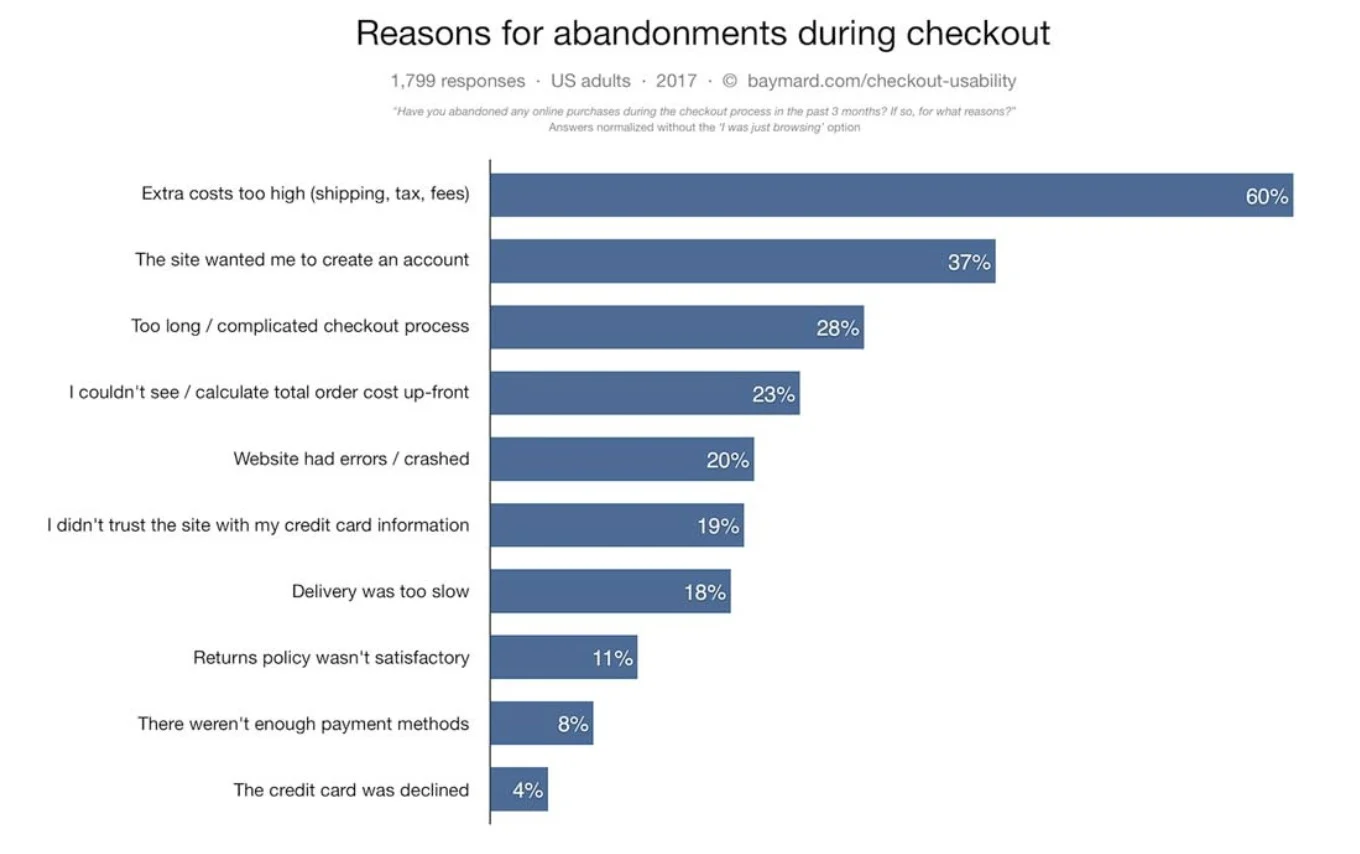
These unexpected charges create frustration at the most critical moment of the buyer journey.
If free shipping isn’t feasible, consider:
Displaying shipping estimates on product pages
Offering shipping calculators in-cart
Testing threshold-based free shipping
Transparency early in the shopping experience can reduce last-minute abandonment.
#2 — Complicated checkout pages.
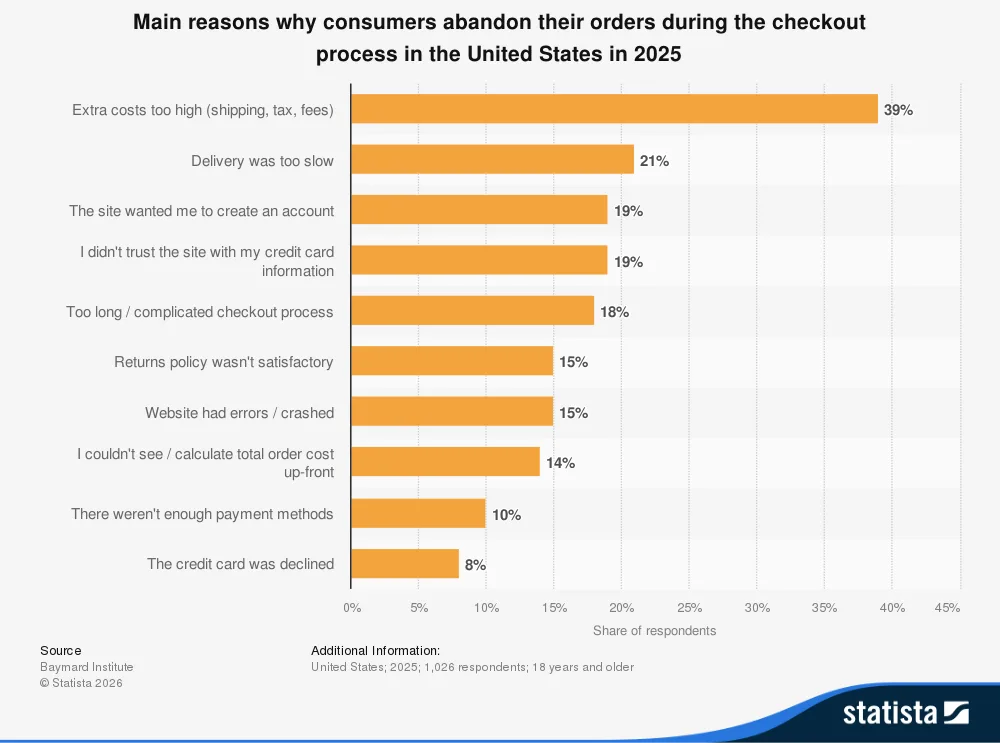
17% of shoppers abandon purchases due to checkout complexity
Long forms. Multiple steps. Unclear progress indicators. Every extra step a customer has to take to get from their cart through checkout increases checkout friction.
To simplify the process, many merchants now offer a single-page checkout process that allows customers to enter payment details, review their order, and confirm their purchase without having to be redirected multiple times.
Mandatory account creation is also an issue, with a recent study showing that it dissuades 24% of shoppers from crossing the checkout finish line. Offering guest checkout reduces friction and improves conversion rates.
Finally, if your checkout asks for excessive information or looks outdated, customers may question your site’s security. Clear design, recognizable payment options, and transparent policies help increase customer trust in you and your products.
#3 — Technical website problems.
Performance issues directly impact conversion.
Slow-loading pages
Broken links
Checkout errors
Non-responsive mobile design
Any technical glitch during checkout increases shopping cart abandonment.
Regularly testing your site across devices and browsers helps ensure you’re delivering a consistent checkout experience. Site speed optimization and reliable payment processing are essential to protecting revenue.
#4 — The customer isn’t ready to buy.
Not all cart abandonment is caused by friction.
Sometimes, shoppers are simply browsing. In fact, a 2024 study by Baymard Institute showed that 43% of online shoppers said they abandon carts because they’re “just looking” or not ready to purchase yet.
This behavior is normal.
Other times, they’re comparison shopping, looking for the best price, fastest shipping options, or a more generous return policy. If they find a better deal, they may leave your ecommerce site without a second thought about what’s in their cart.
Competitive pricing matters — but so does experience.
Fast checkout, flexible payment options, and a seamless mobile experience often outweigh small price differences. A strong value proposition can reduce abandonment even in competitive markets.
“Cart abandonment isn’t a lost sale. It’s a signal. When high-intent shoppers leave, the opportunity is to return with an experience that makes saying yes feel simple.”
— Al Williams, Vice President, Business to Consumer at Commerce

There's a lot to love ❤️
Watch a demo to see the BigCommerce platform in action.
Abandoned cart email best practices
An abandoned cart email campaign isn’t just a reminder. While many brands think of these emails as a simple cart reminder, the most effective campaigns go beyond reminders and actively remove purchase friction.
The best abandoned cart email doesn’t just remind shoppers about their customer’s cart — it removes friction, reinforces value, and makes returning to checkout effortless.
Strong abandoned cart emails sit at the center of any effective ecommerce email marketing strategy. When executed properly, cart recovery emails help recover lost sales, improve conversion rates, and strengthen customer retention across the entire customer journey. It's one of the highest-converting automated ecommerce email marketing flows you can run.
Treat it like a revenue channel — not an afterthought.
Here’s how to maximize cart recovery.
Send abandoned cart emails promptly.
Timing matters.
Sending abandoned cart emails promptly as part of your automated cart recovery strategy is critical.
According to ecommerce email benchmarks from platforms like Klaviyo and Omnisend, abandoned cart emails sent within the first few hours of checkout abandonment consistently outperform delayed follow-ups. Early follow-ups capture shoppers while purchase intent is still high.
A high-performing abandoned cart email sequence typically includes:
Email one: The first email should be sent within one to three hours (friendly reminder)
Email two: A second email sent within 24 hours (add urgency or social proof)
Email three: A final follow-up email sent within 48–72 hours (introduce incentive, if needed)
This automated abandoned cart email sequence is a core component of modern email automation, marketing automation and conversion rate optimization programs. This type of cart automation ensures that every customer receives a timely, relevant message without requiring manual follow-up from your team.
To remove barriers and make it effortless to complete the purchase be sure to clearly display the items left in the customer’s cart, including product images and links, pricing, and direct links back to checkout.
Many retailers also extend their cart recovery strategy beyond email by incorporating SMS reminders. When used thoughtfully, SMS can complement abandoned cart emails and reach customers who may not immediately check their inbox.
Keep the email design simple and conversion-focused.
Clarity converts.
An attention-grabbing layout helps ensure your message stands out in crowded inboxes.
Your abandoned cart email design should:
Reinforce brand trust
Highlight the abandoned products
Make the call-to-action impossible to miss
Avoid clutter, instead prioritize:
A strong headline
Product images
One primary call-to-action
Minimal distractions
The easier it is to scan, the faster customers act.
Personalize the subject line and email copy.
A strong email subject line increases open rates and plays a critical role in the success of your abandoned cart emails. Personalization increases open rates and revenue.
Recent data shows that personalized subject lines can significantly boost open rates — for example, achieving ~46% open rates versus ~35% without personalization, a ~31% improvement.
So, instead of using something general and predictable like, “Did you forget something?”, try:
“Still thinking about those running shoes?”
“Your cart is waiting — complete your summer look.”
“Free shipping on the items in your cart.”
Adding a sense of urgency — such as limited-time discounts or low-stock indicators — can increase conversions when used authentically. Consumers respond to value so mentioning an incentive directly in the subject line can increase open rates.
A compelling email subject line should be personalized, concise, and create a clear sense of urgency.
Abandoned cart email examples
High-performing abandoned cart email examples often include:
A product image with price
A short reminder message
Social proof
A clear checkout button
Studying abandoned cart email examples across industries can help refine your own email marketing strategy.
Use high-quality product imagery.
Shoppers abandoned for a reason — but visual reminders can bring the product back to the top of mind.
Use:
Clear product images
Variant details (size, color, quantity)
Low-stock indicators when accurate
Subtly incorporating a sense of urgency and scarcity — i.e. “Only 3 left in stock” — can also create FOMO (fear of missing out) and increase conversions without feeling pushy.
Include one clear call-to-action (CTA).
Every abandoned cart email should center around a single goal: Complete the purchase, supported by one clear CTA button.
Use direct language:
“Complete your purchase.”
“Return to your cart.”
“Checkout now.”
Avoid multiple competing CTAs. Reducing friction drives action.
Offer incentives strategically.
Not every cart recovery email needs a discount. The best option is to start with a reminder and introduce incentives later in the sequence if needed.
Effective incentives include:
Free shipping Shipping costs are one of the top causes of checkout abandonment. Removing that barrier often recovers the sale.
Limited-time discounts A small percentage off can push undecided shoppers to convert.
Exclusive offers for first-time buyers Tailored incentives increase perceived value. This could include a limited-time coupon code that encourages shoppers to complete their purchase before the offer expires.
If using urgency tactics like countdown timers, ensure they’re authentic and aligned with your brand.
Cross-sell and upsell thoughtfully.
Abandoned cart emails can also increase average order value.
Recommend:
Complementary products
Product bundles
Upgraded versions
Keep recommendations relevant and limited. Overload the email and you risk confusing the shopper and possibly losing the sale.
Incorporate smart, thoughtful product recommendations, and you improve both cart recovery rate and revenue per customer.
Add social proof.
Trust can reduce hesitation.
Consider including:
Star ratings
Short customer reviews or testimonials
“Customers also bought” recommendations
User-generated content
Proof that others have purchased — and loved — the same products act as reassurance that the shopper is making the right decision.
Provide friction-reducing support.
Sometimes checkout abandonment is caused by confusion or technical issues.
Use recovery emails to:
Offer customer support
Clarify return policies
Reinforce security and payment options
Answer common objections
Even a simple line like “Need help? Our team is here.” can increase conversions.
How to improve the customer experience when sending abandoned cart emails
Improving the customer experience starts with relevance, transparency, and personalization.
Abandoned cart emails should reference the exact abandoned items left in the customer’s cart and provide a seamless path back to your online store. Clear product images, pricing, and a direct checkout link reduce friction during the online shopping journey.
To strengthen performance, retailers can also:
Use personalized emails based on browsing and purchase history
Include support contact information, such as a customer service phone number, for shoppers who need assistance
Ensure messaging aligns with the overall brand experience
When cart recovery feels helpful rather than pushy, it enhances the overall customer experience and builds trust — even if the shopper doesn’t convert immediately.
BigCommerce can help you recover lost sales by winning back shoppers you’ve already reached but haven’t yet converted to buyers. Request a demo to learn more about how our Abandoned Cart Saver works.
Optimize your cart recovery engine.
Abandoned cart emails shouldn’t be “set and forget.” They’re a performance channel.
Treat them like one.
A/B test continuously.
Testing improves revenue — structured testing compounds it.
Instead of experimenting randomly, use a focused optimization framework:
What to test and what to measure.
Test element | Why it matters | Primary metrics to measure |
Subject lines | Determines whether shoppers open the email in the first place | Open rate |
Send timing | Captures customers while purchase intent is still high | Open rate, click-through rate |
Incentives vs. no incentives | Balances conversion lift with margin protection | Conversion rate, revenue recovered |
Test one variable at a time. Measure results over a statistically meaningful sample size. Then iterate.
Small improvements in open rate or conversion rate can significantly increase total revenue recovered over time.
Track performance and refine.
Your abandoned cart strategy should be data-driven.
Monitor performance consistently and optimize based on real outcomes — not assumptions.
Key cart recovery metrics.
Metric | Description |
Cart recovery rate | How effectively your abandoned cart emails convert shoppers |
Revenue recovered | Total revenue generated from your cart recovery flow |
Average order value | Whether cross-sell and upsell strategies are working |
Time to conversion | How quickly shoppers return to complete their purchase |
When these metrics improve, your entire ecommerce email marketing strategy benefits.
The brands that treat abandoned cart emails as a measurable revenue engine — not just a reminder sequence — consistently outperform competitors.
Use AI to optimize abandoned cart emails at scale.
A/B testing is powerful — AI makes it continuous.
Instead of manually testing one subject line against another, AI-powered ecommerce tools can enhance email automation by analyzing real-time customer behavior and automatically optimize your abandoned cart emails.
Here’s how AI can improve cart recovery performance:
Predict the best send time.
AI models can analyze when individual customers are most likely to open and engage with email.
Rather than sending every abandoned cart email at the same time, AI can stagger delivery based on predicted engagement windows — improving open rates and conversions.
Personalize incentives dynamically.
Not every shopper needs a discount.
AI can identify:
High-intent shoppers who just need a reminder
Price-sensitive shoppers who respond to incentives
Repeat customers who convert without discounts
This protects margin while increasing recovered revenue.
Optimize subject lines automatically.
AI tools can generate and test subject lines in real time, learning which phrasing, urgency cues, or product references drive the highest open rates for specific audience segments.
Over time, performance improves without manual intervention.
Recommend smarter product substitutions.
If a product is low in stock or frequently abandoned, AI-powered recommendation engines can suggest better-fit alternatives directly within the abandoned cart email.
This increases:
Cart recovery rate
Average order value
Customer satisfaction
Reduce over-discounting.
One of the biggest risks of aggressive cart recovery campaigns is training customers to abandon intentionally to trigger a coupon.
AI helps brands avoid this by:
Limiting incentives to customers who require them
Adjusting offers based on purchase history
Detecting behavioral patterns
The result: higher recovery revenue without eroding profit margins.
As ecommerce grows more competitive, these AI-driven cart recovery strategies serve as a differentiator — especially for mid-market and enterprise brands looking to scale.
The final word.
Cart abandonment isn’t failure.
It’s friction. It’s distraction. It’s hesitation.
“When a shopper leaves their cart, they’re not always saying no — they’re saying not yet. Sending emails that feel helpful, not pushy is a powerful way to turn hesitation into revenue.”
— Al Williams, Vice President of Business to Consumer at Commerce
The brands that win in ecommerce don’t assume the sale is gone. They respond with relevance, timing, and clarity.
A well-structured abandoned cart email strategy — built on personalization, thoughtful incentives, and continuous optimization — turns high-intent browsing into measurable revenue.
Add AI-driven refinement, and cart recovery becomes more than a follow-up. It becomes a competitive advantage.
In a landscape where acquisition costs continue to rise, the smartest growth strategy isn’t always more traffic.
It’s recovering lost sales — revenue which is already within reach.
FAQs about abandoned cart emails
The best subject line strategy for cart recovery emails is personalization combined with clear value. Reference the exact product left in the cart and, when relevant, highlight an incentive like free shipping or a limited-time discount.
Cart recovery emails function as a form of email retargeting, so clarity and relevance are essential. High-performing subject lines typically:
Mention the abandoned product
Include a clear benefit
Create subtle urgency
Stay under 50 characters when possible
Personalized subject lines consistently outperform generic reminders and improve open rates.
You can use AI to test abandoned cart emails by automatically optimizing send times, subject lines, incentives, and product recommendations, and entire email workflows based on customer behavior.
AI improves traditional A/B testing by:
Predicting the best time to send each email
Dynamically adjusting discounts
Testing subject lines in real time
Personalizing recommendations
This increases cart recovery rates while protecting profit margins.
While abandoned cart emails are often triggered automatically, they are typically classified as marketing emails — not transactional emails — and must follow applicable regulations.
To stay compliant with GDPR and other email marketing laws, you must obtain proper consent, provide clear unsubscribe options, and be transparent about how customer data is used.
To ensure compliance:
Collect valid marketing consent
Include an unsubscribe link in every email
Clearly identify your business
Honor opt-out requests promptly
Maintain a clear privacy policy
Following these practices reduces legal risk and builds customer trust.
⏰ Isn't about time that you evaluated your ecommerce platform?
Request a demo to see how the BigCommerce platform is different.