




Written by
Josh Jennings
30 Ecommerce Conversion Rate Optimization Techniques to Boost Sales (with Checklist)
Get The Print Version
Tired of scrolling? Download a PDF version for easier offline reading and sharing with coworkers.
A link to download the PDF will arrive in your inbox shortly.
Key highlights
If you want to turn your website into a conversion powerhouse, you need to start doing research and A/B testing.
CRO involves identifying and testing opportunities to improve the percentage of users who take a desired action on your website.
There are 4 steps you can follow to launch a successful CRO program: analytics tracking, research/ideation, experimentation, and iteration.
Make sure you are tracking product views, adds to cart, orders/purchases, total revenue, and average order value.
Start quickly with our list of 30 different ideas to test on your ecommerce website.
Meet Greg.
“What if we put recommended products on the cart page?”
This was the thought that came to engineer Greg Linden in 1998 while working at Amazon.
But when he brought his idea to the team, it didn’t go well.
One of the senior marketing vice presidents hated it. He was certain it would distract users from checking out and crush their order rates.
And since Amazon had gone public just the year before, any loss of orders was unacceptable.
But that didn’t stop Greg.
Despite being forbidden to work on the project, he created a test on amazon.com to measure the impact on sales.
Turns out, his idea was right.
According to Greg’s blog from 2006:
“The results were clear. Not only did it win, but the feature won by such a wide margin that not having it live was costing Amazon a noticeable chunk of change. With new urgency, shopping cart recommendations launched.”
What does this mean for you?
Testing is the path to a successful, high-quality ecommerce website.
Let’s talk about conversion rate optimization.

There's a lot to love ❤️
Watch a demo to see the BigCommerce platform in action.
What is conversion rate optimization?
Conversion Rate Optimization is the practice of analyzing your website to identify opportunities to increase the percentage of users who take a desired action, typically product purchases for an ecommerce business. This metric is known as conversion rate.
For ecommerce businesses, the conversion rate of your online ecommerce store can have a big impact on your bottom line. Any increases to your product purchase rate improves the ROI of every new visitor that comes to your website.
CRO practitioners use a wide range of skills and strategies to increase conversion rates, but the most prevalent of these is A/B testing.
What is A/B testing?
A/B testing is an experimentation technique that displays two or more versions of a portion of your website to users and monitors the data for each version. Using statistical methods, a CRO practitioner can evaluate which of the versions will perform better than the other. Once a winner is determined, the A/B test is concluded and the winner is rolled out to all users.
How do I calculate my ecommerce conversion rate?
Ecommerce conversion rates are calculated by dividing the number of visitors to your website by the number of purchases made. This gives you the percentage of visitors that you can expect to make a purchase, allowing you to forecast future performance.
Ecommerce conversion rates can also be calculated by dividing visitors by overall revenue or average order value. These metrics can give you a better understanding of the overall impact of your conversion rate optimization efforts.
4 steps to successful CRO strategy
There’s no magic bullet for improving conversion rates.
Achieving a high-converting ecommerce website takes time, patience, and discipline.
There are 4 steps to running an effective, data-driven CRO program for your ecommerce business:
Analytics Tracking
Research & Planning
Experimentation
Iteration
Step 1: Analytics Tracking
In order to optimize your website, you need to make sure that you’re tracking its performance with analytics.
After all, how are you going to know if your efforts are working?
Luckily, most ecommerce platforms have easy ways to set up analytics tracking through tools like Google Analytics. If you’re on BigCommerce, you can check out our documentation on Setting Up Google Analytics 4.
No matter how you set up tracking, make sure that you can see each of these events:
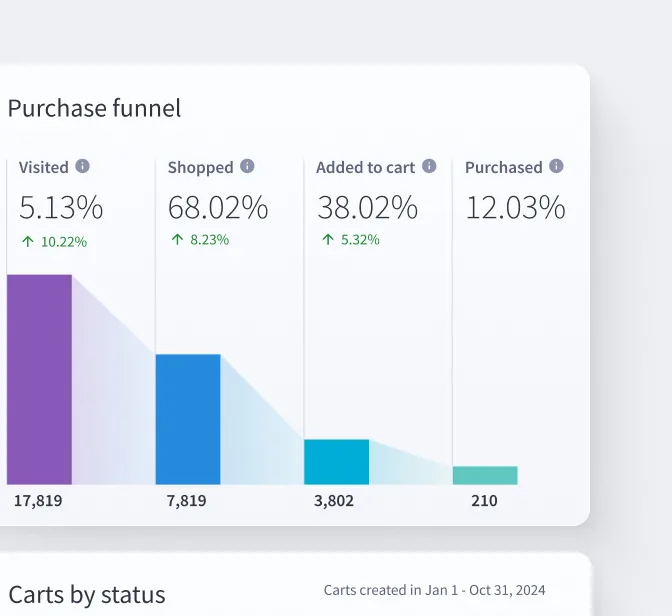
Unique website visitors – the total number of unique users or sessions that a website receives on a regular basis.
Page views – the number of views of the various pages on a website, particularly product pages for an online store.
Bounce rate / exit rate - the percentage of users that leave each page rather than clicking to a new page on a website.
Add to carts – the number of times that users have added an item to their cart on an ecommerce website. Ideally, you’d want to be able to see which products are added as well.
Orders/purchases – the number of times that users have placed an order and how much they spent on each order.
Total revenue – the sum of the dollar amount spent on purchased products.
Average order value – the average value of orders placed on an ecommerce store, calculated by dividing total revenue by total number of product purchases.
There are many other good metrics to track, like click heatmaps, scroll depth, session recordings, and load times/page speed. But the list above will get you started.
Tracking these metrics allows you to understand the user behavior on your ecommerce website and look for trends or gaps in engagement that you can use for testing.
Step 2: Research & Ideas
Many website designers make updates based on gut feelings and best practices.
But not you.
You want to make informed decisions about what will work best for your audience.
To do this, you need to do research.
Research helps you to identify insights about your target customers, leading to ideas that you think will improve conversion rates.
There are 3 kinds of research that can help you discover opportunities for improvement:
Analytics research – reviewing your website data to see how users are engaging.
Industry research – reviewing other websites in and adjacent to your industry.
User research – recording testing participants as they explore your website.
1. Analytics research
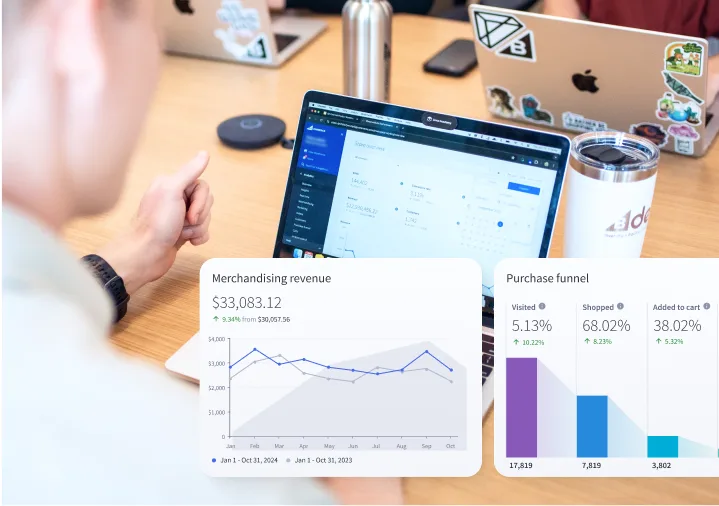
Once you have your analytics tracking set up, you can start doing research into your analytics.
Look for things like:
What page gets the most visits?
What are users clicking on?
What products have the highest conversion rates?
What products drive the most revenue or AOV?
What searches or filters are users using to find products?
As you do this analysis, look for differences between your expectations and what the data is saying. Perhaps you learn that one of your products is driving a higher average order value than the others. Why is that?
Keep digging until you know how users are interacting with the website.
Example scenario: Paul’s Bike Shop is trying to optimize its website to get more sales. Paul looked at his website data and found that one particular product is getting a lot of traffic from social media, but isn’t getting as many sales as other products. Looking at the page, Paul notices that the page only has one photo and a bland product description. He writes this down as an opportunity for improvement.
2. Industry research
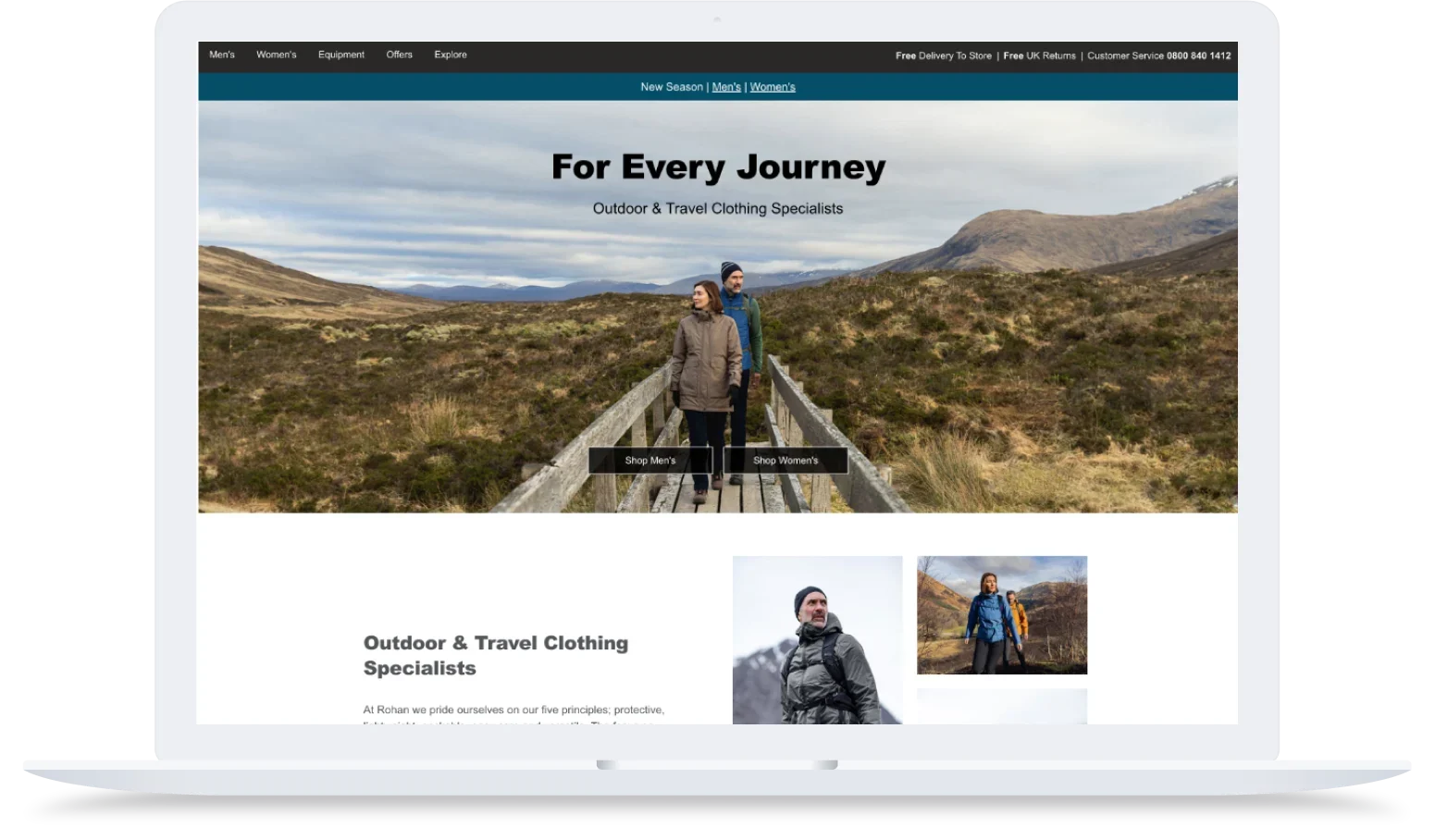
When practicing CRO, you need to be aware of what others are doing in your industry.
This is because of a principle called Jakob’s Law:
“Users spend most of their time on other sites. This means that users prefer your site to work the same way as all the other sites they already know.”
When users spend most of their time on your competitors’ websites, they’re going to expect your website to behave similarly.
However, you also have to understand when/how to stray from the industry standards to stand out.
By doing industry and best practice research, you can learn:
Is my website better or worse than my competitors?
What are the best websites in the industry doing that I can use?
What best practices can I follow that have shown success in the past?
Pro tip: Make sure you go from the homepage all the way down to the product pages, and make note of anything that you aren’t doing.
All of these learnings give you a frame of reference to start coming up with ideas that will beat out the competition.
Example scenario: Paul’s Bike Shop wants to make sure that its website is better than the competitors’. Paul goes to his competitors’ websites and notices a few things they’re doing that he could be doing. But he doesn’t stop there. He goes to a motorcycle manufacturer’s website and sees a motorcycle “builder” that would make his website even better.
3. User research
User research allows you to make better decisions about the stuff on your website that you should be optimizing by asking users to perform tasks on your website.
This is the best way to understand the customer experience on your online store.
It’s also one of the most exciting parts of the CRO process. It’s when you find out what actually works on your website, and what desperately needs to be fixed.
And it’s really not too hard.
To start, find some people who are similar to your target customers and ask them if they’d be willing to participate in a short research study. You can find these people in any way that you’d like, but try to avoid close friends/family or previous customers. You want someone who can give you unbiased (I prefer to use the word “blunt”) feedback about your website, not someone who is going to boost your ego.
Importantly, you only need 5 participants to find 85% of the usability problems.
So don’t feel overwhelmed.
If you still need help finding participants, there are plenty of usability testing tools with pools of people ready to take a test.
Once you have some people willing to participate, ask them to get on a video call with you, have them visit your website, and ask them to share their screen as they explore it. With their permission, record the session and watch as they attempt to navigate your website to find a product that they may be interested in.
You’ll likely be surprised by things that you never thought they’d do.
By the end of this, you’ll have an authentic understanding of your customer journey.
Example scenario: Paul’s Bike Shop needs to know if users actually like the website. Paul creates a post on a bike parts subreddit offering $20 for anyone who would let him record their reactions. Five people respond and they each schedule a video call. Watching the users, Paul realizes that they are interested in particular bike brands, but there’s no way for them to filter by those brand names on the website. This is an opportunity for improvement.
Step 3: Experimentation
Once you’ve completed your research, you should have plenty of ideas for how to improve your website.
But how do you know if these ideas will actually work?
You learn through experimentation.
Technically, any change to the website is an experiment as long as you monitor the data and make sure you see improvements.
But the most scientific way to do experimentation is through A/B testing.
For most websites, A/B testing requires the purchase of an experimentation tool, such as Optimizely, VWO, or Amplitude.
Once you’ve installed the tool on your website and connected it to your analytics, you can start running A/B tests.
Here are some important considerations for A/B testing:
Don’t peek at the metrics. Make sure your experiment runs for at least 2 weeks before you determine if it is a success.
Keep an eye on your sample size and statistical significance. Both of these values will help you know if you can be confident in your results.
Track the right metrics. Make sure that you know what metrics you want to improve before starting your experiment.
And once you’ve started A/B testing, don’t slow down. Keep your experiment velocity up.
What is experiment velocity?
An important consideration for a successful CRO program is experiment velocity.
Experiment velocity is the measure of how many A/B tests you’re running on an ongoing basis.
The mark of a successful CRO program is a steady velocity of tests being launched, completed, and implemented to production.
The more tests you run, the more success you’ll see. (As long as you don’t sacrifice quality.)
Step 4: Iteration
A/B testing, research, and optimization are an ongoing process that never ends.
Sometimes you’ll win. And sometimes you’ll lose.
To make sure your ecommerce CRO program is successful, you’ll need to do it over and over again.
This also makes coming up with test ideas easier!
Rather than having to think up a new test idea every time, you can continually improve on opportunities that you’ve identified in your research.
The good news? With each iteration cycle, you’ll either A) boost conversions with a winning result or B) learn from your mistakes, getting better at optimizing your ecommerce conversion funnel with each experiment that you run.
The important things to remember: never stop testing.
Ecommerce CRO checklist
Even though a good CRO program requires a lot of research, we’ve put together a list of ideas to help you get your program off to a running start.
Here are 30 conversion rate optimization strategies you should best testing:
Increasing overall sales
Some conversion rate optimization strategies can help boost your entire conversion funnel. Try these out to see big results.
✅ | Offer product discounts | Any good online store is running regular promotions to get extra sales that can drive repeat customers. |
✅ | Offer free/discounted shipping | Add-on fees in checkout are always a pain for users. Try offering free or discounted shipping to see how users react. |
✅ | Improve your return policies | Users often hesitate to buy a product because they don’t want to regret their purchase. Flexible return policies help mitigate this concern. |
✅ | Optimize for mobile | Mobile devices account for 59% of ecommerce sales. Make sure your website is easy for mobile users to navigate. |
✅ | Personalized experiences | As you collect data on your users, find ways to create personalized recommendations for them. |
✅ | Add FAQs | Most users have questions they need answered before they’re comfortable making a purchase. A central FAQ page is an easy place for users to find these answers. You might be surprised how many views this page gets. |
✅ | Live chat support (+ AI) | What happens if a user wants to buy a product, but they have a question and can’t find the answer? They leave. Live chat with the addition of AI answers solves this problem. |
Increasing product views
Without easy ways to find products they want, users will never purchase from your website. These tests will help you ensure users are able to navigate your site easily.
✅ | Product listing layout | Your product grid or list layout influences how many items users explore. Experiment with image sizes, white space, and product information density. Even small design tweaks can drive big changes in engagement and revenue. |
✅ | Product listing filtering | Users expect powerful filters to narrow down options quickly. Offer filters for product category, price, color, size, rating, and availability. The faster a user finds what they want, the more likely they are to view additional products. |
✅ | Product search | Search is often the fastest route to intent-driven users. Optimize for speed, relevance, and typo-tolerance — and track what terms users are searching for but not finding. |
✅ | Navigation / product categorization | Poor navigation kills discovery. Ensure your categories match how your potential customers actually think and shop, not how your company organizes inventory internally. |
✅ | Homepage – single product vs. multiple products | Test whether featuring a single hero product or a variety of best-sellers on your homepage drives more exploration. For some brands, focus sells; for others, choice inspires browsing. |
Increasing add to cart
Adding products to cart is the first step to getting users to place an order. Encouraging users to add items to their cart significantly increases the chance they will convert.
✅ | Product listing quick add-to-cart buttons | Allow users to add items to the cart directly from listings or category pages. This streamlines the buying journey and helps capture impulse clicks without a view of the product page. |
✅ | Product page descriptions | Clear, benefit-driven descriptions convert better than generic ones. Focus your copywriting on why the product matters, not just what it does. |
✅ | Product page button placement | Users shouldn’t have to hunt for the “Add to Cart” button. Keep it above the fold and visually distinct. Subtle layout shifts can drastically improve conversion rates. |
✅ | Product page specifications | Detailed specs build confidence. Include all key details — sizing, materials, dimensions, compatibility — so shoppers don’t need to leave the page to research. |
✅ | Product page credibility badges | Display guarantees, return policies, shipping information, and security badges near the CTA to build trust. These reduce friction and reassure hesitant buyers. |
✅ | Product price comparison (framing) | Price anchoring (showing the “compare at” price) and highlighting savings can make your offer feel more compelling. Test various ways to visually frame discounts. |
✅ | Product page testimonials | Social proof is powerful when done correctly. Showcase customer reviews, ratings, and photos to help visitors feel confident adding the item to their cart. |
Increasing checkout
Improving your checkout experience is one of the most direct methods for increasing conversion rates, since every user must utilize the checkout to purchase a product.
✅ | Cart button placement/design | Monitor how many users who add items to their cart actually reach checkout. A large drop-off often points to hidden friction. Try making your cart link more prominent or add a counter that shows how many items are in the users’ cart. For bigger tests, try making your cart a slide-in experience rather than a distinct page, or skip the cart entirely–redirect users directly to checkout after they add an item to the cart (this is best for stores that often sell only single products). |
✅ | Single-page vs. multi-page checkout | Simplify. Many stores see higher conversion rates when users can complete checkout on a single page. But test it — for complex purchases, breaking steps apart can help clarity. |
✅ | Checkout usability (e.g., progress bar) | Progress indicators reduce abandonment rates by helping users feel in control. Make the path to purchase predictable and easy to follow. |
✅ | Shopping cart abandonment reminders | Implement cart recovery emails or SMS reminders to rekindle abandoned carts. Often, a simple nudge or limited-time incentive brings customers back to finish the purchase. |
✅ | Security badges | Reassure users that their payment information is protected. Trusted logos (SSL, PayPal, credit cards, etc.) near payment fields can increase completion rates. |
✅ | Guest checkout | Don’t force account creation. Offering guest checkout minimizes barriers and encourages first-time customers to complete their purchase. |
✅ | Payment methods | Give users new and faster payment methods like PayPal, Apple Pay, or Venmo. |
Increasing AOV
Average order value is often forgotten in ecommerce site optimization. However, a high AOV can have a huge impact on your overall revenue, sometimes even better than increasing order rates.
✅ | Product page add-ons | Allow customers to add complementary items (e.g., accessories, warranties) directly from the product page. This upsells without interrupting the buying flow. |
✅ | Product page recommendations | Show related or “frequently bought together” items to encourage bundling. Personalization here can make a big difference. |
✅ | Cart/checkout recommendations | Once users are in the checkout flow, they’re already in a buying mindset. Add subtle, relevant product recommendations that enhance — not distract from — the order. |
✅ | Popups / promotions | Use targeted popups to promote bundle deals, minimum spend discounts, or free shipping thresholds. Just ensure they appear at natural points in the journey, not disruptively. |
The final word
Optimizing your conversion rate is a catalyst to the success of any ecommerce website. The higher you increase your conversion rate, the better all of your marketing efforts will be.
When you integrate CRO into your marketing, you find opportunities to help your customers make better purchase decisions and improve your conversion rates.
And with every improvement to your website experience, your sales go up as well.
Frequently asked questions
The average ecommerce conversion rate typically falls between 2% and 3%, but it can vary depending on your industry, product type, and customer base. High-performing stores may see rates above 3%, while niche or luxury retailers often convert at lower levels due to higher prices and longer consideration cycles. The best benchmark is your own past performance — measure, test, and aim to improve over time. Every percentage point gained represents real growth and efficiency for the long run.
Most shoppers abandon their carts because of unexpected costs, slow site speed, or a confusing checkout process. Others leave when trust signals — like clear return policies, product reviews, or secure payment options — are missing. Some shoppers won’t add a product to their cart because they don’t think it’s worth the cost. Even small usability issues can add friction that costs sales. Identifying and removing those barriers through testing and research can quickly turn more visits into purchases
Running multiple A/B tests at once is possible, but they need to be carefully isolated to avoid conflicting results. For most stores, it’s smarter to start with one well-designed test at a time, especially if traffic volume is moderate. As your experimentation process matures and your team gains confidence, you can increase testing velocity for faster insights. The key is to balance quality with quantity — more tests aren’t better unless they’re structured well.
Plan for each A/B test to run at least two full weeks to capture enough traffic and natural shopping patterns. Ending a test early can lead to unreliable or misleading results. Wait until your test reaches statistical significance — meaning you have enough data to be confident in the outcome. Patience pays off here: accurate results give you stronger evidence for what truly improves conversions.
If you already have steady traffic, improving your conversion rate will deliver faster, more cost-effective results than buying more clicks. CRO helps you make the most of the visitors you already have by turning more of them into customers. Once your site is optimized and performing efficiently, scaling traffic will have a greater return on investment. Think of it as building a stronger foundation before you pour in more fuel.
Start where the biggest opportunities exist — typically high-traffic, high-impact pages like your product detail pages, cart, and checkout. Use analytics to identify where users drop off, then prioritize fixes that can have an outsized effect on revenue. Early tests might focus on call-to-action buttons, product images, or page layouts. Using a simple “impact versus effort” framework helps you decide which ideas to test first and which can wait.
Site speed directly impacts sales. Shoppers expect fast, frictionless experiences — ideally within three seconds — and will often abandon slow-loading pages. A fast site builds trust, improves SEO, and keeps users engaged longer. Investing in performance improvements like optimized images, caching, and responsive design is one of the simplest, highest-ROI moves you can make.
Encourage higher-value purchases by suggesting relevant add-ons, bundles, or premium upgrades during the shopping experience. Incentives like free shipping thresholds or small discounts for larger orders motivate customers to buy more. Personalized product recommendations also help shoppers discover complementary items naturally. The goal isn’t to upsell harder — it’s to create a more valuable experience for both the customer and your business.
Campaign-style landing pages are one of the most effective marketing strategies for converting visitors with a specific intent — like a seasonal promotion, product launch, or digital marketing campaign. If you’re running a lot of campaigns, landing page optimization is a big CRO opportunity. The key is focus: remove distractions and guide visitors toward a single clear action, such as making a purchase, signing up, or exploring a featured offer. Every element — from the headline to the call-to-action button — should work together to deliver a seamless, goal-oriented experience that matches the promise of your ad or campaign. When you do this, every dollar of PPC ad spend becomes more valuable.
Heatmaps are visual tools that show where users click, scroll, and spend time on your website. They transform behavior data into color-coded insights — “hot” areas show high engagement, while “cool” areas reveal what visitors ignore. By analyzing these patterns, you can identify which buttons attract attention, where users get stuck, and what content drives action. For ecommerce stores, heatmaps are invaluable for optimizing product layouts, refining calls to action, and improving checkout flows — turning data into design decisions that boost conversions.

Find your favorite features.
Explore all of the capabilities of the BigCommerce platform.