- Start & Build

Product Overview
What you can do with BigCommerce.
Agentic Commerce
 AI-powered solutions for growth.
Design Your Store
Build your store with or without code.
Apps & Integrations
Over 1,200 apps to help you grow.
Migrate to BigCommerce
Switch from Shopify, Woocommerce, Salesforce, Magento, and more.
- Launch Services
Overview
Chart your path to success with specialized services.Implementation Project Management
Experts to ensure you launch on time and under budget.Solution Architecture
Seasoned advisors to help you best design your store.Data Migration & Optimization
Expertise on a clean and clear path to migrating your data.Enterprise Launch Package
Personal training on how to set up and launch your BigCommerce Store.

Professional Services Blog Series
Get to know our teams and how they support your success in this Q&A series.

The Global B2B Buyer Behavior Report
This in-depth report provides actionable strategies to help you sell more online.
11 Things Commerce Leaders Can Do Today to Grow Business and Prepare for an AI Future

Create your store and start selling today.
Create your new website.
See if the BigCommerce platform is a good fit for your business.
No credit card required.

Written by
Anita J. Temple05/08/2026
11 Things Commerce Leaders Can Do Today to Grow Business and Prepare for an AI Future
Get The Print Version
Tired of scrolling? Download a PDF version for easier offline reading and sharing with coworkers.
A link to download the PDF will arrive in your inbox shortly.
Key highlights:
AI success starts with structure, not speed. Many leaders move too fast without the right foundation — those who slow down strategically see better results.
Your existing data may be more valuable than you think. The biggest opportunities often come from using what you already have in smarter ways.
Not all “tests” are created equal. Knowing the difference between exploration and execution is becoming a critical leadership skill.
Customer experience drives real AI ROI. The most impactful innovations solve specific, often overlooked friction points.
Your brand’s visibility in AI tools is a competitive edge. Presence in emerging discovery channels could shape future market leaders.
Inside Commerce Live: The conversations defining modern commerce
Commerce Live was everything attendees would expect from a conference.
The new flagship thought leadership event, formerly known as Big Summit, was created to reinforce the evolution of the Commerce brand, which brought Big Commerce, Feedonomics, and Makeswift together under one umbrella.
Held last week at Chicago’s Navy Pier, it was two and a half days jam-packed with listening and learning from industry experts, talking to peers, meeting vendors, eating whenever the opportunity presented itself, and, of course — lots of coffee. There was the prerequisite high energy welcome from corporate leadership, inspirational keynotes and breakout sessions tailored to the key topics commerce leaders are currently thinking about, plus the standard after-hours events.
That said, while the event fit the conference format, Commerce Live felt different. It had a sense of fun and energy right from the start when the host, Matt Marcotte, Founder and Principal of M2 Collaborative, walked on stage and defined the meaning of momentum:
“It’s simple, mass times velocity. So, the bigger the object and the faster it’s moving, the more unstoppable it becomes. I would argue that’s the kind of story you’re going to hear and see today.”
Over the course of six keynotes, 13 breakout sessions, and an inspiring sit-down conversation between Travis Hess, CEO of Commerce, and DeMarcus Lawence, Superbowl champion, attendees collected incredible insights, ideas, and guidance on navigating commerce today — and how to prepare for tomorrow.
There’s far too much content for a single blog, so we’re delivering five over the next few weeks. Since many of the presenters were asked, “What’s one thing leaders can do right now to grow business and/or prepare for the future?”, we thought we’d kick off the series by providing some of the best answers.
Let’s get started.
Where to focus now: 10 actions for immediate impact
1. Set up a steering committee for AI initiatives.
When asked what leaders should do right now to prepare for AI, Tara Huddleston, Global Vice President of Digital and Ecommerce at Revelyst, didn’t hesitate to respond that without a governing body, teams end up running conflicting pilots in silos with no shared accountability.
She explained that having strong governance gives you a single prioritization queue, a clear decision path, and the organizational mandate to say "not yet" to initiatives that aren't ready. It also signals to the business that AI is being treated as a serious investment, not a free-for-all experiment.
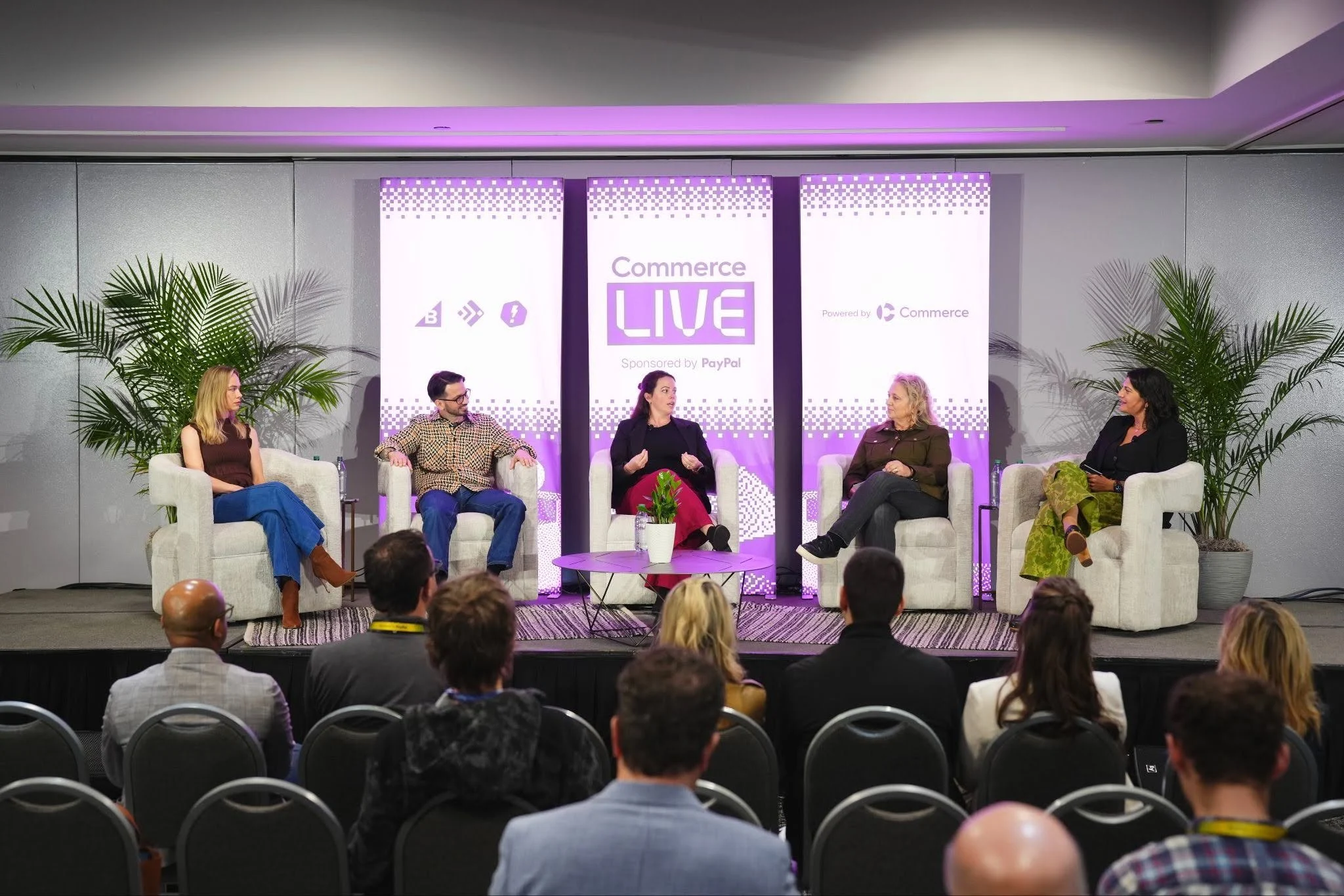
From left: Mallory Wilberding, Power Digital Marketing; Owen Spencer, Friends with Robots; Ashlyn Caporicci, Belk, Inc; Tari Huddleston, Revelyst; Amera Khalil, Commerce.
Ilya Antipin, Head of Technology Consulting at EPAM Digital reinforced the importance of making this initiative a priority. He pointed out that “everyone has an opinion on how to approach it (AI) or where to start. It’s hard to know who to listen to and how to break through the noise.” To actually see a pragmatic path, you need a steering committee to define the strategy, especially as more use cases start coming in. “That will be the true unlock for your potential because they’re going to say this is what our business needs. This is what our customers need.”
“Adoption is much higher when employees perceive a clear AI strategy.”
— Dr. Arthur O'Connor, Distinguished Lecturer and Academic Director, School of Professional Studies, City University of New York
2. Treat your data as an opportunity, not a blocker.
Rajesh (Raj) Mohan, Sr. Director, Digital Commerce & Customer Experience, Oldcastle - CRH Americas Building Products, framed the current data situation as a critical mindset shift: stop waiting for "perfect data" or you'll never start your journey.
He stressed that, “Every organization has actionable data right now. The goal is to find it, understand what use case it supports, and assess whether it's structured, trusted, and usable.”
“Ask yourself, what's that one decision you make every single week? And what's the data that you use to make that decision? And what would happen if it broke? That's where to start.”
— Tari Huddleston, Global Vice President of Digital and Ecommerce, Revelyst
3. Give exploration its own space and stop calling it a pilot.
The core insight multiple speakers pointed to is that many of their AI "failures" were never real pilots: they were exploration efforts mislabelled as pilots. This set them up to be judged by the wrong standard. Owen Spencer, Founder of Friends with Robots, feels that exploration should be deliberately messy, fast, and low-stakes.

Owen Spencer, Founder, Friends with Robots at Commerce Live.
The pressure to show immediate ROI has robbed teams of the space they need to genuinely learn what's possible. Protecting that space, and communicating clearly to leadership what exploration is and isn't, is one of the most important things a commerce leader can do right now.
“You need exploration right now because it allows you to push the boundaries of what's possible, but it also allows you to fail behind closed doors. If you're approaching exploration right, most of your stuff's gonna fail — because if you're just exploring stuff that's successful, you're not really pushing it far enough.”
— Owen Spencer, Founder, Friends with Robots
4. Plan a real pilot and follow three non-negotiable rules.
Spencer stressed that once something moves from exploration into a pilot, the rules change entirely. To make the move successfully, you need three non-negotiables: a single owner, a defined deadline, and one canary metric.
This three-step framework gives teams a clear decision at the end: scale it, kill it, or pivot it. And, in his opinion, “that discipline is what separates learning from drifting.”
But, several speakers repeated the importance of identifying a single problem before you even think about running a pilot. Potential starting points proposed included product attribute enrichment, automating email-based order intake, and generating executive summaries from reviews.
“Almost everyone that comes to us says their board or the powers that be have asked them how they're using AI. But, they don't come to us with a big idea, they come saying, ‘I need to deliver AI. Tell me what to do.’ So, we have to set a foundation before we actually apply and plan true testing.”
— Sarah Schmidt, Chief Operating Officer, Mira Commerce
5. Tie AI investments directly to customer journey friction points.
Joe Cicman, Principal Analyst at Forrester, was blunt: if you're asking how to justify an ecommerce platform, you're thinking about it wrong. You have to start by mapping your customer journeys, identify where the friction is, and work backwards to the technology that removes it — not the other way around.
Chris Baltusnik, Director of Digital Experience and E-Commerce at Vitamix, shared a tangible example: confusion in the blender-buying journey was causing drop-off.
The solution?
Incorporate AI-driven personalization to deliver education-stage content to new visitors and social proof to return visitors. Not only did the company recognize improved conversion, it discovered a second unexpected benefit — reduced returns. The lesson: solve a real customer problem, and the ROI case writes itself.
“AI's not the strategy. You already have your business strategies. AI is the capability that helps you execute and accelerate that strategy.”
— Chris Baltusnik, Director of Digital Experience and E-Commerce, Vitamix
6. Log into AI engines as a customer, ask questions, and see if your brand shows up.
Sam Agris, Principal Director, Accenture Song | Commerce Advisory, called this a DIY exercise you can do in an afternoon. “Open your preferred LLM, put your customer hat on, and search for the products or solutions you sell. Do you show up? Do your competitors show up?”
Lance Owide, Vice President of B2B at Commerce, reinforced the power of Sam’s recommendation, sharing that he recently ran a live test on ChatGPT to check on the searchability of Big Commerce customer, Movora, which sells implants for animals.
He asked where to buy a knee replacement for a Great Dane, and after Movora showed up, he took it a step further:
“I asked why it recommended what it did and where it sourced the information. It was really clear in its answer. ‘Movora has amazing reviews and detailed documentation and information on their site about how to choose the best replacement knee for a Great Dane.’”
“You can do this within an hour and know pretty quickly where you stand — if you're playing catch-up or if you have the opportunity to lead. Either way, the window is closing quickly and you need to act.”
— Sam Agris, Principal Director, Accenture Song | Commerce Advisory
7. Find the right partners. Then trust them.
Mohan from Oldcastle shared this sage advice not once, but twice, on both of the panels he joined. He put it simply:
“AI is evolving too fast for any single team to figure out alone. Find a platform partner, an implementation partner, and where needed, a data or tax specialist — then give them room to lead.”
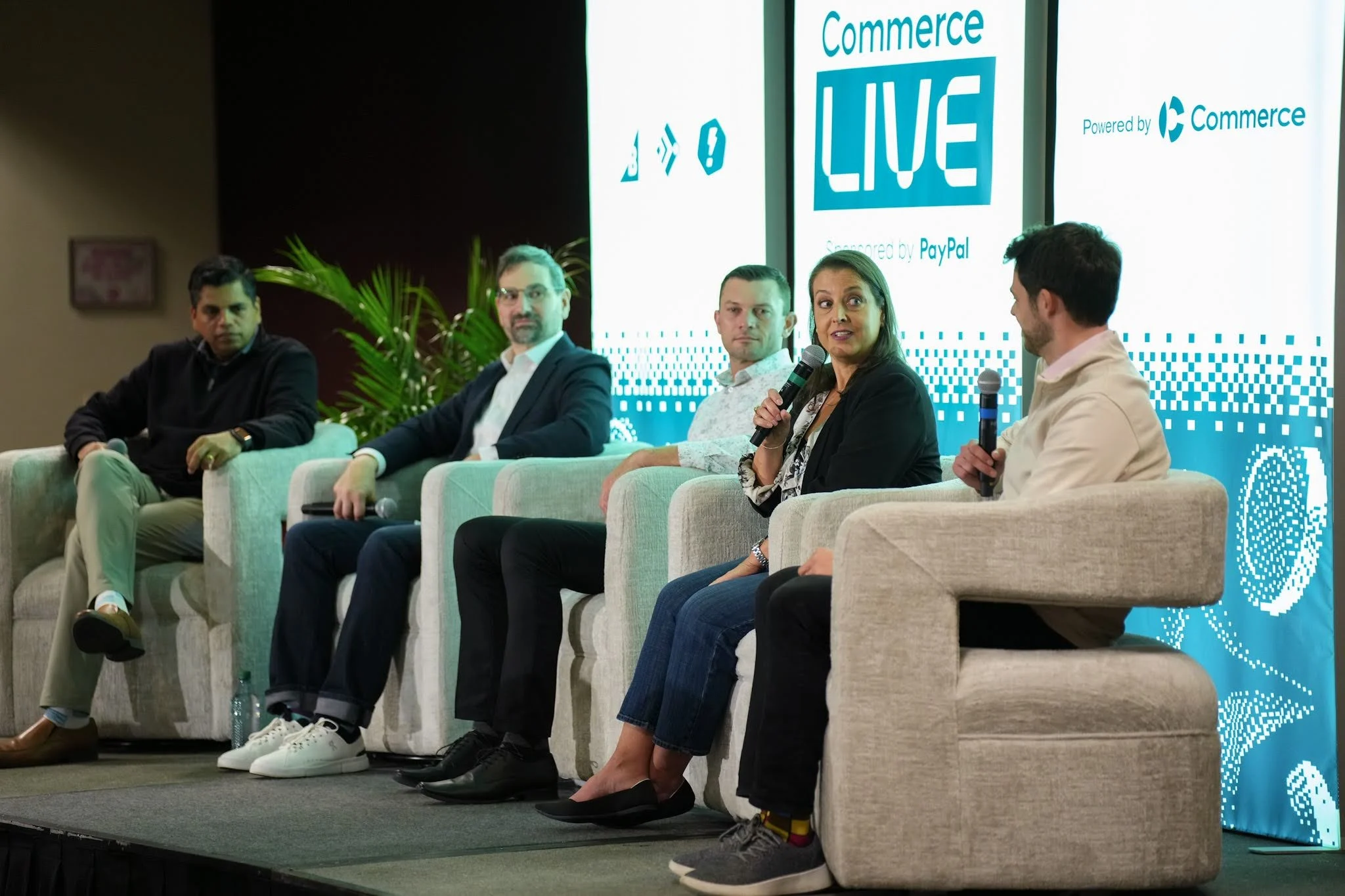
From left, Raj Mohan, Oldcastle; Joe Cicman, Forrester, Travis Powers, Arrow Tool Group; Christy Doshi, Smurfit Westrock; Lance Owide, Commerce on stage at Commerce Live.
He cautioned to make sure to choose partners who are genuinely invested in your success, not just in closing a deal. Several speakers echoed his thoughts, noting that partners can serve as a "shoulder to cry on" and provide a reality check on data quality that internal teams find politically difficult to deliver.
“Stop trying to do everything with internal resources. Don't be afraid to bring in people from the outside. There are partners and SMEs that will help you get there faster, even if it may seem or feel like it's going to cost you a little more money going out the door.”
— Christy Doshi, Director, Digital Product, Smurfit Westrock Packaging Solutions
8. Enrich and structure your product catalog for LLM readability.
IDC Research Director Heather Hershey and the team from Tapestry Inc. both made this point forcefully: AI agents and answer engines read structured attributes — explicit details like material, use case, occasion, fit — not marketing prose.
What this means, Laura Leung, Product Manager, Tapestry Inc. explained, is that AI needs “AI-ready product data” to deliver accurate and relevant discovery. She cautioned that, “It often breaks when the details are inconsistent in structure and lack clear source intent."
Her colleague, Darline Bui, Senior Analyst, Feeds, at Tapestry Inc., provided concrete direction on what brands should do immediately: take your top-selling products and convert their unstructured descriptions into structured attributes.
Bui shared that the company had recently started tagging for trends (e.g. "plaid") that weren't previously attributed — a move that drove measurable improvements in site search and external channel performance.
“Treat product data as the spine for commerce. In a world where the glass is constantly shifting and the way that you engage with your customers is constantly evolving, the one thing that you can really count on is that you're going to need to have good product data. So, it's a pretty safe place to invest, and to really make sure that you get it right.”
— Heather Hershey, Research Director, IDC
9. Add Q&A content to product pages to feed AI engines.
Hershey from IDC made a point that cut against a common assumption: answer engines don't crawl your product catalog, they look for informational intent responses. That means mini FAQs on product detail pages ("What is this best used for?", "How does it compare to X?") are now as strategically important as the product description itself.
She suggested one action leaders should immediately take: start a product data audit.
“Define and enforce a minimum viable taxonomy, at bare minimum,” Hershey said. “Assign a single owner and a governance model for product data. I would highly recommend not ruling the catalog by committee, at least when you're setting up the master."
“The brands that succeed here aren't necessarily going to be the ones in the future with the best-looking pages, but they are going to be the ones who figure out how to show up well within those generative AI experiences they don't have full control over.”
— Lori Cantwell, Lead CRO Strategist, Codal
10. Build AI proficiency across the whole team, not just in a specialist role.
Multiple speakers, including Huddleston at Revelyst and Antipin at EPAM, argued that the biggest unlock isn't buying a new tool, it's getting every person on the team to use AI every day.
To accomplish this, Revelyst opened Copilot access to the entire organization and ran training sessions so that adoption wasn't dependent on one champion.
Antipin made the directive an imperative: “Don't wait until Monday,” he stressed. “Open a laptop at the airport today and start building something. Hands-on experience surfaces the real gaps in your data and processes faster than any audit. The goal is closing the proficiency gap between fast adopters and the rest of the team.”
“I sometimes watch younger folks and how they interact with AI — whereas I'm on ChatGPT on my phone saying 'please show me a restaurant,' they're talking into their phone: 'Hey man, I just did this, I'm hungry but I had Chinese yesterday.' They're just so natural with it. That's what I've been trying to encourage within the team.”
— Wilt Kishimoto, Director of ECommerce, Marketing and Customer Experience, Prime-Line
11. For B2B: before you automate, serve customers in every channel they already use.
One of the most common mistakes B2B operators make when bringing AI into their commerce operations is digitizing the process they already have rather than rethinking it.
Agris at Accenture put it plainly: don't automate what you have — redesign for what you need.
Working with a large industrial manufacturer on an email-heavy RFQ process, his team found that the true solution wasn't optimizing the technology, it was asking what the process would look like if designed around how customers actually behave today. Sam explained, “That reframe changed everything.”
This redesign mindset matters especially in B2B because the channel landscape is so fragmented. Mohan at Oldcastle noted that their customers still place orders by email, fax, phone call, and occasionally on a handwritten napkin. The right response isn't to force them to a portal, it's to serve them in whichever channel they choose, seamlessly.
Kishimoto, at Prime-Line, agreed that this is the way things are at his company as well. For example, he admitted that they still use paper order forms for sales at trade shows. “After a show, there’s a stack of them that customer service has to go through and enter manually.”
Upon hearing this, Owide chimed in, “Have you heard of the BigCommerce Purchase Order Agent? I think they announced it today.”
“At the end of the day, you want to serve your customer. It doesn't matter what channel you're coming in. We have to be channel agnostic. If you pick up the phone, they send an email, they come to the portal, it really doesn't matter. Being able to serve the customer in the channel that they want us to do business with and make it easier for them, that's the goal that we're striving for.”
— Rajesh (Raj) Mohan, Sr. Director, Digital Commerce & Customer Experience, Oldcastle - CRH Americas Building Products
Discover How AI is Transforming the Customer Experience
AI is quickly reshaping the landscape of ecommerce. Learn how you can prepare for the next wave of AI commerce.