- Start & Build

Product Overview
What you can do with BigCommerce.
Agentic Commerce
 AI-powered solutions for growth.
Design Your Store
Build your store with or without code.
Apps & Integrations
Over 1,200 apps to help you grow.
Migrate to BigCommerce
Switch from Shopify, Woocommerce, Salesforce, Magento, and more.
- Launch Services
Overview
Chart your path to success with specialized services.Implementation Project Management
Experts to ensure you launch on time and under budget.Solution Architecture
Seasoned advisors to help you best design your store.Data Migration & Optimization
Expertise on a clean and clear path to migrating your data.Enterprise Launch Package
Personal training on how to set up and launch your BigCommerce Store.

Professional Services Blog Series
Get to know our teams and how they support your success in this Q&A series.

The Global B2B Buyer Behavior Report
This in-depth report provides actionable strategies to help you sell more online.
The Best WooCommerce Alternatives for Ecommerce Stores in 2026

Create your store and start selling today.
Create your new website.
See if the BigCommerce platform is a good fit for your business.
No credit card required.

Written by
John Shieldsmith04/29/2026
The Best WooCommerce Alternatives for Ecommerce Stores in 2026
Get The Print Version
Tired of scrolling? Download a PDF version for easier offline reading and sharing with coworkers.
A link to download the PDF will arrive in your inbox shortly.
Key highlights:
WooCommerce is an ecommerce plugin for WordPress that enables businesses to quickly sell online.
WooCommerce can require developer support for customizations, complicate compliance, and ultimately become too much for a small business to handle as they grow.
There are numerous WooCommerce alternatives, like BigCommerce and Square, each of them offering various perks and suitable for a number of business needs.
Finding the right WooCommerce alternative requires consideration of your needs around customization, scalability, features, and support.
There are more than four-million online stores using the WooCommerce platform. Powered by WordPress, WooCommerce has a low barrier to entry, making it both accessible and appealing to many. But, what about the WooCommerce alternatives?
Your choice of ecommerce platform can make or break your business, enabling growth while taking stress off your plate, or becoming a barrier that hinders your scalability while impacting the customer experience.
Whether you’re currently using WooCommerce or shopping around for your first ecommerce platform, knowing all your options is essential to making the choice that’s best for your business.
What is WooCommerce?
Ecommerce platforms are most often a software as a service (SaaS) format, or open-source.
A SaaS ecommerce solution, like BigCommerce or Shopify, is a hosted platform, meaning you pay a fee for the solution without having to manage finding a separate site or domain. An open-source solution requires a backend host, with the platform itself running on your own system(s).
WooCommerce, while a WordPress ecommerce plugin, falls into the latter group.
Because WooCommerce is a WordPress plugin, it requires a preexisting site and host to function. From there, it enables what is essentially unlimited control over your entire site, allowing you to run an online store, manage search engine optimization (SEO), implement any number of payment gateways, and so on.
Unlike many ecommerce platforms, WooCommerce doesn’t have a price tag. But, while the plugin itself is free, it still requires paid hosting, a domain, and additional plugins for specialized functions — many of which come with a cost.
The above make WooCommerce an easy starting point for many ecommerce businesses, especially those with an existing WordPress website and access to a talented developer. And with roughly 43% of websites running on WordPress, WooCommerce has a pretty big potential audience.
Reasons to migrate from WooCommerce
It’s hard to argue against the benefits of WooCommerce for ecommerce beginners, especially with its lack of price tag. No platform is perfect, however.
There are several reasons to migrate from WooCommerce or choose a different platform when starting.
Developer limitations: WooCommerce is highly customizable, but this can entail extensive developer work and understanding which plugins are compatible with one another. For businesses without dev support, this can make WooCommerce limiting.
Compliance challenges: Navigating PCI compliance, GDPR, and others can require more effort on your end with WooCommerce, whereas many SaaS solutions will be compliant "out of the box."
Growing pains: WooCommerce can support ecommerce as large as enterprises, but with this growth comes an increasing need for technical or developer support. If you don't have an in-house team, this can get costly.
Ballooning costs: WooCommerce can be free, but more traffic and store demands also demands a larger hosting plan, more advanced plugins in some cases, and ultimately more resources over time.
Support requirements: WooCommerce support comes in the form of forums and the general community. If you require more sophisticated, ongoing help, a SaaS solution will have more hands-on support.
Again, WooCommerce has a number of ecommerce features that make it a solid choice, especially for small businesses with an existing WordPress site. But, even those with existing websites can run into technical learning curves or simply outgrow what WooCommerce offers.

Your ecommerce platform should fit you perfectly.
Discover which one has the right mix of features for your business.
7 WooCommerce alternatives
If you’re looking to find a WooCommerce store alternative, there are countless options available, from SaaS offerings to open-source.
To help you narrow your search, we’ve picked seven great choices, each with their own pros and cons.
BigCommerce
BigCommerce is a feature-rich SaaS ecommerce platform, powering online stores for more than 130,000 businesses. With numerous plans and options, BigCommerce is a great option for ecommerce businesses of any size, at any point in their journey.
WooCommerce is highly customizable, both on the frontend and backend. But, much of this customization requires advanced knowledge of plugin compatibility and site development. This is an area where BigCommerce really stands out, as anything that isn’t available first-party, is likely available with a seamless integration.
Pros.
Catalyst: A powerful, headless storefront builder that enables flexible development without a high degree of technical prowess.
24/7 support: Access help anytime, anywhere, with 24/7 support and an extensive library of helpful articles.
Multi-store support: BigCommerce allows you to seamlessly manage multiple digital storefronts and in-person locations, with synced inventory management.
Extensive integrations: A library of nearly 1,300 integrations simplifies growth and enables the easy addition of further functionality, whether it’s customer relationship management (CRM), inventory management, or beyond.
Payment support: BigCommerce integrates with more than 65 payment gateaways and accepts more than 250 payment methods, meaning payment processing won’t hold you back.
Marketing tools: Automatic cart recovery emails, SEO themes, easy targeting, and email marketing integrations with platforms like Mailchimp make it easier to stay on top of marketing.
Omnichannel enablement: Integration with major social media platforms and marketplaces, like Amazon, allows you to manage your omnichannel presence with a clean dashboard.
Automated security: Take the stress out of compliance and security with automatic updates, managed hosting, and extensive support.
Cons.
Theme count: BigCommerce is always adding more site themes, but some competitors currently offer more.
Vendor lock-in: Because BigCommerce is a SaaS platform, some vendors find it difficult to migrate their data off the platform if they decide to leave after a significant period of time.
Category | WooCommerce | BigCommerce |
Hosting | Self-hosted | Included |
Set up & Maintenance | Moderate difficulty, requires manual updates, and WordPress knowledge | Fast, guided, beginner-friendly |
Pricing | Free core plugin, pay for hosting, themes, and plugins | Annual subscription (Core, Growth, Scale, and Performance) |
Built-in Features | Core is minimal, features added via plugins | Strong native features: SEO, promotions, abandoned cart, and multi-currency |
Themes & Design | Variety of free & paid theme options | Over 200 customizable themes, including Catalyst/Makeswift builder |
Scalability | Depends on hosting & optimization | Automatic scaling handled by platform |
Performance | Degrades as you scale since it requires added functionality | Optimized out-of-the-box |
Security & PCI Compliance | Merchant responsibility | Included and managed |
Multi-Channel Selling | Plugin-based integrations | Native integrations with Amazon, Meta, and Google |
Support | Community forums + paid support | 24/7 phone, chat, and email |

There's a lot to love ❤️
Watch a demo to see the BigCommerce platform in action.
Shopify
Shopify is a major SaaS ecommerce solution, offering an all-in-one platform with broad capabilities.
Shopify is known for general ease-of-use, giving businesses the tools to quickly build sites, while also providing extensive support for brick-and-mortar locations. Because of Shopify's scale, they're also known for offering a large library of apps and integrations.
Pros.
User-friendly: Shopify is known for being beginner friendly, requiring no coders or technical experts to fully utilize the drag-and-drop website builder or begin your journey.
Shop Pay: Shopify's proprietary one-tap checkout solution is easy to setup and simplifies the checkout experience on the front and backend.
International market access: Shopify is widely used around the world, with extensive experience in localization and international expansion.
Cons.
Inflating cost: Shopify plans have a low entry fee, but many users comment that costs can quickly balloon via add-ons, premium themes, and transaction fees.
Customization limits: A large reliance on themes can result in less customization, especially compared to developer-heavy, open-source options.
Limited core features: Many capabilities require apps, which can lead to a disjointed backend experience.
Content limitations: Shopify doesn't have the extensive content marketing features of some platforms, limiting category customization and additional SEO efforts.
Square
Square is a well-known name in the business world, dating back to 2009. Square first made waves by offering an affordable, accessible card reader that attached to mobile devices.
Since then, Square has expanded into offering an ecommerce platform that's ideal for many smaller businesses and those just starting out, especially given they have a free plan.
Pros.
Affordability: A free plan and lower-tier paid plans make Square an affordable, competitive choice.
Streamlined POS: The Square ecommerce platform seamlessly integrates with in-person POS hardware, a large perk for those with brick-and-mortar locations.
Simplified checkout options: Easily generate links for payment requests, or create QR codes that further streamline ordering.
Cons.
Design limitations: Square offers a number of templates, but design customization is limited when compared to many competitors.
Transaction fees: Depending on your plan and number of sales, transaction fees can add up and eat into profit.
Limited payments accepted: Square works with many U.S.-based payments, but doesn't accept international payment types, limiting growth.
Slower site speeds: Many users report site slowdowns, as well as issues with the site builder itself.
Surecart
SureCart is an ecommerce plugin for WordPress, similar to WooCommerce. Unlike WooCommerce, this solution is hosted on SureCart servers, not self-hosted.
SureCart also offers a headless approach, enabling ecommerce businesses to make frontend changes without drastically altering the backend, and vice versa, leveraging APIs.
Ultimately, SureCart brings similar perks to those already operating on WordPress, while standing out by offering a slightly more streamlined, secure process.
Pros.
Security: SureCart is hosted on the company’s servers, adding a layer of security that open-source solutions lack.
Cloud support: The use of cloud computing allows SureCart to handle many tasks with speed other WordPress plugins lack, improving general load times, invoice generation, and more.
Digital product support: Unique automation allows ecommerce businesses selling digital products to automatically generate keys or licenses, and quickly sell easy digital downloads.
Cons.
Limited payment support: SureCart supports fewer payment gateways, like Paypal and Stripe, when compared to competitors, including WooCommerce.
Simple reporting: The reporting features of SureCart aren't as robust as some ecommerce platforms.
Newer ecosystem: The SureCart ecosystem began in 2022, leaving a lot of room for it to grow but fewer integration and app options (for now).
Design limitations: Many users comment on the limited design options, especially where the checkout experience is concerned.
Wix
Starting way back in 2006, Wix is now a borderline household name (If your household is as nerdy as mine). Originally a general website builder, Wix now offers a comprehensive ecommerce experience.
Wix enables everything from general store management to cross-marketplace selling. And, with the same intuitive site builder that launched the company in the first place.
Pros.
Intuitive site builder: The site builder offered by Wix is still known for its ease-of-use and relative customizability.
Extensive dashboards: A variety of dashboards make it easy to view and manage fulfillment, store and site analytics, product catalogs, and more.
Currency support: An in-cart converter and support for global payments simplify international selling.
Cons.
Catalog limitations: Wix is limited to 50,000 products, so companies with expansive inventories will find themselves hindered.
Cumbersome site testing: Wix doesn't support template switching, making it difficult to test different design layouts or rebrands without first rebuilding everything.
Non-responsive templates: A lack of responsive site templates means you have to edit both a desktop and mobile version of your site.
No data exports: Wix doesn't offer a data export option, making it difficult to quickly export site data to another platform.
Squarespace
Squarespace, much like Wix, began as a powerful site builder. While Squarespace still has a number of site building features that can simplify design workflows, they’ve since expanded into the ecommerce space.
Squarespace offers a number of unique ecommerce features, including a product page designer that's oft-praised for its usability, the ability to offer member-only areas, and support for in-person POS hardware.
Pros.
Digital marketing tools: Numerous automations make digital marketing easier, with quick email generation, copy support from AI, and content templates that follow SEO best practices.
Brand-heavy visuals: Eye-catching templates, image-oriented product pages, and highly praised designs make Squarespace ideal for those prioritizing branding.
Complementary product support: Suggest complementary products to customers within a product page, driving add-on sales.
Cons.
Costly add-ons: Adding functionality to Squarespace can require integrations and plugins, many of which come with monthly fees that can quickly snowball.
Restrictive templates: The professional-grade templates of Squarespace often come at the cost of restrictive design, limiting customization.
Simplistic inventory: Many users report complex catalogs are difficult to manage on Square, especially if there are numerous variations of a product.
Incomplete regulated product support: Square doesn't offer comprehensive support for regulated ecommerce businesses, prohibiting certain businesses, like those selling firearms, from operating on their platform.
Adobe Commerce
Adobe Commerce, the artist formerly known as Magento, is a comprehensive ecommerce platform with a number of features geared toward larger businesses. Adobe Commerce offers both a cloud-based service, as well as an open-source self-hosted offering, Magento Open Source.
Adobe Commerce has a number of basic to advanced features that support both B2B and B2C companies, including support for complex purchase orders, full Adobe cloud integration, global support within a single instance, and more.
Pros.
Growth capabilities: Support for international payments and the ability to manage numerous brands and stores on a single instance enable extreme growth.
Inventory management: Adobe Commerce can support inventory management across multiple stores, syncing product availability and fulfillment data in real-time.
B2B features: Support for tiered pricing, advanced workflows, and custom catalogs make B2B management easier than many ecommerce options.
Cons.
High cost: Adobe Commerce isn't the cheapest ecommerce solution, with high monthly costs for their hosted version, and costly developer support required for successful self-hosting.
Complex functionality: The vast, advanced features of Adobe Commerce make it difficult to learn, which can also limit how many people you want using it.
Limited marketing tools: A lack of built-in marketing tools make it more complex to tackle email marketing, social media, and so on.
Lengthy setup: Adobe Commerce doesn't happen overnight, with users reporting months of setup before site launch.

Find your favorite features.
Explore all of the capabilities of the BigCommerce platform.
Selecting the right WooCommerce alternative
The number of ecommerce platforms available is staggering, with many of them offering unique, compelling features. This can make it difficult to know which is the right choice for your business.
The right ecommerce software can make all the difference. Whether you’re currently on WooCommerce or shopping around, consider the following when making your choice.
Platform | Customization | Scalability | Built-in features | Support | Ideal for |
Bigcommerce | High (APIs, Catalyst) | Enterprise-ready | Comprehensive | 24/7 support, dedicated success team (Enterprise) | Growth-focused B2C and B2B brands |
Shopify | High (APIs) | Enterprise-ready | Comprehensive | 24/7 support, Help Center | Entrepreneurs-to-enterprise businesses with physical stores |
Square | Low (template-based) | Mid-tier | Omnichannel ready, physical POS support | Online community, phone support M-F | Small-to-medium businesses |
SureCart | Medium (dependent on WordPress site) | Limited | Basic ecommerce and marketing tools | Online community, ticket-based support | Small-to-medium businesses without physical location |
Wix | Low – medium (template-based) | Mid-tier | Basic ecommerce and marketing tools, powerful site builder | 24/7 callback service (English only), Help center | Small-to-medium businesses wanting simplicity |
Squarespace | Low (template-based) | Limited | Basic ecommerce and marketing tools, powerful site builder | 24/7 email, Live chat M-F | Small-to-medium businesses with a brand-heavy approach |
Adobe Commerce | High (APIs) | Enterprise-grade | Expansive ecommerce tools, limited email marketing | 24/7 phone, Chat 7 days/week with limited hours | Large businesses and enterprises with complex, multi-store needs |
WooCommerce customers who joined BigCommerce
BigCommerce has been the platform of choice for countless successful ecommerce businesses, including many who made the switch from WooCommerce. Ventum and Diono are two such customers.
Ventum.
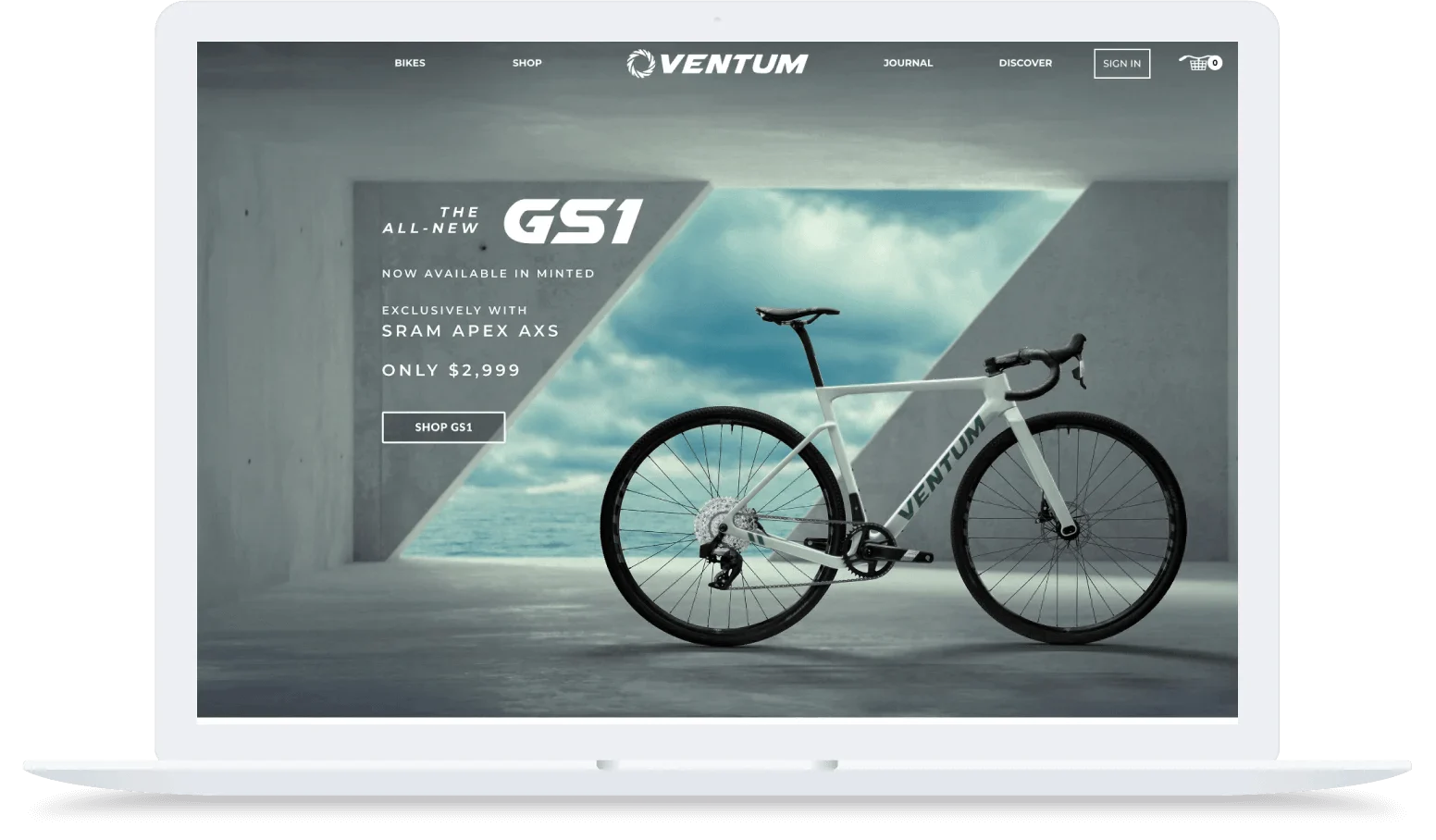
Ventum put their tires to the ground in 2015, quickly building a reputation for their tailormade performance cycles. No two bikes from Ventum are the same, each one built to fit a customer's specs. This approach requires advanced product and order support, and an inventory system that can keep up. Unfortunately, manual invoicing and supply chain issues kept their platform, WooCommerce, from staying in the race.
“So when customers would go to the site and put in an order, their inventory on the site might not reflect their actual inventory in the warehouse. People would make their dream build and put in an order, then get an email saying they couldn’t actually make their bike because the parts weren’t available.”
-Monte Persinger, Creative Director and President at Internet Design and Publishing, Inc.
After some input from their agency partner, TWIO, and a conversation with Internet Design and Publishing (ID), a BigCommerce certified agency partner, Ventum landed with BigCommerce. Drawn in by the customization offered by BigCommerce, including support for real-time inventory updates, Ventum was soon off to the races.
In the end, Ventum was able to deliver on their promise of custom bikes, without all the shopping cart woes, resulting in:
17% increase to session duration
9% increase in sessions per user
Diono.

Diono, Seattle-based maker of booster seats, strollers, baby carriers, and related accessories, has been keeping families safe since 1999. The company inherited a new CEO, Tim Maule, in 2017, and he inherited the company's old WooCommerce site — and the litany of problems that came with it.
“It was not stable and required daily, if not hourly, attention to keep everything live. The biggest issues I had with the site were that it was structurally unsound, unstable, commercially inflexible and unscalable. It was a disaster."
-Tim Maule CEO, Diono
Diono partnered with BigCommerce in 2020, using a BigCommerce Implementation Project Manager to ensure things were on track and locked in tighter than a car seat. In less than one year, the Diono team had five headless ecommerce stores on the platform, spanning five countries.
Today, Diono painlessly sells online, while also distributing their products to a number of partnering retailers. The results? They speak for themselves:
44% increase in transactions
48% increase in average order value (AOV)
114% increase in revenue
The final word
It’s hard to deny the allure of WooCommerce, especially for small businesses who are eager to sell products online. While this can be enough in the beginning, you want your business to grow, and you need a platform that can not just grow with it — but also encourage growth.
BigCommerce offers a comprehensive ecommerce solution that combines extensive out-of-the-box capabilities with a large library of integrations and plugins. Whether you’re just starting out, selling online only, or wanting a hybrid approach with a strong online presence and physical products in a brick-and-mortar store, BigCommerce can help.
See for yourself how BigCommerce compares to WooCommerce, and set your business up for success with a platform that grows with you.
Get a free 15-day trial of BigCommerce.
No credit cards. No commitment. Explore at your own pace.