




Written by
John Shieldsmith10/09/2026
What Is Agentic Commerce? A Guide to the New AI Shopping Model
Get The Print Version
Tired of scrolling? Download a PDF version for easier offline reading and sharing with coworkers.
A link to download the PDF will arrive in your inbox shortly.
Key highlights:
Agentic commerce is an AI-driven form of online commerce in which agents can support customers with product discovery, comparison shopping, checkout, and more.
Agentic commerce differs from other forms of commerce, including conversational commerce, in that it’s a more comprehensive experience and includes AI-powered actions on the customer’s behalf.
Agentic commerce is powered by four layers: discovery, reasoning, checkout, and payment.
Agentic commerce is powered by numerous protocols, each of which not only enable the technology required for agentic commerce, but also work toward making the process as safe as possible for customers and merchants alike.
What is agentic commerce and how is it changing the landscape?
One of the core benefits of ecommerce is the convenience it affords shoppers and merchants alike. Agentic commerce is taking that a step further, delivering a reality where AI agents act on a shopper or buyer’s behalf. Numerous stages of online shopping, from product discovery to comparison shopping to checkout, all handled by an AI agent.
For shoppers, agentic commerce offers an alternative to traditional ecommerce, a more convenient way for many to shop, and a way to quickly compare products and prices across platforms and brands. And, it’s taking off.
Already, 58% of online shoppers use generative AI to start their product journey, rather than traditional search.
The benefits are there for merchants, too. By leaning into agentic commerce, you’re leaning into the increasingly dominant approach to product discovery. And that’s only scratching the surface.
To better answer, “what is agentic commerce,” let’s take a look at the specifics behind it. Then, we can cover the layers that power agentic AI, how to get discovered, and more.
What is agentic commerce?
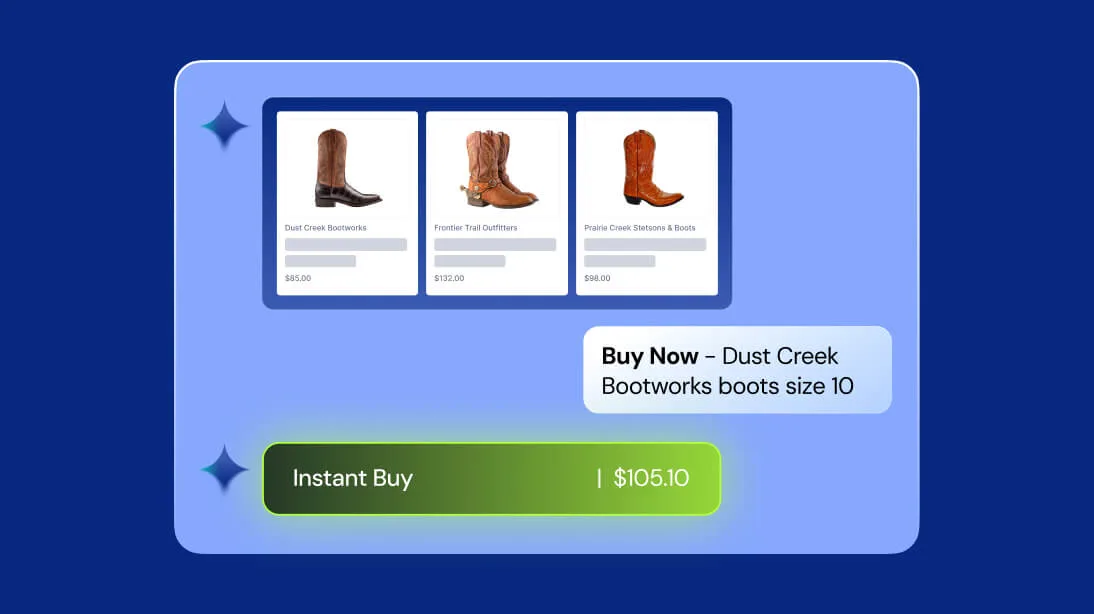
At its core, agentic commerce is when an AI agent — like Perplexity, ChatGPT, or CoPilot — helps a shopper discover products, compare products and prices, and even complete the checkout process.
In action, agentic commerce goes something like:
The shopper makes a natural language query, often in the form of a question or statement like, “Find me a $150 coat appropriate for a nice restaurant.”
The agent queries merchants, compares options across product catalogs, and surfaces a number of results.
The shopper evaluates the options and replies to the agent.
The agent continues acting within the permissions set by the shopper until the goal is met or the engagement ends.
In short: AI shopping agents help a shopper fulfill whatever goal it is they set out to accomplish, and merchants get the benefit of more brand exposure and potential sales without lifting a finger (for the most part).
Agentic commerce vs. conversational commerce.
Agentic commerce may involve talking to an autonomous AI agent, but it’s different from conversational commerce.
Conversational commerce enables a more user-friendly commerce experience within a branded site using a chatbot. With this approach, a chatbot can often help a customer find a page they’re looking for, surface product recommendations within a site, or elevate issues to a human expert.
Agentic commerce takes this a step further, using large language models (LLMs) to let shoppers query across the open web as a whole, and again, even make a purchase.
Agentic commerce vs. generative AI.
Agentic commerce runs on agentic AI, which is powered by a form of generative AI, but the two are not the same.
Generative AI creates content, like descriptions, images, conversational replies, and so on. Agentic commerce then builds on this, with agentic AI using these outputs to fuel an exchange, but then going beyond with autonomous execution of processes.
For instance, if someone is querying about a jacket, generative AI fuels the conversation. Meanwhile, agentic AI powers the actual execution of any requests, like pulling a product from a certain brand or adding an item to a cart.
Agentic AI vs. agentic commerce.
Agentic commerce is the umbrella under which all these various workflows sit: the automated product hunting, comparison making, ordering, and so on. Agentic AI is the proverbial AI assistant running around doing the work.
While still in an emergent state, this is where agent-to-agent commerce (A2A) enters the conversation. In this model, a buyer can have their agent negotiate with a seller’s agent, with the two agents ultimately coming to an agreement and executing a decision.
How agentic commerce works: the four layers of an agent-led purchase
Agentic commerce involves countless workflows, with numerous autonomous moving pieces in the mix. Naturally, there’s more than a hamster in a wheel powering all this.
Before an agent can begin the discovery process and make a purchase, there are four layers that fold into the mix, each playing a vital role.
1. Discovery: how agents find your products.
First, agents have to be able to find your products. To do this, AI crawls sites across the open web, including yours, to find products that match a user’s query.
AI can only pull machine-readable data, otherwise your site is as good as invisible. So, it’s essential you have structured product data that’s optimized and accurate.
During the discovery process, AI will also crawl third-party sites and marketplaces, like Amazon, and ad channels, like Google Shopping, for further accuracy and more complete information.
For a closer look at how this all works, be sure to read our guide on ChatGPT product discovery.
2. Reasoning and context: how agents read your catalog.
It’s one thing for an agent to find your catalog, it’s another for it to actually read it. This is where different protocols come into play.
Protocols, like the model context protocol (MCP) or agentic commerce protocol (ACP), use API-based frameworks to give agents access to the right systems. From there, assuming all your data is in good shape, an agent can get real-time pricing, stock updates, product variant information, and even policy info.
All of the above depends entirely on the right data, however. If you have stale pricing, missing variants, or incomplete or inconsistent data, an agent will move onto a competitor’s option.
3. Checkout: how agents build a cart and hand off or complete the order.
After an agent discovers your brand and reads your catalog, the action can begin. During the checkout layer, there are two potential paths that can take place:
Hand-off: The agent pulls the right product data and adds your product(s) to the shopper’s cart. The shopper is then directed to your actual checkout, where they can verify and complete the order.
In-conversation checkout: The agent finds the right products and adds them to the cart or order. From there, the agent completes an in-conversation checkout, with you remaining the merchant of record.
While the hand-off approach is more common today, expect the in-conversation route to continue trending. Coupled with A2A commerce, and agentic checkout is set to become the primary form of checkout.
4. Payment and trust: how agents pay without seeing card numbers.
Payment is the final barrier for agentic checkout and true agentic commerce as a whole. And for good reason: security is a major concern.
Protocols take this into account, using tokenized credentials, scoped to a single transaction. This prevents both the agent and the AI platform from holding raw card data.
On top of this, there are consent records that allow the merchant to prove the shopper authorized the purchase, which protects you as the merchant.
Bring this all together, and the four layers play out like:
Layer one: A shopper makes a query, “Find me a beige couch for $800 from a regional brand.” The agent surfaces several brands, including yours.
Layer two: The agent goes through your machine-readable product data, pulling options that match that query.
Layer three: The shopper goes through the options and decides they want yours (Score!), and has the agent add it to cart. The agent moves on with an in-conversation checkout.
Layer four: Using tokenized credentials, the agent completes the purchase via agentic payment, without any raw credit card data getting stored. The shopper receives a confirmation email, you remain merchant of record.
Again, it bears repeating: The above isn’t hypothetical, but something that’s playing out all the time. With tokenized credentials and an increasing focus on security, fraud prevention is less of a concern, making adoption easier for shoppers, too.
Where shoppers meet AI agents today
Unlike conversational commerce, where shoppers have to seek out a digital helper on your site, agentic commerce can start far, far away from your site. In fact, shoppers can often meet AI agents right inside their AI tool of choice, long before they reach any branded site.
But, this isn’t always the case, as some brands are launching their own branded agents that live in their digital store, too. Agentic commerce is a lot like a “choose your own adventure” experience, but without the constant risk of death. Let’s take a closer look.
General-purpose assistants: ChatGPT, Gemini and Google AI Mode, Microsoft Copilot, Perplexity.
General-purpose assistants, like ChatGPT, Gemini, Anthropic, and others, are pioneers of the agentic commerce space. And, for good reason: they’re popular.
Within tools like these, shoppers can go from querying about how much a blue whale weighs (It’s up to 150 tons) to asking for help finding the best price on a new pair of running shoes from their favorite brand.
These tools make it possible for shoppers to:
Engage in conversational discovery and find brands or products.
Take advantage of varying degrees of agentic commerce and checkout.
Surface real-time pricing and discount data on products.
Shift orders and checkout to merchant sites or apps.
Keep in mind the granular capabilities of these general-purpose assistants varies. While some can engage in agentic checkout, others will hand things off to the merchant site.
Retailer-owned agents: Amazon, Walmart and the walled-garden model.
Retailer-owned agents are increasingly popular, with major brands like Amazon and Walmart incorporating them into their own sites and apps.
For example, Amazon’s built-in AI, Rufus, can help you find a product, suggest alternatives, summarize reviews, answer questions, and even purchase via the “buy for me” feature. It should come as little surprise that Rufus is built almost entirely around product discovery.
Walmart’s assistant, Sparky, takes a different approach and focuses on conversational, scenario-based queries. Users can ask Sparky for help planning a cookout or the like, and Sparky will guide them from product to product until they have everything they need.
On-site and brand-owned agents.
Both on-site and brand-owned agents are similar to retailer-owned agents, but serve a slightly different purpose.
Whereas retailer-owned agents have to understand a wide variety of brands and products, on-site and brand-owned agents are focused only on the products and data of the company they’re built around. This allows them to be highly specialized, with granular workflows that go beyond product recommendations, striving to improve the overall customer experience.
For example, you could have your own on-brand agent that knows your various products or solutions inside and out, but also understands your various policies, technical support documentation, and which representative best suits any particular query.
The protocols powering agentic commerce
As briefly touched on earlier, there are a number of protocols that power agentic commerce. Two of the biggest are MCP and ACP, along with the universal commerce protocol (UCP), but they’re not the only ones, nor the only types.
The below table covers the countless protocols currently making agentic commerce possible, along with the layer it’s responsible for, and whether it’s open or vendor-controlled.
Protocol | Who maintains it | Layer it covers | Open or vendor-controlled | Where to read more |
UCP (Universal Commerce Protocol) One shared language a merchant publishes once so any AI agent can find products, check out, and track orders. | Google (lead), with retail and payments partners; spec published on GitHub by the “UCP Authors.” | Full journey: discovery → context → checkout → payments → post-purchase order management. Uses AP2 for payment authorization; runs over REST, MCP, or A2A. | Open-source (Apache 2.0). | |
ACP (Agentic Commerce Protocol) Lets an AI assistant complete a purchase against a merchant’s existing store and payment setup. | OpenAI and Stripe (founding maintainers); governance states a path toward neutral foundation stewardship. | Checkout and delegated payment. The agent passes a scoped payment token; the merchant stays merchant of record. | Open standard (Apache 2.0). Status: beta, per the maintainers. | |
MCP (Model Context Protocol) The standard way an AI agent connects to outside tools and data, such as a store’s catalog and cart. | Created by Anthropic (2024); donated Dec 2025 to the Agentic AI Foundation, a Linux Foundation fund. Existing maintainers continue. | Context (agent tool access): real-time queries of catalogs, carts, inventory, and policies. Not commerce-specific; UCP, ACP, and AP2 can run over it. | Open standard; vendor-neutral foundation governance. | |
AP2 (Agent Payments Protocol) Proves a shopper authorized an agent to pay, using signed digital permission slips called mandates. | Google (lead), developed with payments and technology partners. | Payments: authorization and proof of consent via cryptographically signed intent, cart, and payment mandates. Extends A2A and MCP; UCP uses it for payment authorization. | Open protocol; spec at v0.1, reference code on GitHub. | |
Card-network and wallet frameworks Visa Trusted Agent Protocol / Visa Intelligent Commerce; Mastercard Agent Pay; PayPal agentic commerce services. The payment companies’ own rules for recognizing approved agents and issuing them safe-to-use payment tokens. | Each network operates its own: Visa (TAP built with Cloudflare), Mastercard, PayPal. | Payments: trust and tokenization. Agent verification (Visa TAP signed requests; Mastercard agent registration), agent-scoped tokens (Visa Intelligent Commerce credentials; Mastercard Agentic Tokens), and agent-originated payment acceptance on existing merchant accounts (PayPal Agent Ready). Sit beneath ACP, UCP, and AP2 rather than replacing them. | Vendor-operated programs. Specs are published, but agents and merchants enroll with each network. |
Closed vs. open models of agentic commerce
There are two models of agentic commerce, each with their own tradeoffs, and each at the opposite ends of the spectrum. Neither model is right or wrong, as both models have use cases that make one the better choice over the other.
The closed model: one platform mediates catalog, checkout, and data.
A closed model of agentic commerce is limited to a particular retailer or ecosystem, ensuring the platform owner stays in control. A closed model can theoretically be built by a company in-house, but it’s far more likely a brand contracts with an AI company to have their own walled garden built.
With a closed model, a brand has fewer worries about data, more control over the conversation and workflows, and a guarantee only the products or brands they want to surface, get surfaced.
But, a closed model also comes with its downsides: User choice is limited, product pricing isn’t as competitive (meaning users are more likely to go elsewhere), innovation comes slower, and you’re more locked in with the AI vendor you chose.
The open model: protocols connect any agent to the merchant’s own systems.
An open model of agentic commerce sits at the opposite end, leaving the ecosystem open and allowing agents to communicate with other agents and brands or platforms. This is where many ecommerce brands fall, as it’s far more accessible and requires little-to-no developer lift.
Getting into an open model largely revolves around the earlier points concerning product data, machine-readability, and so on. From there, an open model allows your data to get interpreted by any number of AI agents people are engaging with.
An open model is largely appealing because it enables greater customer choice, comes with lower costs and developer upkeep than a closed model, and enables a more rapid pace of innovation.
The open model isn’t without its cons though. With the open model, data concerns are always present, you have less control over the narrative and information, and tracking can be far more difficult.
What the difference means for your customer data.
Customer data stands as one of the biggest differentiators between the closed and open models.
In a closed model, whoever provides the AI platform owns the data. Plain and simple. In an open model, the merchant owns the data and has more visibility into transactions and relationships. Again, largely depending on tokenization and how authorization models are setup.
The closed model allows for stricter governance. The open model gives merchants more ownership, but requires more scrutiny and attention to security-related matters.
Agentic commerce use cases: customer-facing and merchant-facing
Agentic commerce is a case where parties at both ends can benefit from its existence. For customers, there are numerous use cases that play out everyday. And for merchants, the same is true.
Customer-facing agents.
Customer-facing agents are most likely what comes to mind when you think of any AI agent. These, as the name implies, exist to help the customer with various tasks.
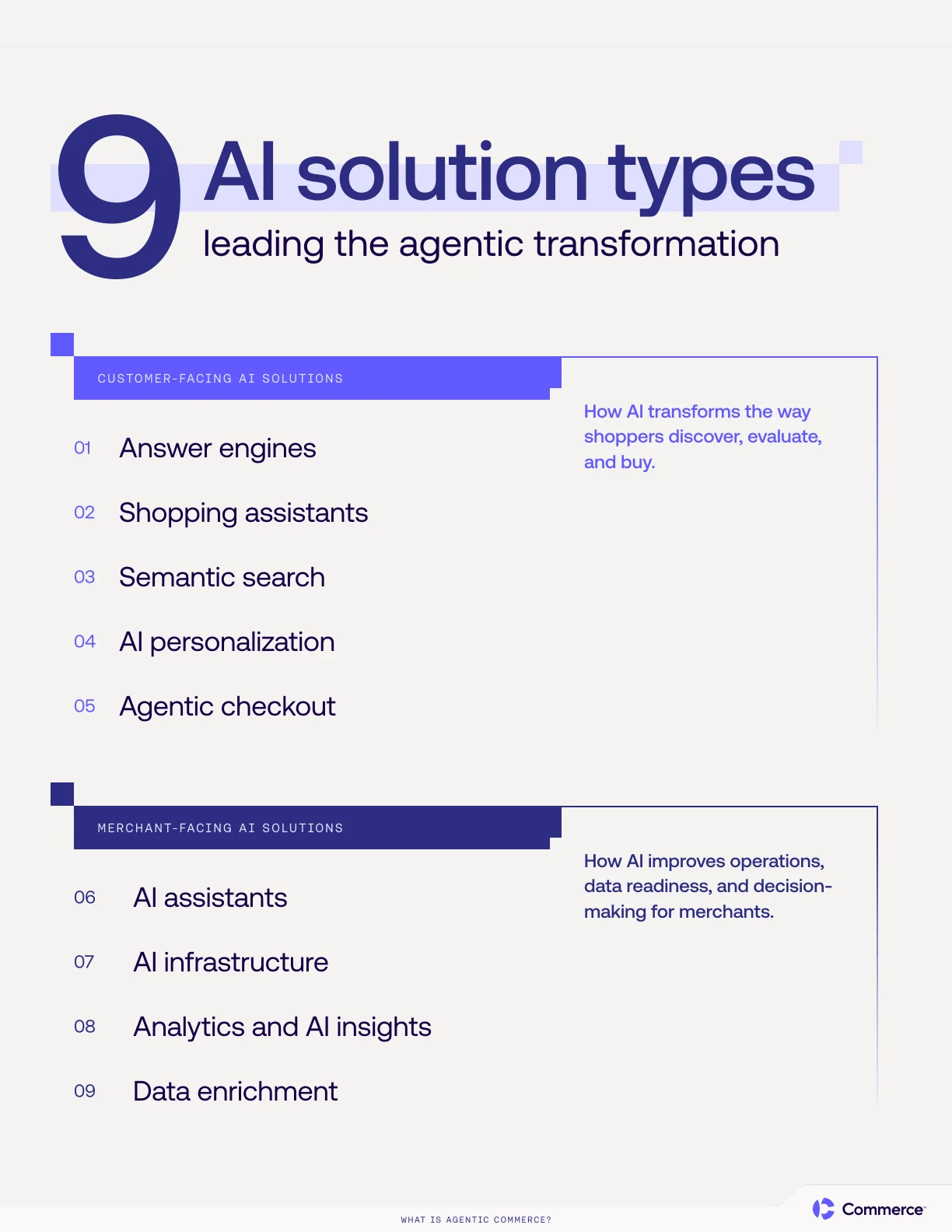
Common examples of customer-facing agents include:
Answer engines: AI-powered engines that help customers with general queries, pulling from multiple sources and the open web.
Shopping assistants: An assistant that lets customers engage via conversational query, allowing them to get product recommendations, further details on items, and more.
Semantic search: Advanced search that goes beyond basic keyword-matching, with an understanding of the context surrounding a customer’s query.
AI personalization: Real-time personalization of content, product recommendations, pages, and more.
Agentic checkout: AI that allows customers to have a full conversational transaction, including automated checkout and purchase of a product.
Again, customer-facing agents are there to help improve the overall customer experience. Sure, they might help you close a few more deals or make more sales, but at the end of the day, they should make the customer’s life easier or their experience more delightful in some way.
Merchant-facing agents.
Merchant-facing agents wear the horrifying visage of a merchant. (Not really, but this is a long piece and I want you engaged.) A merchant-facing agent serves the merchant, helping with everything from monitoring spending limits to pulling analytics to enabling bulk data enrichment across your catalog.
More specifically, merchant-facing agents often come in the form of:
AI assistants: Similar to customer-facing AI assistants, these help merchants with inventory management, analytics, and more.
AI infrastructure: Specialized AI assistants that help merchants with IT infrastructure, cloud management, and networking optimizations.
Analytics and AI insights: Advanced analytics and insights pulled by an AI, giving merchants the ability to forecast, optimize efforts, streamline finances, and more.
Data enrichment: AI-powered product data enrichment, allowing merchants to get their catalogs into answer engines and have a more proactive role in agentic commerce.
A lot goes on behind the scenes in business. Merchant-facing agents are here to help with just about all of it.
Agentic commerce for B2B
Agentic commerce isn’t just a great fit for B2C and a more traditional ecommerce experience. In fact, B2B agentic commerce is arguably a natural fit:
Purchases are often rules-based and repeated.
Approval workflows are time-consuming when handled manually.
Contract pricing provides natural guardrails for AI agents.
A single raincoat purchase is one thing. A six-figure order of materials? That kind of deal often involves numerous stakeholders and review stages. Any steps you can take to expedite things should be taken. Agentic commerce can make a big impact here in two different forms.
Purchase-order and reorder agents.
Purchase-order and reorder agents are highly specialized AI agents that fit nicely into the B2B space.
For example, the BigCommerce purchase order agent, currently in early access, follows a simple pattern that saves precious time:
The agent reads a PO (Whether uploaded, emailed, or faxed)
The agent checks the price and stock against the buyer’s account
The agent routes the PO to checkout or approval
The above workflow, while only a few steps, can get hung up at numerous points when handled manually. With the agent, it can be completed in a quick manner that stays compliant with the guardrails and policies you set in place.
Logged-in agents: contract pricing and permissions.
In the B2B space, it’s not uncommon to have customer-specific pricing, catalogs, and permissions. This is where logged-in agents come in.
Logged-in agents need account authentication-level access, which allows them to go above and beyond other agents. For instance, the BigCommerce B2B storefront MCP, available in early access, can access user-specific pricing, quotes, and shopping lists.
What agentic commerce means for your ecommerce strategy
Okay, so agentic commerce can help people find stuff, help you with operations, complete checkout processes, and so on and so forth. This is all great, but what does any of this mean for your ecommerce strategy?
Your product data is your foundation.
In an agentic commerce world, AI tools are only as good as the data they have access to. If your product titles are vague, your attributes are incomplete, or your descriptions aren’t optimized for how people actually search, you’re harder to surface — whether that’s on an AI answer engine, a shopping assistant, or an AI-powered storefront search.
In other words: Investing in clean, structured, enriched product data is more than a back-office concern. It’s critical to establishing a front-line competitive advantage.
Best of all, this isn’t something you have to handle manually.
Feedonomics Data Enrichment helps merchants close those gaps at scale, filling in missing attributes, generating optimized content, and ensuring products are structured in a way that AI-powered discovery channels can actually read and surface.
Discovery happens before shoppers reach you.
When a significant portion of the buying journey unfolds inside AI tools, your storefront is no longer the starting point. In fact, shoppers may already have a strong opinion about your storefront before they even arrive.
Brands that treat AI discovery channels as secondary will feel it in their traffic and conversion numbers. The ones that show up early, accurately, and consistently in those channels are the ones capturing demand before it ever hits a search bar.
The infrastructure underneath your store matters more than ever.
Agentic checkout, AI protocols, and emerging agent-to-agent commerce all require a technical foundation that can support them.
Establishing the right foundation requires headless architecture, open APIs, and flexible integrations. And that’s only to start, as these elements are increasingly table stakes.
Measure agent-driven demand separately.
Before your agentic efforts start taking off, it’s important to set up the right tracking. By measuring agent-driven demand separately, you’re ensuring you have a more accurate picture of agentic’s role in your performance, and you have a better idea on whether you need to focus on other channels as well.
Lastly, agent-driven demand can fluctuate wildly, so by measuring it separately you can begin to identify trends and forecast demand more accurately.
Risks, trust, and what’s still unresolved
While agentic commerce is growing leaps and bounds with each passing week, there are still risks, trust issues, and unresolved challenges. This isn’t to say you should ignore agentic commerce until they’re resolved, but more to help you get ahead of these potential hurdles before they become very real problems.
Fraud and agent verification.
In a perfect world, every agent would be working as intended, with no nefarious purpose. Unfortunately, there are fraudulent agents used for stealing company information and more. On top of this, without the right framework and guardrails in place, it’s possible for users to potentially utilize an agent for purposes outside its original intended use.
Tokenized payments, as mentioned earlier, can help protect users from fraud. On top of this, there are agent verification frameworks that reduce the chances of a fraudulent agent getting access to your organization.
Returns, disputes, and liability.
With the advent of agentic checkout, a big question has entered the conversation: Who’s responsible for returns when an agent makes a purchase on behalf of a buyer?
Even if an agent made the purchase for a customer, ultimately you stay the merchant of record. This means returns fall within your store’s policy.
Disputes, like chargeback disputes, and liability are in a murkier spot than returns. It’s technically possible for a customer to dispute a purchase, claiming they didn’t authorize an agent to make a purchase. While there are consent records and transcripts, these aren’t in the same legal area as traditional records of consent and purchase.
As a result, merchants typically take on the burden whenever disputes or liability matters arise, but this could change in the future as laws adapt to agentic commerce.
Attribution and data visibility.
You can track various agentic metrics, but in-depth attribution is often difficult, as discovery and consideration both happen inside an AI platform. This means merchants lose out on data visibility in many cases, only seeing what happens after discovery and consideration — purchase.
Again, you’ll still have order and shipping numbers, and it’s possible to gauge your general agentic traffic. But, you lose visibility around the upper ends of the funnel.
The final word
Agentic commerce is just getting started. It’s not a passing fad, nor is it simply another channel to consider. It’s an increasingly popular form of ecommerce, and a vital step to future-proofing your business.
It’s also a colossal undertaking. Don’t be intimidated, but instead:
Audit your product data for the fields agents read
Confirm that your platform exposes protocol endpoints and that your data is machine readable
Set up agent-channel attribution in your analytics tool of choice before any volume
Curious how customers are feeling about the agentic shift? Download our free agentic AI shopping report and better understand how agentic commerce plays into the shifting expectations of shoppers everywhere.
FAQs about agentic commerce
Agentic commerce is when AI agents — software that acts on a shopper’s or buyer’s behalf — discover, compare, and buy products.
Unlike a search engine or chatbot, the agent doesn’t just answer questions; it takes action, from product discovery through checkout and payment, within the permissions the shopper sets. For merchants, it means product discovery increasingly happens inside AI tools before a shopper ever reaches your site.
Conversational commerce is a chatbot on a single brand’s site that answers questions and recommends products, while agentic commerce is an AI agent that works across the open web and can complete the purchase itself.
The key difference is who acts: in conversational commerce, the shopper still does the clicking and buying. In agentic commerce, the agent does the comparing, carting, and checkout on the shopper’s behalf.
Yes, but only within the permissions a shopper has granted, such as a budget cap, a product type, or a one-time authorization. Most agents today use a hand-off model, building the cart and sending the shopper to the merchant’s checkout to confirm. In-conversation checkout, where the agent completes the order itself, is less common but growing. Either way, the shopper’s consent is recorded so the merchant can prove the purchase was authorized.
Agentic commerce is designed so that neither the agent nor the AI platform ever handles raw card numbers. Payments use tokenized credentials — a one-time stand-in for the card, scoped to a single transaction — and consent records document that the shopper approved the purchase.
Customer-data ownership depends on the model: in a closed model, the AI platform typically holds the data, while in an open model, order and customer data land in the merchant’s own systems. Merchants should still verify agents and review each AI platform’s data-sharing terms.
The main agentic commerce protocols are the Universal Commerce Protocol (UCP), the Agentic Commerce Protocol (ACP), the Model Context Protocol (MCP), and the Agent Payments Protocol (AP2).
Each covers a different layer: MCP lets agents read catalogs and carts, ACP handles checkout and delegated payment, AP2 handles payment authorization, and UCP spans the full journey from discovery to post-purchase. Card networks and wallets add their own trust and tokenization frameworks at the payments layer. Protocols exist so a merchant can integrate once rather than once per AI platform.
Start with your product data, because AI agents in ecommerce can only surface what they can read. Titles, attributes, variants, price, stock, shipping, and returns policy all need to be complete, accurate, and structured.
Next, confirm your platform exposes protocol endpoints so agents pull real-time data rather than scraping stale pages. Finally, set up agent-driven traffic and orders as their own channel in analytics before volume arrives.
Yes, B2B is arguably the strongest fit for agentic commerce, because purchases are repeat, rules-based, and governed by contract pricing. Purchase-order agents can read a PO, cheque price and stock against the buyer’s account, and route it to checkout or approval. Logged-in agents use authenticated access so they respect negotiated prices, quotes, and buying permissions for a specific account.
Discover How AI is Transforming the Customer Experience
AI is quickly reshaping the landscape of ecommerce. Learn how you can prepare for the next wave of AI commerce.