


Written by
Mandy Spivey06/12/2026
Why Ecommerce Experience Is the Foundation of Online Growth
Get The Print Version
Tired of scrolling? Download a PDF version for easier offline reading and sharing with coworkers.
A link to download the PDF will arrive in your inbox shortly.
Key highlights:
Experience beats price. 70% of shoppers abandon a purchase over poor UX.
UX delivers ROI. Every $1 in UX returns ~$100, and strong design can lift conversions up to 200%.
Good CX wins spend and loyalty. 3 in 4 consumers will spend more with businesses that provide a good CX, and 60% have purchased from a brand solely based on the service they expect to receive.
Ecommerce experience drives measurable growth. Customer-obsessed organizations report 41% faster revenue growth and 51% better customer retention than non-customer-obsessed peers.
Bad experiences cost you customers fast. More than half of consumers will switch to a competitor after a single bad experience, and 73% will switch after multiple.
Win with purpose and the right ecommerce platform. Start with clear objectives and build on flexible, scalable infrastructure like BigCommerce Catalyst.
Price Gets Shoppers There. Experience Keeps Them.
Ecommerce has matured from a novelty into the primary way millions of people shop, and the bar for what counts as a "good" online store keeps rising.
As more businesses move online, the thing that separates a brand customers return to from one they abandon is rarely price alone — it's the experience.
The ecommerce experience encompasses every interaction a customer has with your brand online, from the first ad or search result to browsing, checkout, delivery, and post-purchase support. Each of those moments either builds trust or erodes it.
And the stakes are real. With 70% of customers abandoning purchases because of a bad user experience, the quality of your store can make the difference between a sale and a bounce.
Here we'll explore what an ecommerce experience is, why it matters, the benefits and challenges of investing in it, and how to build an experience that keeps customers coming back.
Customize and simplify your storefront tech stack with Catalyst.
Empower your team to quickly create and optimize storefronts for performance and scale.
What is an ecommerce experience?
The ecommerce experience refers to the sum of every interaction a shopper has with your online store:
How they find you
How they navigate your website
How easily they discover products
How smoothly they check out
How supported they feel afterward
Both the user experience (UX) and user interface (UI) play a role in the overall ecommerce experience. UX is how people interact with your product, services and website, from visual appeal to ease of interaction, while UI is the look and feel of the screens they actually touch. A quality UX increases user adoption, enhances the customer experience, and improves retention.
To put it simply: your ecommerce experience is a mirror of your company.
How customers perceive your brand is often a direct reflection of how your store makes them feel.
Why ecommerce experience matters
In a crowded digital marketplace, a quality, modern experience is one of the most important keys to success. It directly shapes how customers view your company, how they navigate your products, and whether they ultimately complete a purchase.
Beyond the abstract, there's clear statistical evidence for prioritizing experience:
Great CX drives more spending: 3 in 4 consumers will spend more with businesses that provide a good customer experience, and 60% have bought from a brand based solely on the service they expect to receive.
Experience now beats price and builds trust: More than half of consumers say great customer service matters more than product price, and 87% trust a brand more when it delivers an excellent experience.
One bad experience sends shoppers to a competitor: More than half of consumers will switch to a competitor after a single bad experience, and 79% would switch to a company with a better customer experience.
The pattern is consistent: the more you prioritize the experience, the more successful your store tends to be.
Benefits of investing in ecommerce experience
A thoughtfully designed ecommerce experience unlocks a range of advantages across your business.
Increased revenue.
Customer experience is one of the most direct levers for ecommerce revenue: up to 75% of shoppers say they will spend more with businesses that provide a good CX, and 60% have purchased from a brand solely based on the service they expect to receive.
For online retailers competing on more than price, a strong experience turns one-time shoppers into repeat, higher-value customers.
Optimized costs.
An underrated benefit of focusing on experience is that it forces you to understand your customers and what kinds of interactions work for them and what they actually need. By analyzing user behavior to spot trends and expectations, you can target your time and budget where they'll have the most impact instead of guessing.
Improved accessibility.
Building accessibility into your experience is increasingly a must rather than a nice-to-have. Enabling people with disabilities to view, navigate, and understand every part of your store doesn't just expand your potential audience, it also strengthens your reputation as an organization that takes all of its customers seriously.
Enhanced customer satisfaction.
Satisfaction is one of the most critical components of an ecommerce experience and one of the best ways to showcase the quality of what you offer. The cost of getting it wrong is steep: 67% of customers cite bad experiences as a reason for leaving a website.
A site that’s user-friendly, mobile-friendly, and easy to use goes a long way toward keeping shoppers happy.
Improved customer retention.
A strong customer experience is one of the most reliable ways to keep ecommerce shoppers coming back.
Two-thirds of consumers who believe a business cares about their emotional state will likely become repeat customers, and 85% will go out of their way to switch to a company with better customer service.
The reverse is just as powerful: more than half of consumers will switch to a competitor after only one bad experience, making a consistently good experience essential to retaining customers in a market where switching is just a click away.
Scale with your business.
As your customer base grows, your experience needs to grow with it. An experience built on modern, flexible technology can adapt to new products, channels, and customer expectations without buckling, making your business more resilient as demand increases.
Challenges of improving ecommerce experience
Investing in your ecommerce experience is worth it, but it isn't without obstacles. Knowing these challenges up front is how you plan around them.
A budget is a must.
Meaningful improvement comes at a cost. Any significant restructuring of your store should be backed by enough budget to actually move the needle on customer satisfaction.
A greater emphasis on design often means new technologies, modern tools, and specialized expertise — from purchasing solutions to hiring talent. Ecommerce site costs vary, ranging from $0 to $250,000+ depending on your platform, level of customization needs, and business complexity.
It takes time.
The design and development process can take real time, spanning UX research, development, feedback, and iterative testing. Before committing to a major experience overhaul, make sure you have the time to spare and the processes in place to manage an expansive project.
Misaligned expectations are a reality.
Before any redesign, teams need to be aligned on goals and outcomes.
When the IT department, the design team and leadership each picture a different end result, the whole effort suffers. Encouraging collaboration across departments builds a shared understanding and keeps the project on track.
How to build a better ecommerce experience
Understanding the benefits and challenges is one thing; executing is another. These approaches help turn intent into results.
Communicate the value of experience.
Many stakeholders may not be familiar with experience design or its payoff. Before diving in, highlight the value to everyone involved — from leadership to support staff — by showcasing best practices and potential outcomes. Bringing people along only makes the rest of the process smoother.
Take a lean approach.
A modern, lean approach is designed to reduce inefficiency and deliver value to the company and its users. It blends traditional team collaboration with an analytical mindset, focusing less on heavy deliverables and more on rapid, iterative cycles.
Involve other departments.
Experience projects easily become siloed inside a single team. Aim for collaborative design instead, pulling in stakeholders, designers, and developers so everyone builds a shared understanding. Cross-functional input consistently produces deeper insight than working in isolation.
Start with a purpose.
Begin with a specific goal in mind. "Improve the store" is too vague to execute against; instead, define what improvement actually means and which parts of the experience matter most. Prioritizing the highest-impact areas keeps the project focused and measurable.
Share your vision with key stakeholders.
Before you begin, make sure stakeholders understand your vision for the project and the experience itself. Communication is essential to success here.
By demonstrating commitment, building relationships with everyone involved and leading by example, you set the project up to deliver.
How BigCommerce powers exceptional ecommerce experiences
Delivering a standout experience is far easier on a platform built for flexibility and performance.
BigCommerce combines the customization freedom businesses want with the reliability, security, and scalability of a SaaS solution.
The end result?
Teams can craft distinctive storefronts without managing hosting, security patches, or infrastructure.
Through its headless commerce capabilities and robust APIs, BigCommerce lets brands design tailored, fast, engaging experiences across every channel, then iterate quickly as customer expectations evolve.
Tools like Catalyst, its composable storefront framework, and the Makeswift visual editor empower developers and marketers to co-create and refine the customer experience together, reducing development overhead while keeping the store flexible enough to grow with the business.
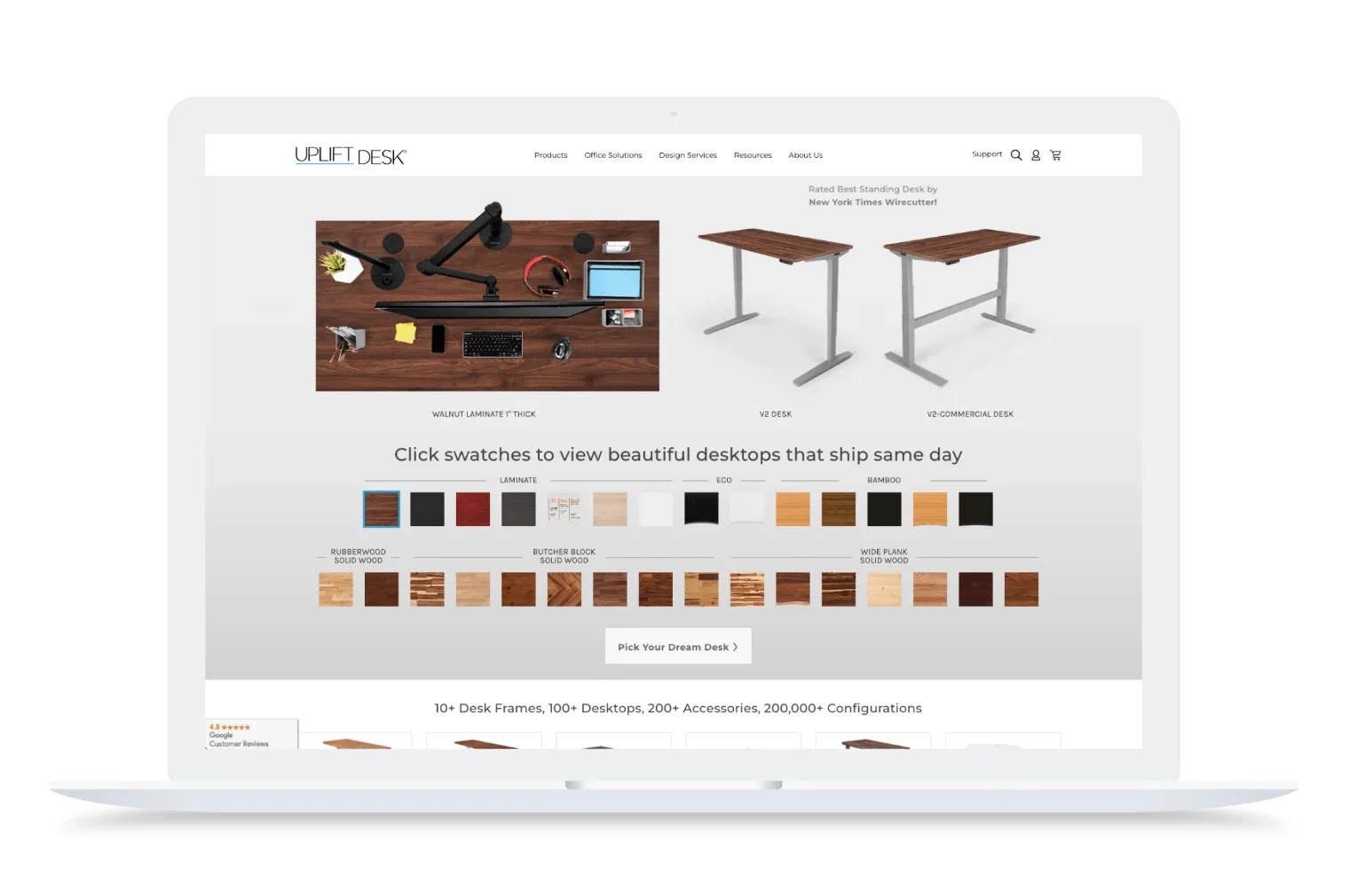
Look no further than the customer experience UPLIFT Desk built into their ecommerce experience.
After migrating to BigCommerce and implementing a tailored storefront that allowed shoppers to pick and choose parts of their desk and watch it come to life on screen via the interactive desk builder, they saw increased conversions almost immediately after launch. Where it took weeks to run site updates, it now took hours, too.
“Since launching, we’ve rebuilt our cart page and navigation — projects that used to take weeks are now completed in days or even hours.”
— Daniel Burrow, VP of Sales and Marketing, UPLIFT Desk
Catalyst’s composability made it possible for their team to create a more personalized online shopping experience, and the results spoke for themselves.
Customize and simplify your storefront tech stack with Catalyst.
Empower your team to quickly create and optimize storefronts for performance and scale.
The final word
The ecommerce experience is no longer a finishing touch; it's the foundation of online growth.
In a digital world where every interaction counts, a quality, customer-focused experience is what earns trust, drives conversions, and keeps shoppers loyal.
Building a great experience can feel daunting, especially for businesses new to UX and CX. But the evidence is overwhelming: stores that prioritize experience see higher conversion rates, stronger retention, and measurable returns on their investment.
Ultimately, the needs of the customer come first. Design your store around them and you'll show them how much they matter — which is exactly what keeps them coming back.
FAQs about ecommerce experience
User experience (UX) focuses on how a person interacts with your website and interface, including navigation, layout, speed and ease of use. Customer experience (CX) is broader, covering every touchpoint a customer has with your brand, including marketing, support and delivery.
Ecommerce experience sits at the intersection of UX and CX: it's the complete journey of shopping with your brand online, shaped by both strong UX and strong CX.
Start evaluating your current ecommerce experience with an audit to see how your store is meeting business needs and where it can improve.
An ecommerce experience audit should include reviewing your business objectives, understanding your users and their goals, gathering analytics such as conversion metrics and sales data, completing a heuristic evaluation, consolidating your findings, and building out a set of best practices to work toward.
Updating or redesigning your store depends on how well your current store performs and whether legacy systems are holding it back.
Before deciding, ask whether your site reflects your business goals, whether it's mobile-friendly, how easy it is to use, how fast it loads, whether your content and images are current, and how well it ranks in search. If you can't answer those questions affirmatively, it may be time to move away from legacy systems toward a modern platform built for the experience you want to deliver.
The ecommerce experience is evolving in a number of ways, all of them largely driven by more accurate and rich data, and a higher degree of personalization.
Experience design grows more precise and data-informed every year. Brands have moved beyond basic metrics like retention and conversions toward richer signals such as click-through rates and time spent per page. With more information available than ever, businesses can tailor the shopping experience ever more closely to individual customer preferences.

There's a lot to love ❤️
Watch a demo to see the BigCommerce platform in action.