- Start & Build

Product Overview
What you can do with BigCommerce.
Agentic Commerce
 AI-powered solutions for growth.
Design Your Store
Build your store with or without code.
Apps & Integrations
Over 1,200 apps to help you grow.
Migrate to BigCommerce
Switch from Shopify, Woocommerce, Salesforce, Magento, and more.
- Launch Services
Overview
Chart your path to success with specialized services.Implementation Project Management
Experts to ensure you launch on time and under budget.Solution Architecture
Seasoned advisors to help you best design your store.Data Migration & Optimization
Expertise on a clean and clear path to migrating your data.Enterprise Launch Package
Personal training on how to set up and launch your BigCommerce Store.

Professional Services Blog Series
Get to know our teams and how they support your success in this Q&A series.

The Global B2B Buyer Behavior Report
This in-depth report provides actionable strategies to help you sell more online.
Agentic Commerce in Action: Highlights From Google Cloud Next 2026

Create your store and start selling today.
Create your new website.
See if the BigCommerce platform is a good fit for your business.
No credit card required.

Written by
Annie Laukaitis05/06/2026
Agentic Commerce in Action: Highlights From Google Cloud Next 2026
Get The Print Version
Tired of scrolling? Download a PDF version for easier offline reading and sharing with coworkers.
A link to download the PDF will arrive in your inbox shortly.
Key highlights:
The traditional commerce funnel is collapsing. Agents now handle discovery, evaluation, and selection on a shopper's behalf, compressing the entire purchase journey into a single moment.
Most brands are less data-ready than they think. Incomplete attributes, inconsistent product content, and catalogs built for keyword search are quietly keeping brands out of agentic results.
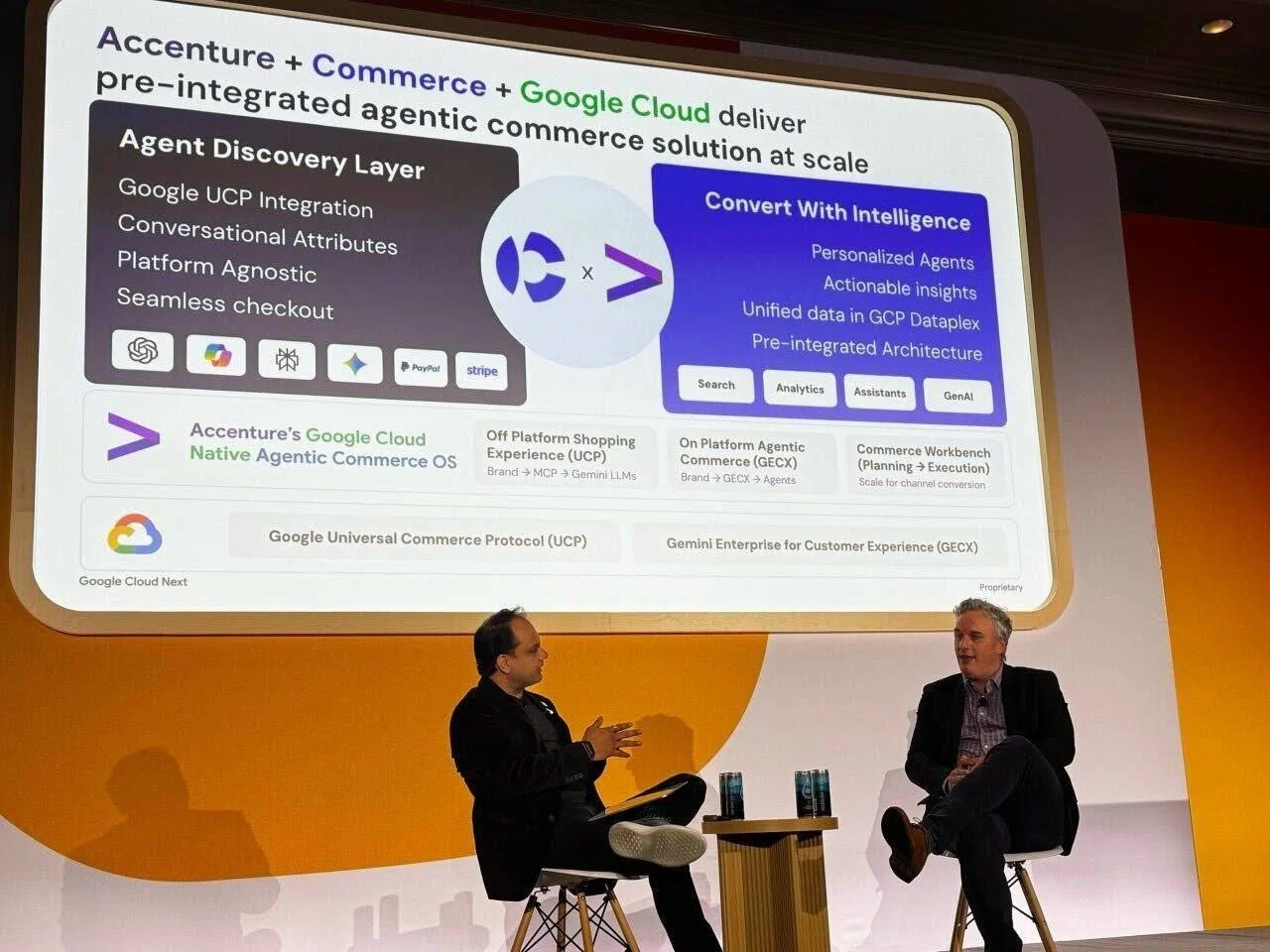
Commerce, Accenture, and Google Cloud have built a production-ready agentic commerce platform that connects product data to AI-powered discovery, conversion, and checkout.
Agentic checkout lets shoppers, or agents acting on their behalf, complete a purchase without ever leaving the AI surface, integrated with PayPal and Stripe.
The best place to start is a catalog audit. Clean, structured, enriched product data is the foundation everything else sits on.
Agentic commerce isn't a trend to keep an eye on. It's already here, and the brands that treat it that way are pulling ahead — fast.
At Google Cloud Next 2026, Commerce CEO Travis Hess sat down with Mayank Bhatnagar, Global CTO of Accenture's Google Business Group, for a candid conversation about what that really means for retail. As Travis put it: "What's happening right now with agentic AI is unlike anything we've seen."
Their conversation covered why the traditional commerce funnel is under pressure, why most brands are further behind than they realize, and what Commerce, Accenture, and Google Cloud have built together to help brands close that gap quickly.
No prototypes. No hypotheticals. Just real deployments, honest insights, and a practical look at what it takes to compete in an AI-driven world.
Here's what they covered.
The commerce funnel is collapsing
Shoppers are skipping steps brands spent decades optimizing for.
Think about the difference between a shopper searching "blue sneakers" and a shopper telling an agent "I need an outfit for Saturday night."
The second shopper just skipped the entire funnel.
No awareness stage. No consideration. No evaluation. The agent handled all of it — discovery, filtering, selection. The shopper just showed up to confirm.
Travis and Mayank have a name for this: Commerce Compression. The traditional awareness-to-purchase journey is collapsing into a single, agent-mediated moment. And it's reshaping the rules of retail in a fundamental way.
Brands have spent years optimizing for each stage of that funnel. SEO for awareness. Paid media for consideration. Product pages for evaluation. But when an agent compresses all of that into one interaction, those investments don't carry the same weight anymore.
The question is no longer just "How do we get found?"
It's "How do we get chosen by an agent acting on behalf of a shopper?"
Winning in an agentic world comes down to three things
Clean, structured data gets your products in front of the right agents.
Here's the uncomfortable truth: the brands winning in the next three years won't necessarily be the ones with the biggest media budgets. They'll be the ones whose product data is structured, enriched, and ready for how AI surfaces consume it.
Because when a shopper asks an agent to find the best running shoe for wide feet under $150, the agent doesn't browse. It reads structured product data and surfaces the most relevant results. If your catalog doesn't have the right attributes in the right format, your product simply doesn't show up. The biggest ad spend in the world can't fix that.
Most brands aren't there yet. And many don't know how far they have to go until they actually look closely at their catalogs.
The good news is that it's a solvable problem, and it's one Commerce through Feedonomics are already helping enterprise brands work through.
Frictionless checkout closes the gap between discovery and purchase.
Getting found is only half the battle. Converting is where most brands still have a major gap.
Right now, when an agent surfaces a product, shoppers often have to leave that experience entirely to complete the purchase. That drop-off is a significant problem, and a significant opportunity for the brands that solve it first.
What Commerce and Accenture built with Google UCP is agentic checkout. A shopper, or an agent acting on their behalf, can complete a purchase without ever leaving the AI surface. Integrated with PayPal and Stripe, the experience is seamless from discovery to confirmation.
Very few brands have this working in production today. The ones that do have a real competitive advantage.
Your own shopping agent builds loyalty no marketplace can replicate.
Being discoverable on third-party AI surfaces is important. But the brands building the most differentiated experiences are going a step further, deploying their own shopping agents on their own platforms.
Powered by Gemini Enterprise for Customer Experience, these owned agents know a shopper's preferences, purchase history, and intent. They don't just surface products. They build a relationship.
That's where loyalty gets built in an agentic world. Not through a generic search result, but through a personalized experience no marketplace or aggregator can replicate. Every interaction makes the agent smarter, continuously improving based on real shopper behavior.
What Commerce, Accenture, and Google Cloud built together
Commerce, Accenture, and Google Cloud have spent the last year building and deploying a production-ready agentic commerce platform for enterprise retail clients.
At the core is a four-agent system:
Catalog Agent: Built on Commerce and Feedonomics, this agent keeps product data enriched, accurate, and agent-ready continuously.
Shopping Agent: Powered by Vertex Retail Search, it surfaces the right product to the right shopper based on intent and context.
Payment Agent: Integrated with PayPal and Stripe, it handles frictionless checkout inside the agent experience.
Orchestration Agent: Running on Gemini via Vertex AI, this is the intelligence layer that coordinates everything in real time.
The whole system is pre-integrated and built on the full Google Cloud stack, including Vertex AI Agent Builder, Customer Engagement Suite, BigQuery, and Model Armor. Clients don't build from scratch. They get to production faster, with Accenture's delivery accountability behind every engagement.
Where to start.
The platform is ready. But before brands think about agents, checkout flows, or personalization, Travis had one clear message at Google Cloud Next: run a catalog audit.
Understand where your product data actually stands today. How complete are your attributes? How consistent is your information across channels? Is your content structured for how AI surfaces read it, or just for how humans search for it?
Those answers determine everything else. The agent experience, the checkout flow, the personalization layer all sit on top of the data foundation. If that foundation has gaps, nothing downstream works the way it should. Commerce and Feedonomics can help brands close those gaps quickly.
The final word
Agentic commerce isn't coming. It's already here, and the brands investing now in their data foundation, their agent-readiness, and their checkout infrastructure are the ones that will be found, chosen, and preferred as AI-mediated commerce becomes the norm.
Commerce, Accenture, and Google Cloud have built something real to help brands get there, grounded in actual deployments, with the delivery accountability to back it up.
But as Travis put it at Google Cloud Next:
“Before anything else — before you talk about agents, before you think about checkout — understand where your product data actually stands today. Because that's the foundation everything else sits on.”
— Travis Hess, CEO, Commerce
That's the starting point. And it's closer than most brands think. Request a free data enrichment audit from Commerce and Accenture to find out exactly where you stand and how to move forward.
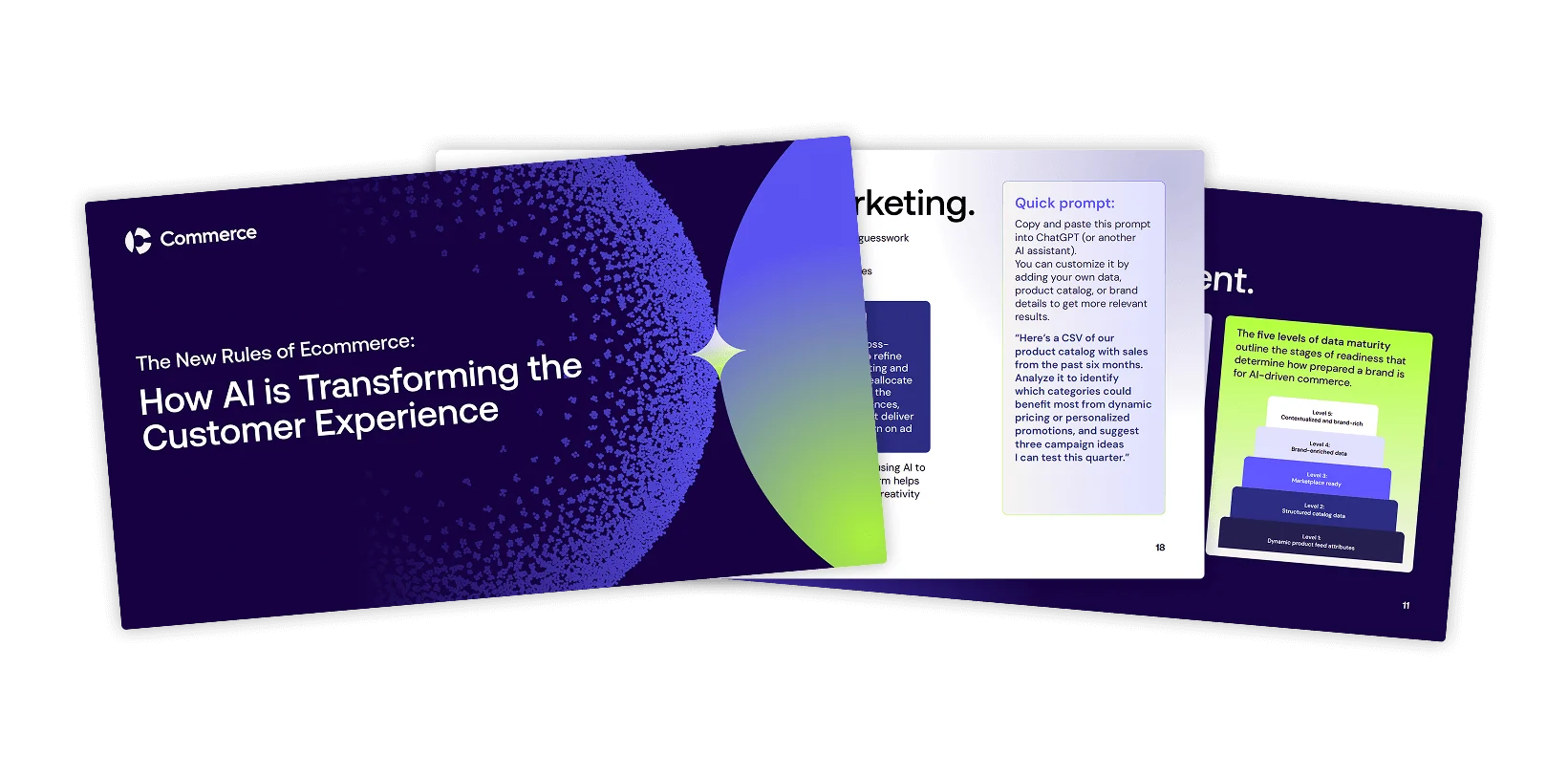
Discover How AI is Transforming the Customer Experience
AI is quickly reshaping the landscape of ecommerce. Learn how you can prepare for the next wave of AI commerce.