Start & build


Launch Services
Overview
Chart your path to success with specialized services.Implementation Project Management
Experts to ensure you launch on time and under budget.Solution Architecture
Seasoned advisors to help you best design your store.Data Migration & Optimization
Expertise on a clean and clear path to migrating your data.Enterprise Launch Package
Personal training on how to set up and launch your BigCommerce Store.

Professional Services Blog Series
Get to know our teams and how they support your success in this Q&A series.


Simplify Your App Billing: Introducing BigCommerce’s Unified Billing!

Create your store and start selling today.
Create your new website.
See if the BigCommerce platform is a good fit for your business.
No credit card required.

Written by
Katie HoesleyAs a BigCommerce tech partner, managing your app's billing can be a complex and time-consuming task. To address these challenges, BigCommerce is launching Unified Billing, a streamlined solution that automates app billing and provides a seamless payment experience for your customers. In this blog, we will dive into what Unified Billing is, why you should consider it, and how to implement it into your app.
What is Unified Billing?
Unified Billing is a system offered by BigCommerce that centralizes the billing process for apps sold in the BigCommerce App Marketplace. Instead of requiring customers to enter separate payment information for each app they subscribe to, Unified Billing consolidates all charges onto a single invoice managed by BigCommerce.
This means that BigCommerce will now handle the billing, including subscription payments and chargebacks, while the app partner focuses on developing and supporting their app.
Why Use Unified Billing?
Unified Billing offers several compelling advantages for app developers and customers alike:
Streamlined Customer Experience
One of the major hurdles for customers purchasing third-party apps is the fragmented billing experience. Without Unified Billing, customers must manage individual billing relationships with each app provider. With Unified Billing, they get an all-in-one invoice, simplifying their experience and removing the hassle of dealing with multiple billing systems.
Increased App Adoption
A frictionless billing process often leads to higher conversion rates. Unified Billing removes barriers to entry, such as requiring customers to create separate billing accounts. This drives faster and easier adoption of your app, leading to potentially higher sales.
Reduced Operational Overhead
App developers no longer need to manage their own billing systems, saving time on building and maintaining PCI-compliant payment infrastructure. BigCommerce handles everything from billing to fraud prevention, allowing developers to focus on improving their products rather than managing billing issues.
Lower Transaction Costs and Risk
Unified Billing shifts the financial risk of chargebacks and fraud to BigCommerce. Additionally, developers benefit from reduced credit card transaction fees and no longer need to chase down overdue payments from customers.
Exclusive Benefits
App developers who participate in Unified Billing are eligible for perks like exposure in BigCommerce marketing materials, and a Unified Billing badge for their app.
Implementing Unified Billing
If you’re a BigCommerce app developer, implementing Unified Billing is straightforward. The process depends on whether you are a primary or secondary user of your BigCommerce account.
Once Unified Billing is enabled, customers can easily purchase apps and subscriptions directly through BigCommerce's checkout process. They will have the option to use an existing payment method already associated with their BigCommerce account or to add a new one. Subscriptions will be tied to their BigCommerce billing account, ensuring a smooth and unified purchasing process.
If you’re a Tech Partner who wants to opt-in to using Unified Billing:
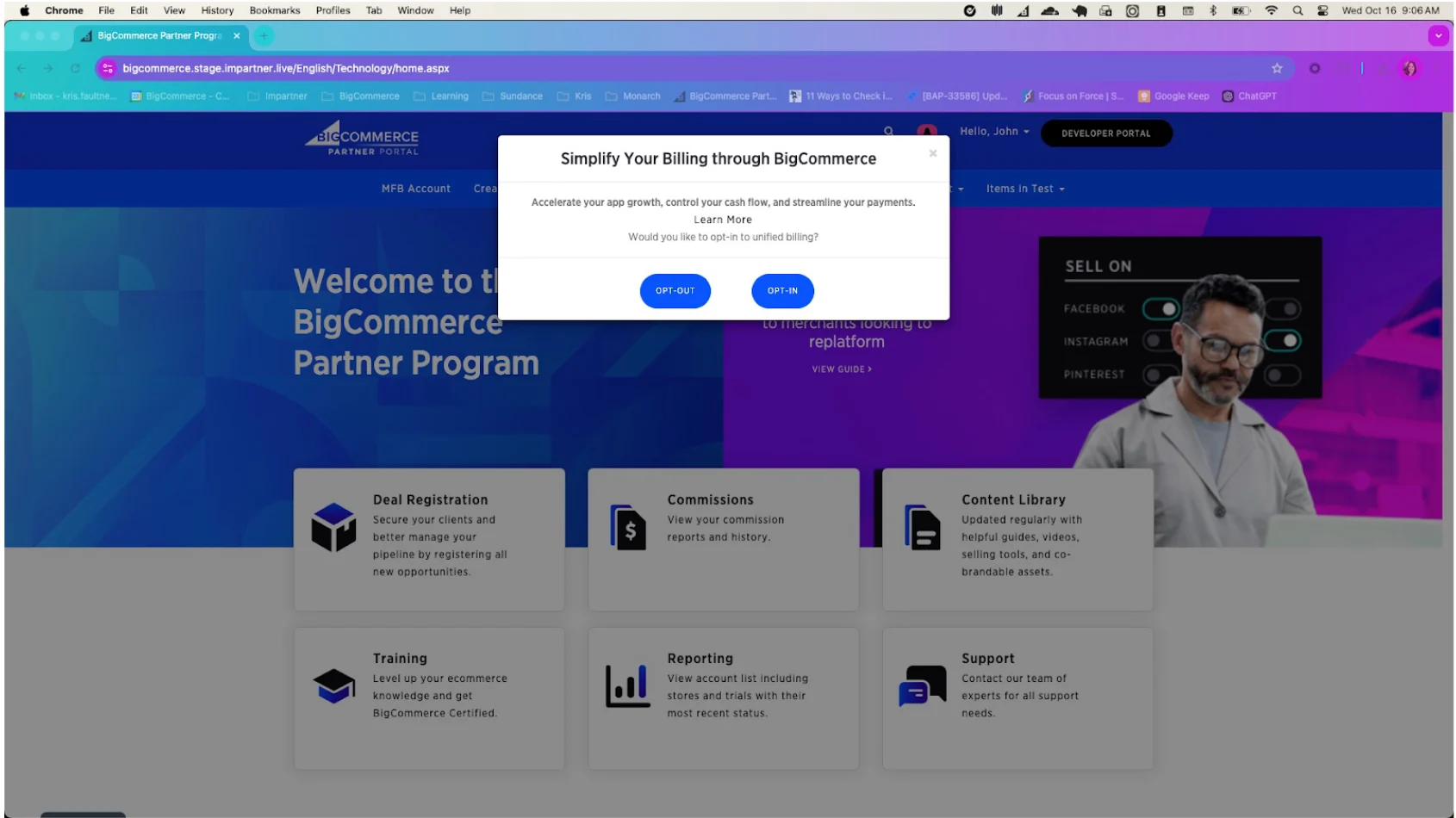
1. When logging into your BigCommerce partner account, a popup will appear offering the option to Learn More, Opt-In, or Opt-Out of Unified Billing. Click "Learn More" to review additional information.
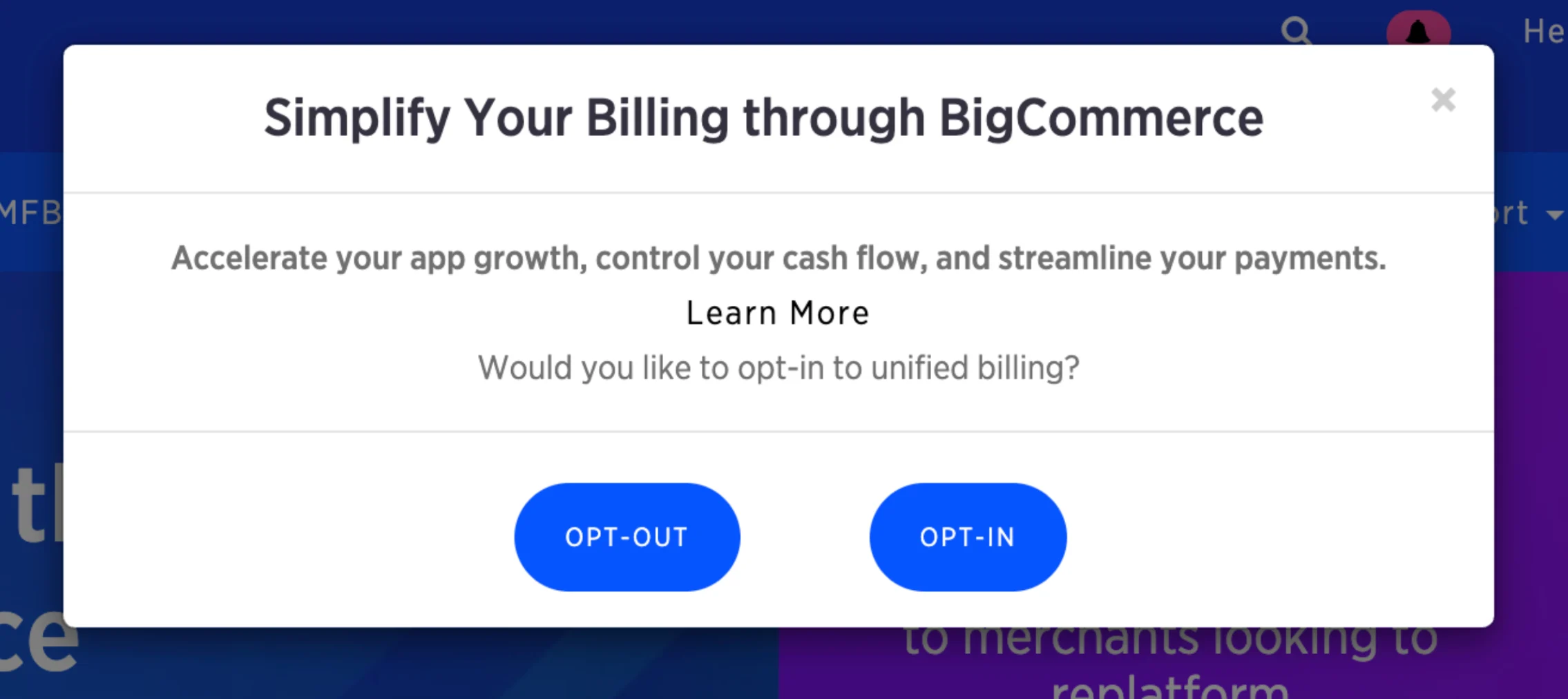
2. After reviewing the information, click "Opt-In." This will lead you to a form to fill out with your App Info. From there, our teams will do a quick review to ensure your compatibility with Unified Billing, and alert you via email when you've been enabled.
3. Once enabled, you'll be sent a Powerform by our team.Fill out the Powerform document, download it, and implement.
If you’re an app developer looking to connect a partner’s app to Unified Billing:
First things first! To implement Unified Billing, you need:
The GraphQL API
A partner portal account for reconciling charges with your other systems.
1. Once you have a partner portal account, you're able to start integrating the Unified Billing API with your app.
2. Once you've integrating the API with your app, you'll submit your application for review.
3. Our Marketplace Ops team will review and test your app and its Unified Billing feature. Upon a successful review, your app will be published and become usable!
4. From here, you'll receive payout in USD from BigCommerce each month via PayPal, ACH, or wire transfer.
And that's it!
What is supported with Unified Billing?
Billing models supported | Tiered Pricing Model | Freemium Model | Flat-rate Model |
Description | You offer your customers a selection of different plan levels or “tiers,” each with a set of features and a corresponding price. The base tier typically includes the must-haves, with each higher tier including more features at a higher price. | You offer your customers basic services at no cost and a premium for advanced features.
| Your customers pay a single, fixed fee for a service. |
Examples | Plan A for $30/mo* Plan B for $50/mo* Plan C for $100/mo* | Plan A for $0/mo* Plan B for $30/mo* | Plan A: $30/mo* |
Available billing frequencies | One-time charge: Pay a one-time fee to have full access to the app. Monthly: Pay a fixed amount on a recurring monthly basis. Annually: Pay a fixed amount on a recurring annual basis. Semiannually: Pay a fixed amount on a recurring semiannual basis (every 6 months). Quarterly: Pay a fixed amount on a recurring quarterly basis (every 3 months) | One-time charge: Pay a one-time fee to have full access to the app. Monthly: Pay a fixed amount on a recurring monthly basis. Annually: Pay a fixed amount on a recurring annual basis. Semiannually: Pay a fixed amount on a recurring semiannual basis (every 6 months). Quarterly: Pay a fixed amount on a recurring quarterly basis (every 3 months) | One-time charge: Pay a one-time fee to have full access to the app. Monthly: Pay a fixed amount on a recurring monthly basis. Annually: Pay a fixed amount on a recurring annual basis. Semiannually: Pay a fixed amount on a recurring semiannual basis (every 6 months). Quarterly: Pay a fixed amount on a recurring quarterly basis (every 3 months) |
Can I offer a trial period? | Yes | Yes | Yes |
Plan adjustments | Cancellations - Customer can cancel their app subscription (app developer would call the API to cancel the subscription)
Updates - Customer can choose to upgrade/downgrade their app plan (app developer would call the API to change the price and/or billing frequency of the app subscription). Requires the customer to go back through the checkout flow. | Cancellations - Customer can cancel their app subscription (app developer would call the API to cancel the subscription)
Updates - Customer can choose to upgrade/downgrade their app plan (app developer would call the API to change the price and/or billing frequency of the app subscription). Requires the customer to go back through the checkout flow. | Cancellations - Customer can cancel their app subscription (app developer would call the API to cancel the subscription)
Updates - Customer can choose to upgrade/downgrade their app plan (app developer would call the API to change the price and/or billing frequency of the app subscription). Requires the customer to go back through the checkout flow. |
Additional Callouts
Unified Billing is available to app developers based in the United States, Canada, United Kingdom or India.
Any of the models can support the ability to offer a trial period before the one-time or recurring charge starts.
* These figures are examples only and do not reflect any actual app plan prices. The plan prices are up to the app developer to decide.
The app developer can query the API to get:
A list of subscriptions by one or many IDs
All subscriptions associated with a given application
All subscriptions that are of a given status (active, canceled, etc).
All subscriptions updated at or since a given time period (e.g. in the last 24 hrs what changes occurred?)
Any combination of the above
Getting Started
If you're building apps for BigCommerce or already have one in the marketplace, consider opting into Unified Billing to enhance your app's growth and streamline your operations.
Additional Resources
If you have questions or concerns, please feel free to email unifiedbilling@bigcommerce.com or speak directly to your partner manager.
Build more than code. Build connections.
From edge cases to workarounds, learn from developers solving things in real time.