




Written by
Mandy Spivey
Industrial Ecommerce
Get The Print Version
Tired of scrolling? Download a PDF version for easier offline reading and sharing with coworkers.
A link to download the PDF will arrive in your inbox shortly.
Key highlights
Industrial ecommerce drives measurable growth, with digital channels projected to account for more than half of B2B revenue in the coming years.
Modern B2B buyers expect B2C-like experiences, including self-service purchasing, transparent pricing, and mobile-first design.
Data-driven operations improve pricing, inventory management, marketing ROI, and supply chain performance.
AI, automation, and ERP integrations streamline complex industrial sales cycles and reduce operational costs.
Scalable, secure ecommerce platforms support large catalogs, custom pricing, headless builds, and omnichannel expansion.
Industrial companies may sell products that feel highly technical or niche, but their economic impact is anything but small.
Manufacturing and wholesale ecommerce sales accounts for trillions of dollars in the U.S. each year, and B2B transactions across supply chains amplify that impact even further. In 2024 alone, around 12% of B2B sales in the U.S. were done digitally, and that figure will continue to grow to 14.3% in 2028.
In 2025, BigCommerce partnered with Channel Marketing Group to survey 345 buyers of electrical, HVAC, and industrial supply products, combining this research to build on a 2018 Channel Marketing Group study that benchmarked early digital adoption among industrial B2B buyers.
What we found was that 62% of buyers purchased online in 2025 — up from just 45% in 2018.
Looking at the number of industrial ecommerce shoppers, 62.3% of buyers purchase electrical, HVAC, or industrial supply products online, representing 30% of total purchases — a staggering 702% increase since 2018.
At the same time, the way industrial buyers research and purchase products has fundamentally changed. Digital channels now influence the majority of the B2B buying process, and buyers expect the same seamless, intuitive experiences they encounter in B2C ecommerce. Long sales cycles, complex pricing structures, and detailed product specifications no longer justify clunky digital experiences.
To compete, industrial manufacturers and distributors must invest in ecommerce strategies that combine self-service functionality, real-time data, mobile optimization, and secure infrastructure.
This guide explores the best practices, emerging technologies, and real-world examples shaping the future of industrial ecommerce.
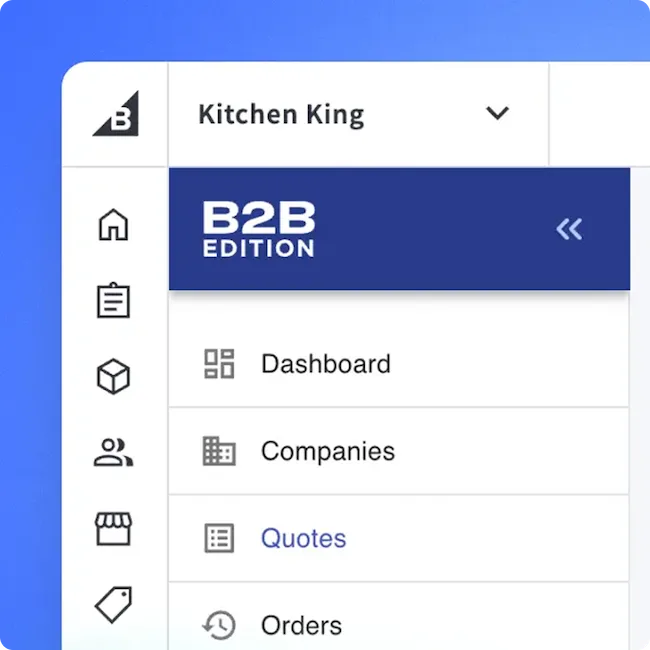
We're serious about B2B.
BigCommerce B2B Edition gives you account management and quoting tools to help your sales team get more orders.
The industrial sector is investing in digital transformation
While adoption rates may have lagged behind retail and consumer goods companies, industrial ecommerce is a huge driver for growth and profitability. Digital acceleration in the industrial ecommerce space brings huge opportunities for businesses that step up to deliver personalized pricing, real-time inventory visibility, and simple online experiences.
But buyers expect fast, self-serve options through websites, apps, and even text. If those expectations aren’t met, they’ll likely turn to digital-first competitors like Amazon.
What’s driving them isn’t just technology; it’s convenience. Industrial ecommerce shoppers want to save time, avoid unnecessary trips, and place orders when and where it fits their schedule.
Research from BigCommerce’s 2025 Industrial Buyer Report further cements this fact — 65.8% of respondents in the B2B space say buying online is easy, and 60% reported it saves them time.
The bottom line: Ease of use, mobile access, and intuitive search are essential features for industrial ecommerce — not just extras.
As more of these digital channels become available for product discovery, the ecommerce stores that provide the best experience will set themselves up for more success (and more share of the market). It’s a fact: B2B industrial buyers now expect B2C-like customer experiences online, and configurable and forward-thinking B2B ecommerce platforms are uniquely suited to meet those expectations.
A well-designed B2B website is the best salesperson a company could ever want — it nurtures leads over a long sales cycle and provides complex technical information buyers want. When done right, an industrial ecommerce website lets the buyer make an informed decision without ever talking to a sales rep.
Industrial ecommerce best practices to follow
Industrial companies are embracing digital transformation in a major way, with generational expectations playing a big role in this evolution. There’s no better example than millennial B2B industrial buyers, a segment that doesn’t just want a touchless experience through the purchase process — they demand it.
Here are some ways to appeal to these online natives.
Frictionless customer experience.
Industrial ecommerce companies can personalize the customer journey by researching the client’s industry, procurement process, and unique needs.
Meeting customer needs includes providing personalized product recommendations, detailed product information, and ongoing content to educate customers about the product is essential to any B2B transaction.
Transparent pricing and custom quote generation build trust by ensuring customers only pay for what they need.
Robust security and fraud prevention.
B2B companies deal with sensitive information like financial data, intellectual property, and confidential information belonging to other businesses. Additionally, the average order value for a B2B transaction is much higher than B2C, making B2B businesses an attractive target for wire fraud.
Fraud prevention measures, such as two-factor authentication, transaction monitoring, and anti-phishing measures can prevent cyberattacks.
Omnichannel presence.
An omnichannel presence means meeting customers’ needs in their preferred digital channel and providing a unified customer experience across all of them. For industrial ecommerce businesses, this means providing a seamless customer experience through their website, social media, email, and increasingly AI-driven conversational shopping and agentic checkout in their favorite LLM app.
A presence in offline channels, such as tradeshows or brick-and-mortar stores, can further customer relationships with additional touchpoints.
An omnichannel presence also requires flawless data integration between channels — meaning your CRM system is connected to your ecommerce website, social media, inventory management software, and other systems to monitor real-time updates across channels.
Social commerce.
Establishing a social media presence creates opportunities for social commerce. Here are some ways sellers of industrial goods and services can use social media to drive sales:
Showcase products: Social media platforms like Instagram or TikTok let brands set up storefronts to showcase products, including product information and pricing.
Build relationships: B2B businesses often use professional social networking sites like LinkedIn to identify decision-makers at target companies, build relationships, and schedule sales calls with new customers.
Provide customer support: Customer satisfaction scores go up when businesses provide live support or chatbots and schedule appointments through messaging services on social media platforms.
Advertising: Social media ads enable businesses to target audiences based on demographics and interests and tap new markets
Build brand awareness: Posting on social media builds brand awareness and increases website traffic, leading to conversions.
Integrated ERP solutions.
ERP solutions provide a central database for all business intelligence, delivering real-time updates on sales trends, customer behavior, and inventory turnover. This data empowers businesses to identify inefficiencies, reduce costs, and improve business processes.
To reach its full potential, an ERP solution must be fully integrated within the organization’s technology stack, including email marketing software, accounting software, a CRM system, and other software systems.
Data-driven decision-making.
Data-driven decisions are grounded in truth rather than intuition and help businesses optimize their operations and profitability. Here are some examples of data-driven decisions businesses can make:
Pricing: By analyzing data on total sales volume, customer behavior, and market trends, ecommerce companies can make informed pricing decisions. For example, they may adjust prices to optimize profitability, offer discounts to encourage digital sales, or adjust prices to match competitors.
Inventory management: Businesses can avoid stockouts or overstocks, reduce inventory carrying costs, and prioritize certain products based on customer demand using data on inventory levels, lead times, and sales volume.
Marketing: Data insights enable businesses to focus their marketing budget on channels generating the highest ROI and A/B test different strategies.
Supply chain: Data on lead times, delivery times, and supplier performance lets businesses choose suppliers based on performance metrics and optimize delivery routes to reduce shipping costs.
Customer service: Customer behavioral data reveals website activity, purchasing habits, and key metrics like customer lifetime value. This shows businesses where they can improve the customer experience and reward loyal customers.
Streamlined supply chain management.
A centralized inventory management system lets businesses track inventory levels, orders, and deliveries from a single platform. This provides insight into supplier performance and the order fulfillment process. Here are some ways industrial ecommerce businesses can streamline supply chain management:
Real-time tracking: RFID tags and barcodes enable businesses to track inventory and shipments in real-time, improving visibility across the supply chain.
Work with reliable suppliers: Industrial ecommerce businesses can monitor data on supplier performance to prioritize suppliers and distributors with a proven track record of delivering high-quality products on time.
Optimize logistics and transportation: Real-time logistics data lets businesses choose the most cost-effective delivery routes and shipping partners.
Automated order processing: Order processing tools track inventory levels, process payments, and track order delivery, reducing the chances of error.
The future of industrial ecommerce
The industrial sector is increasingly investing in digital transformation to remain competitive, improve operational efficiency, and adapt to rapidly changing market conditions. Here's a breakdown of how they are investing in this transformation.
Increasing adoption of mobile.
Mobile devices are an important touchpoint in B2B transactions, putting the power of ecommerce right in the hands of customers. As more B2B product research happens on mobile devices, having a mobile-friendly digital storefront is no longer a luxury — it's a necessity.
B2B buyers typically engage with around 10 sales channels when researching ecommerce for industrial products or service providers, with a notable trend toward channels centered around mobile platforms. Industrial businesses that fine-tune their ecommerce platforms for mobile-savvy buyers are tapping into a vast market of professionals seeking solutions at their fingertips.
Whether you’re selling industrial equipment, manufactured parts through a distributor network, or dropshipping products worldwide, your customers expect seamless experiences on their phones and tablets.
In addition to building a responsive website, B2B ecommerce brands could offer a companion mobile app where users can make purchases, contact customer support, and receive push notifications for order tracking and personalized recommendations.
AI and industrial ecommerce.
AI provides new opportunities for industrial commerce companies to streamline operations, automate processes, tailor customer journeys, and implement personalization at scale. New features like agentic checkout let customers shop and purchase goods, right in their favorite LLM app.
Here are some use cases:
Personalized product recommendations: AI-powered recommendation engines provide personalized recommendations based on customers’ browsing and purchase history.
Chatbots: Chatbots provide customer support by answering FAQs, resolving issues, and collecting information before handing the customer off to a live agent.
Predictive maintenance: AI algorithms analyze data from sensors to predict when industrial equipment needs maintenance. This reduces the risk of unplanned downtime and stockouts.
Inventory management: Inventory management software analyzes ecommerce sales data to predict demand and optimize inventory levels.
Supply chain optimization: AI algorithms analyze data on shipping times, delivery routes, and carrier performance to reduce costs and improve the customer experience.
Rise of subscription-based models.
Subscription-based business models compel companies to build lasting relationships with customers to generate recurring revenue through repeat purchases and reorders. While the average order value is lower, subscription models create opportunities for higher average customer lifetime value. Predictable demand from a subscription business can help streamline inventory management.
Sustainable supply chain sourcing.
Ecommerce customers increasingly prefer to partner with companies that minimize environmental impact, which extends into ecommerce for industrial products. This means optimizing delivery routes to reduce carbon footprint, eliminating unnecessary packaging, and ensuring manufacturing plants and other physical facilities adhere to green building codes.
Headless commerce.
Headless commerce is an ecommerce architecture that separates the front-end user interface from the back-end ecommerce platform, allowing for greater customization and performance across multiple touchpoints. Headless commerce has several advantages for industrial commerce businesses:
Business continuity: Companies can quickly deploy new front-end experiences without disrupting the backend (i.e., no downtime).
Personalization: The front end can be customized to deliver relevant content based on individual customer data.
Better user experience: Build seamless user experiences across different devices and touchpoints including desktop, mobile, and smart devices.
Easier integration: Integrate other software systems for a unified view of customer data.
Get a clear view of your B2B digital maturity.
Learn key areas for improvement and actionable insights to help your business grow faster and smarter.
Examples of industrial ecommerce websites
Industrial ecommerce companies supply businesses across various industries with products used for equipment maintenance or manufacturing. The best industrial websites strive to build relationships with customers and provide them with up-to-date information about products.
It’s easy to recognize exceptional websites by the way they integrate customer reviews, digital marketing automation, on-site search, appointment management, and more. Page speed is also prioritized since so many prospects and customers first visit a web page using a mobile device.
Below are a few examples of exceptional industrial ecommerce sites that we love:
Tradelink.
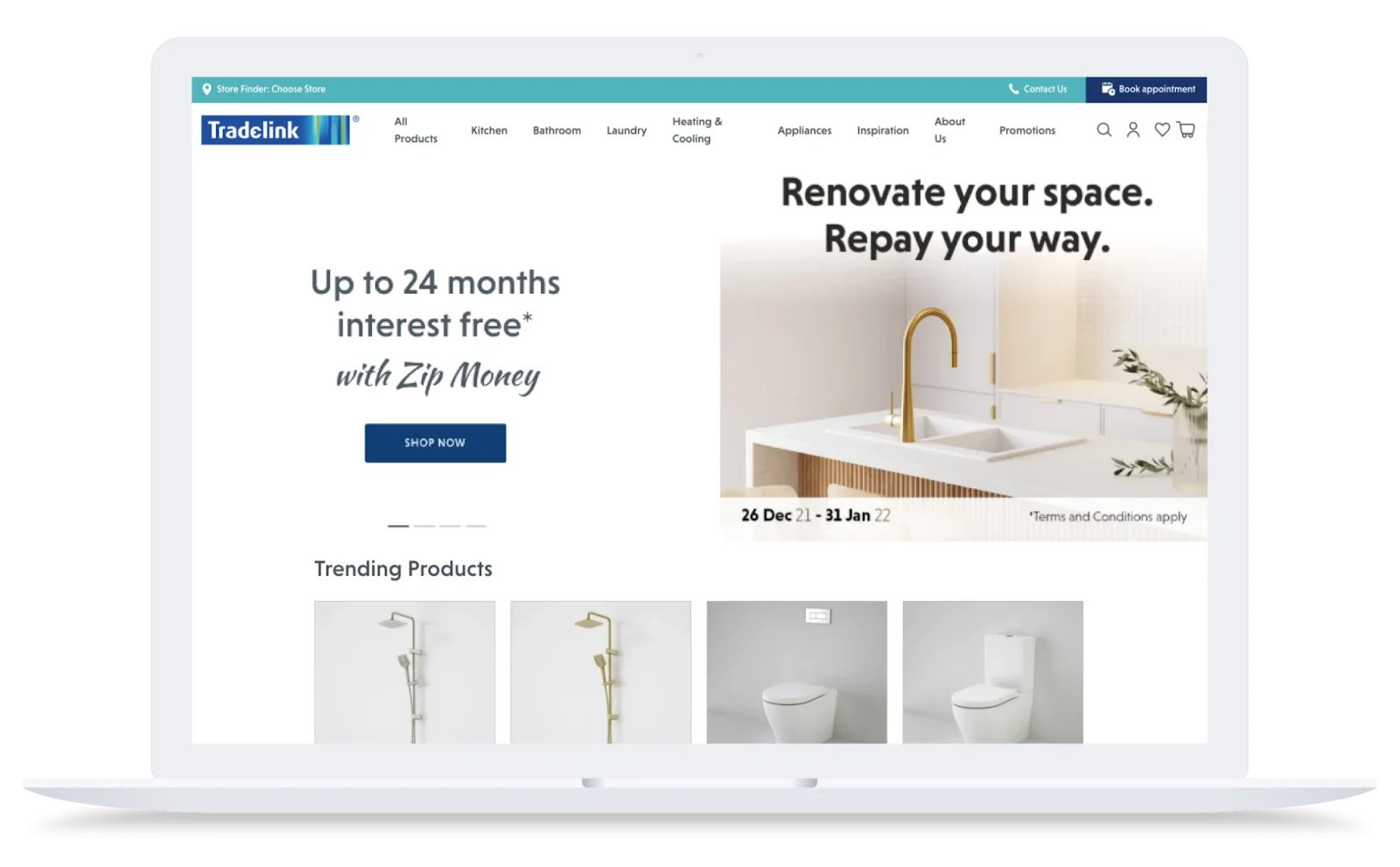
Australia’s oldest plumbing merchant, Tradelink produces plumbing products and appliances for bathrooms, kitchens, laundry rooms, and more. With an estimated 15,000+ live products available, it’s essential to create a site that lets customers filter and find the products they’re looking for — quickly and easily. Tradelink’s site includes a virtual showroom allowing customers to connect directly with a consultant.
Heat Transfer Warehouse.

Case Study: Heat Transfer Warehouse
Since opening its doors in 2010, Heat Transfer Warehouse has established a strong B2B and B2C presence. More recently, they’ve tapped into the DTC sector through their acquisition of Shirts From Fargo, a custom t-shirt and embroidery company. Their foothold in these three areas has allowed them to have full-circle involvement in the world of custom product decoration.
USCutter.
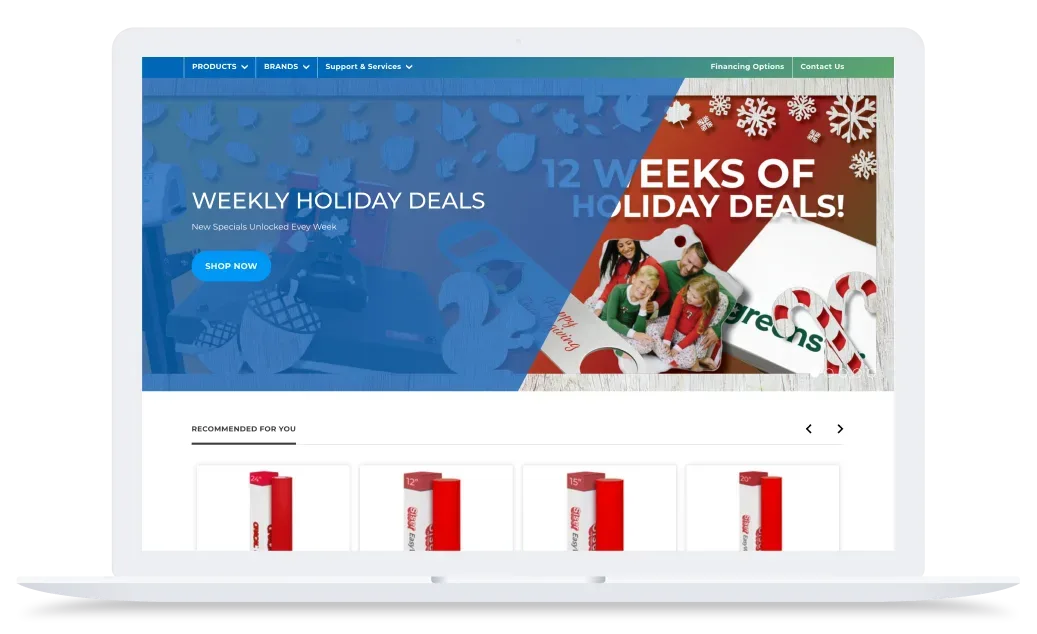
Known for its vinyl-cutting products, USCutter is a maker of vinyl products, digital printers, flatbed cutters, and other goods. The website offers educational content, including case studies, video tutorials on product use, news articles, and even a forum for customers to ask questions.
Ballard Industrial.
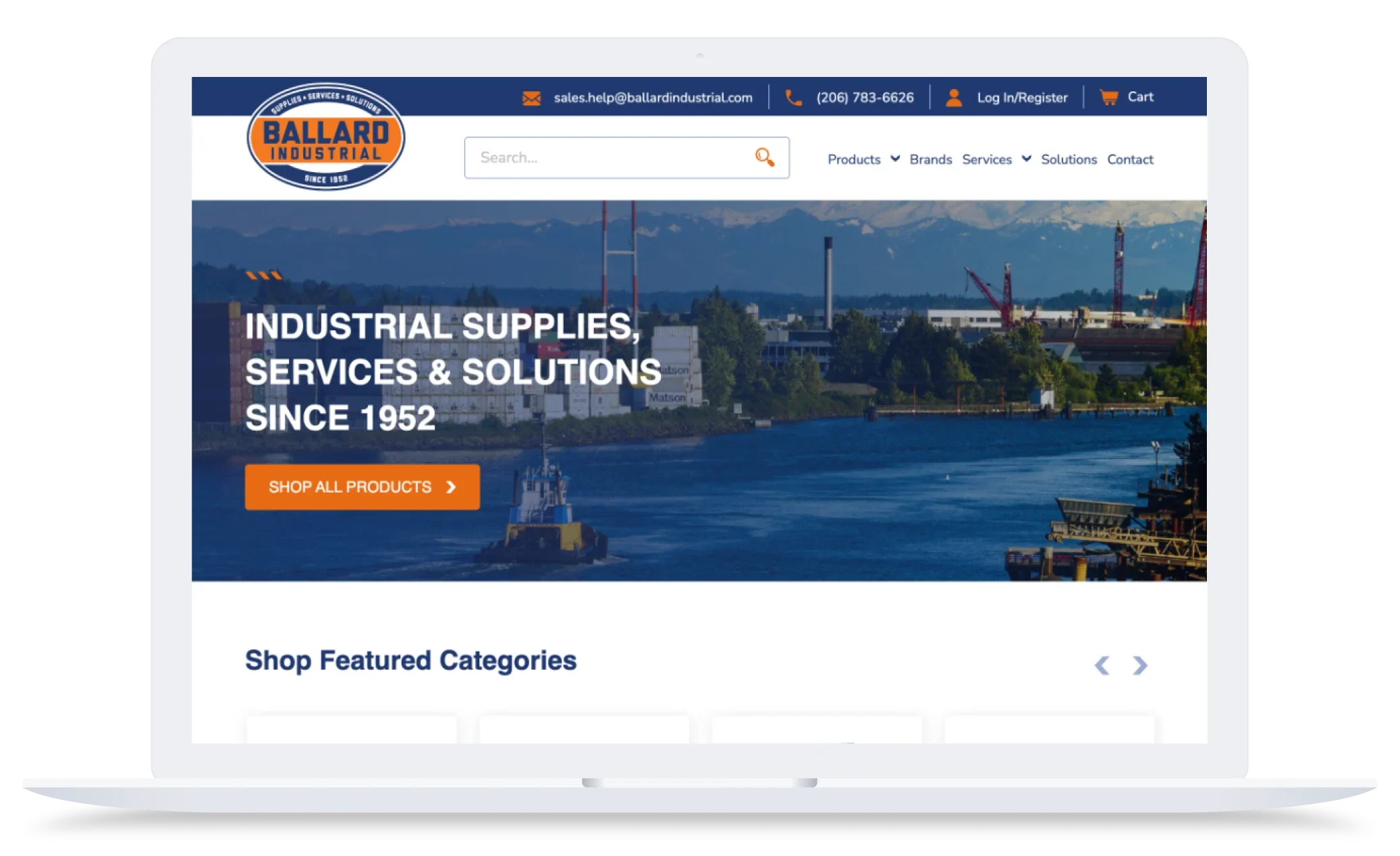
Case Study: Ballard Industrial
Ballard Industrial works to supply tangible solutions for its B2B and DTC audiences, expanding into a 45,000-square-foot warehouse, serving marine, manufacturing, and industrial customers across the country. Driven by “a deliberate intention to resolve and respond to our customer's problems,” Ballard Industrial knew it needed an ecommerce platform that would do the same for them.
TYGRIS.
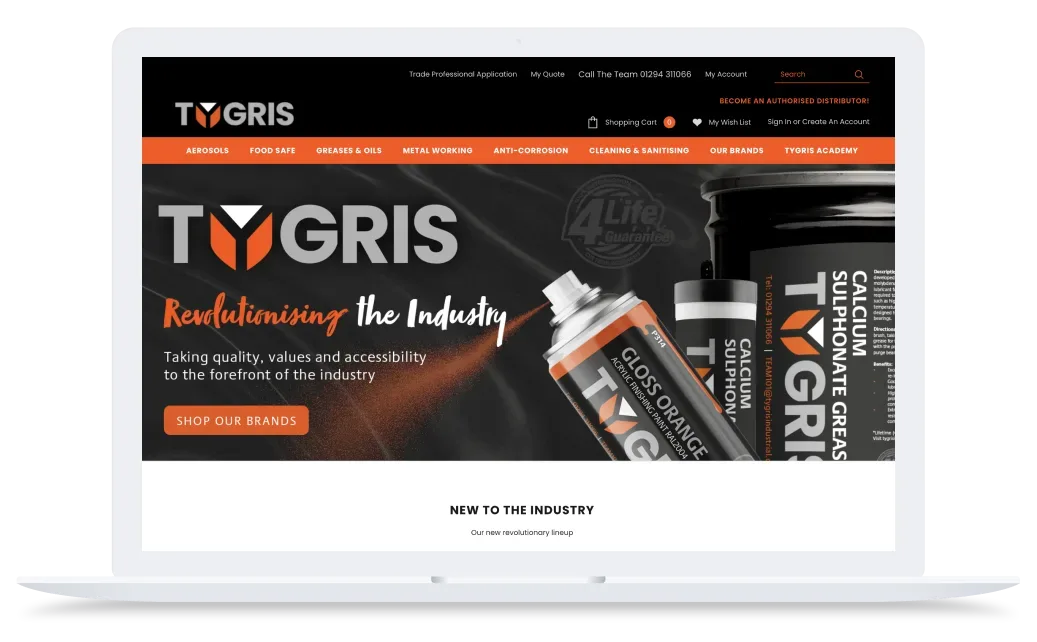
Tygris makes anti-corrosion products designed to withstand hostile environments and improve the performance of metal components. A quick order pad allows buyers to search for products by their codes and a price quotation system. The purchase order feature enables better control and tracking of order details. In addition, customers can request custom quotes online and learn more about product usage through Tygris Academy.
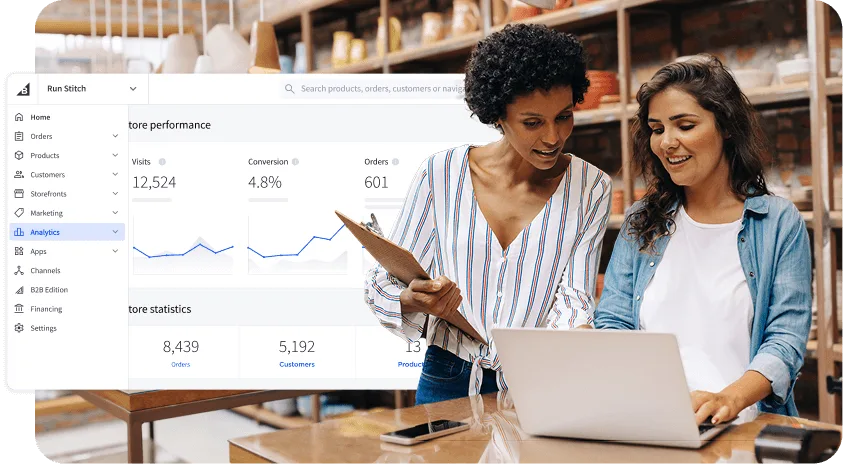
Find your favorite features.
Explore all of the capabilities of the BigCommerce platform.
How BigCommerce helps industrial companies
Industrial ecommerce businesses need robust, highly customizable ecommerce solutions that grow with them. Designed for scalability, the BigCommerce platform can handle large product catalogs, high traffic volume, and complex integrations.
As a composable ecommerce platform, BigCommerce provides a range of customization options, including modular storefronts, customizable checkout, and integrations with popular third-party tools.
BigCommerce supports various sales channels, including online marketplaces, social media platforms, and point-of-sale (POS) systems, allowing businesses to reach customers wherever they are. Additionally, BigCommerce is PCI DSS-compliant and includes advanced security features such as fraud detection and prevention, two-factor authentication, and SSL encryption.
With best-in-breed analytics and reporting, businesses can track their performance and make data-driven decisions.
Industry-leading B2B ecommerce capabilities.
Our robust platform is tailored to meet the unique needs of B2B sellers and buyers, offering a comprehensive suite of features to drive online success. Here are some of the best-in-class capabilities that make it possible:
Create a beautiful site.
The days of boring static brochure websites are long gone. Industrial websites have merged the visual appeal of B2C sites with state-of-the-art functionality that sophisticated B2B buyers demand. The beauty of using BigCommerce is that your new and improved storefront is just a drag-and-drop away.
Offer a seamless checkout experience.
In the complex world of B2B industrial ecommerce, customers crave a seamless checkout experience. The customer journey should be easy. Better yet, it should feel easy. That visitor conversion rate — the journey from site visit to order — is what BigCommerce is thriving in, according to Incisiv.
Integrate to back-end systems.
While frontends serve as an ecommerce store’s front porch, it’s the backend that serves as the foundation that keeps the whole site working. A strong ecommerce backend can save resources, reduce costs, and avoid costly downtime.
Flexible payment options.
Making it easy for customers to pay you means fewer items left in shopping carts. A best-in-class payment solution that accepts a variety of payment methods means more completed sales. Stripe, for example, is a great way to accept payments online and one of the easiest payment gateways to set up with BigCommerce.
But there are more payment methods available to B2B ecommerce customers, starting with:
Traditional trade credit.
Traditional trade credit refers to a firm extending credit terms to its buyers. This payment method is often, but not always, managed by a third party.
It is essentially the B2B version of a "buy now, pay later" arrangement, where an ecommerce supplier allows a customer to buy goods or services, but defer payment for 30, 60, or 90 days (these are usually referred to as Net 30, Net 60, and Net 90). It functions as a short-term, interest-free financing tool that improves buyer cash flow, builds supplier loyalty, and increases order values.
Purchase order.
One of the most common ways to pay in B2B, a purchase order (or PO) is an official document issued by a buyer to pay a supplier for products or services.
It’s also a legally binding document that outlines the specific goods or services to be bought, quantities, agreed prices, payment terms, and delivery schedules. It serves as an official offer to buy, preventing disputes, controlling spending, and tracking inventory.
Paper checks.
This is an actual, physical check sent to the seller, who then must endorse it and deposit it at a bank (or through mobile banking apps that also allow electronic deposits).
Cash on delivery.
Of course, there is always cash on delivery, or COD, where the seller places an order and pays in cash for it when the order is delivered.
Credit card.
Payments via credit card are when a buyer charges the order and then decides how/when they’ll pay back their financial institution. Different payment processors built with credit cards in mind make this payment method one of the most favorable for industrial ecommerce sellers today. BigCommerce offers a growing number of payment processors that our platform works with, enabling safe and secure transactions without needing to deal with manual paperwork or checks.
Digital payment platforms.
This is when a buyer stores their bank account or credit card information on a digital platform or in a digital wallet, allowing them to choose the payment account when placing an order. Digital payment platforms include companies like PayPal and Venmo.
Bank-to-bank wire transfers.
An increasingly popular option for businesses, bank-to-bank wire transfers include both ACH (Automated Clearing House) and EFT (electronic fund transfer). EFTs are the electronic transfer of funds from one account to another, whereas ACH transfers are utilized by banks and fintech institutions to process transactions in batches.
Industry-leading performance and security.
Security is vitally important, especially if you’re storing customer data. You should aim to meet the highest ecommerce standards by providing regular updates to performance, security and design, keeping your site refreshed and in a constant state of improvement.
BigCommerce has delivered 100% uptime during every cyber week since 2016 and 99.98%+ since 2009. In addition to industry-leading site performance, earning the prestigious PCI DSS 4.1 Level 1 Attestation of Compliance, ISO/IEC 27001:2022, ISO/IEC 27701:2019, ISO 22301:2019, ISO/IEC 27017:2015, ISO/IEC 27018:2019 is another accolade we’re proud to share.
The final word
Industrial ecommerce has entered a new phase of maturity. Buyers expect fast, intuitive digital experiences backed by accurate product data, transparent pricing, and self-service functionality. Manufacturers and distributors that deliver on these expectations earn trust earlier in the buying journey and shorten complex sales cycles.
To stay competitive, industrial businesses must align their ecommerce strategy with modern buyer behavior. That means investing in omnichannel engagement, integrating backend systems for real-time visibility, optimizing for mobile, and using data to guide pricing, inventory, and marketing decisions.
Personalization, automation, and AI in ecommerce further strengthen performance by improving operational efficiency and customer satisfaction at scale.
Industrial products are often complex, customizable and tied to multi-stakeholder procurement processes. A modern ecommerce foundation supports that complexity while making it easier for buyers to research, configure, and purchase on their own terms.
Companies that treat ecommerce as a core growth engine (and not just a side channel) position themselves for long-term resilience in an increasingly digital B2B economy.
Request a demo with our team today to see what you could be improving on your site.
FAQs about industrial ecommerce
Industrial ecommerce typically involves the sale of goods used in industrial applications such as manufacturing, construction, and maintenance. Examples of industrial products include:
Industrial machinery and equipment: From heavy equipment like bulldozers and cranes to specialized machinery like milling machines.
Supplies and components: Items like bearings, belts, fasteners, motors, and pumps as well as raw materials like metals, plastics, and chemicals.
Personal protective equipment (PPE): Hard hats, safety glasses, and masks to specialized equipment like fall protection gear.
Electrical components: Circuit breakers, transformers, and sensors or specialized components.
Maintenance, repair and operations (MRO) products: Products used for maintenance and repair activities including lubricants, adhesives, cleaning products, and general office supplies.
An effective industrial ecommerce platform should have a range of features for managing online sales, including:
Product catalog management: Product catalogs are a central repository for updating and maintaining product information across digital channels.
Order management: Order processing and fulfillment to shipment tracking and returns management.
Pricing: Custom quote generation, dynamic pricing, volume discounts, and contract pricing.
Inventory management: Track inventory levels and manage stock efficiently.
Integrations: API integrations enable different systems and applications to exchange data, such as your payment gateway and accounting software.
Security: A digital commerce platform should include security features such as SSL encryption, fraud detection, and PCI compliance.
Analytics and reporting: Analytics and reporting tools to monitor KPIs and identify areas for improvement.
Industrial ecommerce businesses must safeguard their systems from payment fraud, data breaches, and malware — including phishing attacks and distributed denial-of-service (DDoS) attacks.
Cybercriminals often attempt to impersonate a legitimate business by spoofing their phone number, email address, or website. Ecommerce businesses must warn their customers about such attacks.
And since industrial ecommerce businesses often rely on complex supply chains, any vulnerabilities within supply chains pose a security risk. It’s crucial to stay vigilant to these threats and use the tools available to stop them before they happen.
Industrial companies can optimize ecommerce sites for technical discovery by implementing more structured data, faceted search for specifications (e.g., material, voltage, dimensions), and AI-driven, semantic search that understands tokenized terminology and even misspellings.
A few more strategies to help you optimize your site for technical product discovery:
Structured technical data: Utilize structured schema (such as product data, reviews, and FAQ) to ensure AI models can index detailed technical specifications accurately.
Advanced faceted search: Use granular filters that allow shoppers to narrow down results by precise technical attributes (including things like pressure ratings, thread sizes, and product material).
Semantic search and NLP: Use AI-first, Natural Language Processing (NLP) engines that understand the context of queries, like searching by model numbers or tailored technical jargon.
Synonym and technical mapping: Set up search to recognize industry abbreviations, technical acronyms, and manufacturer part numbers, ensuring "5mm" matches "5 mm" or "5 millimeter".
Visual and contextual discovery: Enable visual search for parts recognition and offer application-based navigation (such as "solutions for automotive") rather than just product type.
An industrial ecommerce platform for high-volume or repeat orders should feature bulk ordering (CSV/SKU entry), one-click reordering, and saved order templates. Key functionalities also include custom, contract-based, or tiered pricing, real-time inventory management, complex approval workflows, and tight ERP/WMS integration for automated order processing.
We're serious about B2B.
BigCommerce B2B Edition gives you account management and quoting tools to help your sales team get more orders.