Start & build


Launch Services
Overview
Chart your path to success with specialized services.Implementation Project Management
Experts to ensure you launch on time and under budget.Solution Architecture
Seasoned advisors to help you best design your store.Data Migration & Optimization
Expertise on a clean and clear path to migrating your data.Enterprise Launch Package
Personal training on how to set up and launch your BigCommerce Store.

Professional Services Blog Series
Get to know our teams and how they support your success in this Q&A series.


Payments as a Growth Lever: Key Insights from Commerce Live 2026

Create your store and start selling today.
Create your new website.
See if the BigCommerce platform is a good fit for your business.
No credit card required.

Written by
Anita J. Temple05/15/2026
Payments as a Growth Lever: Key Insights from Commerce Live 2026
Get The Print Version
Tired of scrolling? Download a PDF version for easier offline reading and sharing with coworkers.
A link to download the PDF will arrive in your inbox shortly.
At Commerce Live 2026, three sessions were dedicated entirely to payments. Not to checkout UI or payment method logos. but to payments as a strategic business driver. The conversations that unfolded, with leaders from Adyen, PayPal, and Commerce, converged on a single idea: payments are no longer just infrastructure. They are a lever for revenue, reach, and customer experience — and the brands who treat them that way are pulling ahead.
Here's what attendees heard.
Stop losing money you don't know you're losing
For most brands, payments feel like a solved problem. They chose a provider, got it integrated and it works. But Dheeraj Sareen, Head of Technology Partnerships at Adyen, made a compelling case that "working" and "optimized" are very different things — and the gap between them is costing real money.
“Are we actually looking at the interchange fee? Are we only looking at the processing fee? Is the scheme fee something we're getting marked up on? Many folks don't see that it's hidden.”
— Dheeraj Sareen, Head of Technology Partnerships, Adyen
Here's the reality: interchange and scheme fees account for 70% to 90% of what a merchant pays per transaction — not the processing fees most finance teams focus on. And most brands have no visibility into them.
The fix starts with a simple audit. Many brands set up their payment integration years ago and never revisited it. Passing incomplete MCC data or stale fields means you're not capturing the savings you're already entitled to. Authorization rates are another quiet revenue leak. A few percentage points of improvement can move the bottom line meaningfully at any scale. And for subscription brands, network tokenization is the often-overlooked solution to involuntary churn caused by expired or reissued cards.
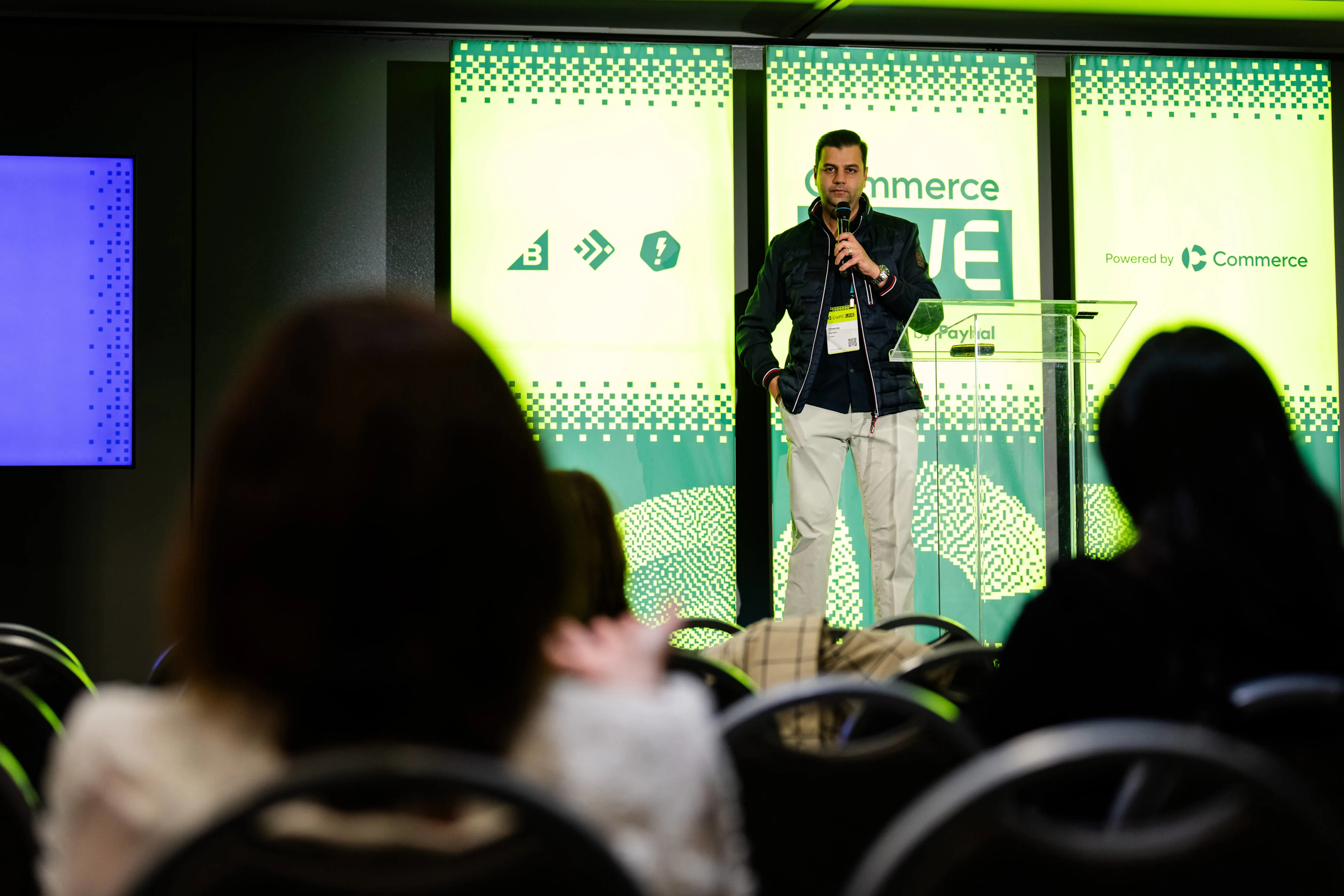
Dheeraj Sareen, Head of Technology Partnerships, Adyen on stage at Commerce Live 2026
For brands expanding internationally, local acquiring (processing transactions through a bank licensed in the same country as the customer) delivers significantly better interchange rates than cross-border processing. It's a lever that often gets treated as a technical detail when it should be a strategic decision.
The bottom line, as Sareen put it: "It's not just about saving money. It's about your own business. Payments is either getting expensive or you're not seeing where the hidden costs are. Why is that happening?"
Friction is a tax. Remove it.
Checkout friction is a self-imposed revenue drag. Jordan Sim, VP of Product Management at Commerce, proved it with data: after BigCommerce reduced checkout load time by one full second (a 37% improvement) in January 2026, early customer data showed approximately a 1% conversion uplift as a result.
“Sometimes a single second difference is the difference between a sale and an abandoned cart. And the best part? Our customers didn't need to do a single thing.”
— Jordan Sim, VP of Product Management, Commerce
That's the power of platform-level improvements: they compound quietly in the background. But brands can't rely on passive gains alone. Adyen's Sareen made the case for more dynamic, personalized checkout experiences, ones that recognize returning customers and immediately present their preferred payment methods, rather than presenting a static list and hoping for the best.
“You already know who they are, you already know why they're buying. If they're on your ecommerce website in a logged-in state, personalization at checkout is something you should be looking at.”
— Dheeraj Sareen, Head of Technology Partnerships, Adyen
For brands with international ambitions, expanding payment method availability is part of the same equation. Offering locally preferred methods doesn't just improve the customer experience. It reduces costs and improves conversion in markets where card-dominant checkout assumptions don't hold.
Reducing friction is a key benefit of BigCommerce Payments. Launched in March 2026, and currently available in the US (opening in the UK in Q3), it brings payment management directly into the control panel. BigCommerce customers are able to sign up using their existing PayPal business account or create a new one to access a full stack of payment methods — credit cards, PayPal, Venmo, Apple Pay, Google Pay, and Buy Now Pay Later — and manage balances and payouts without leaving BigCommerce.
“We launched BigCommerce Payments to alleviate the friction in moving between BigCommerce and your payment provider portal; it’s taking payments from bolted on to built in.”
— Michaela Weber, VP of Product Payments, Commerce
Trust is the new currency
If one theme connected every payments session at Commerce Live, it's trust. Not as an abstract concept, but as the literal prerequisite for a transaction to occur.
When Mike Edmonds, VP of Agentic for Commercial Growth at PayPal, sat down with Michaela Weber to discuss navigating the future of AI and payments, he set the tone for the conversation: "Commerce doesn't happen without a transaction. And PayPal's been around for 25/26 years. In the era of traditional ecommerce, we built trust by knowing your business and knowing your consumer and making sure both actors had a trusted relationship before a transaction could occur. That same paradigm applies in agentic commerce. We're just adding another actor: agents. So, now it's know your agent."
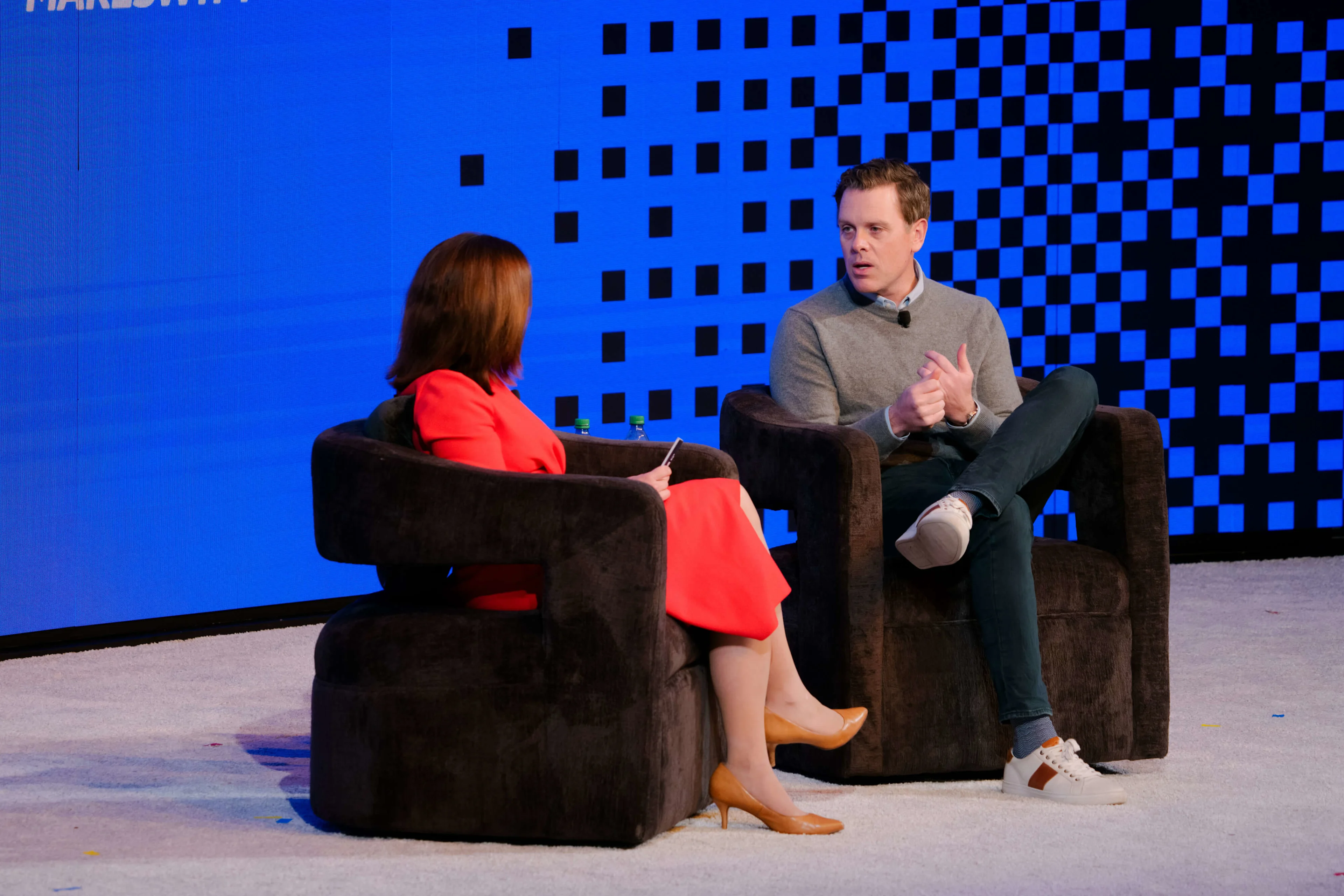
Michaela Weber, VP of Product Payments at Commerce and Mike Edmonds, VP of Agentic for Commercial Growth at PayPal
Edmonds broke down trust into two distinct challenges. The first is recommendation trust, which is basically whether a shopper believes that what an AI surface recommends is genuinely relevant, or subtly shaped by a business model they can't see. He cautioned that as LLMs explore advertising-supported models, the trust gap will only grow, explaining, "If there's any indication that the scale is being maneuvered without being transparent, trust is eroded.”
The second is transaction trust, which is whether a consumer can confidently hand payment details to an agentic surface, knowing they're protected from fraud and risk. This is where PayPal's infrastructure becomes directly relevant, and where Edmonds was most direct about the stakes for brands: fraud, identity, and chargebacks don't become less important in an agentic world. They become more important.
“As we shift from intent to delegation, those things don't go away. They actually become more important because that's an invisible layer now governing not only humans and businesses, but also agents.”
— Mike Edmonds, VP of Agentic for Commercial Growth, PayPal
Are you ready for more agents than humans?
Of all the themes at Commerce Live, none generated more energy (or more genuine uncertainty) than agentic commerce. Mike Edmonds opened with a statistic from Nvidia CEO Jensen Huang: within ten years, there will be more agents online than humans online. He then asked the room how many brands felt their infrastructure was ready for that world.
Almost no hands went up.
Edmonds offered a framework for thinking through what's actually coming. The current era we are in is intent. Shoppers ask AI engines for recommendations, then click to purchase. Humans are still in the loop, the button still exists. The next era, which Edmonds places 18 to 24 months out, is delegation. That’s when shoppers will equip agents with spending parameters and preferred payment methods, and the agents will complete purchases on their behalf.
“In agent-to-agent, the delegation world, the concept of the button isn’t even relevant. What you're doing is giving your agent spending controls, maybe access to your order history, maybe defaulting to your favorite wallet based on channel. When that checkout happens, you're not there to press it — the agent's doing it on your behalf.”
— Mike Edmonds, VP of Agentic for Commercial Growth, PayPal
The protocol landscape adds another layer of complexity: MCP, A2A, UCP, ACP with new standards emerging constantly, each with different requirements. Of course, building a custom integration for every new protocol isn't realistic for most brands. Both PayPal and Adyen framed their role as abstracting that complexity — sitting between brands and a fast-evolving standards landscape so they don't have to navigate it alone.
The brands who act now aren't just capturing early agentic revenue, though that's coming. They're building a learning advantage. As Edmonds put it: "If you have your catalog syndicated to these agentic channels and you're continuously enriching how your product shows up, your ability to test and learn and be in a better position than your competition is going to be exponential."
The ecosystem making it real
The most tangible signal that agentic commerce is no longer theoretical is the launch of PayPal StoreSync, a new app available today in the BigCommerce App Store.
The mechanics are straightforward. Once a BigCommerce customer installs the app, their product catalog becomes available to PayPal, which syndicates their products across the agentic surfaces it supports: Perplexity, Copilot, and Meta today, with Google via Universal Commerce Protocol on the near-term roadmap. A single integration replaces what would otherwise be a custom build for every new channel. And when a shopper completes a purchase inside one of those surfaces, the order routes directly back into BigCommerce. In short, discovery happens in the AI surface, fulfillment runs through the merchant's existing systems, and the customer relationship remains theirs.
But none of it works without clean product data. Edmonds stressed this point, explaining, “Discoverability in agentic surfaces depends entirely on whether a merchant's catalog is structured and enriched for the schemas AI agents are reading. That's where Feedonomics, Commerce's product data platform, becomes the foundation. It ensures merchant catalogs meet the schema requirements of every AI discovery surface, from Google's UCP to OpenAI's specification, without requiring merchants to rebuild their commerce stack each time a new protocol emerges.
The common thread across Commerce, PayPal, and Adyen is openness. None of them compete for merchants' customer relationships, none lock merchants into a proprietary AI interface, and all three are building toward the same interoperable future. In a world where AI surfaces are multiplying and agent protocols are fragmenting demand, they made it clear that neutrality isn't just a positioning statement. It's a structural advantage.
Three bets worth making now
Edmonds closed the PayPal session with a challenge to every brand in the room. Three bets, no hedging.
#1 Get your catalog agent-ready. Discoverability is where the agentic commerce battle is being fought right now. If your product data isn't enriched and structured for AI surfaces, you're invisible to the fastest-growing discovery channel in ecommerce.
#2 Audit your payments stack. From hidden interchange costs to authorization rates to network tokenization, the money is in the details. The brands who treat payments as a live, auditable system rather than a solved problem will recover margin and conversion their competitors don't know they're missing.
#3 Prepare for delegation. The shift from intent to agent-driven transactions is closer than it feels. The infrastructure choices brands make today will determine whether they're ready when that shift arrives, or scrambling to catch up.
The final word
Payments have always been the moment of truth in commerce. That critical point in a shopper’s journey where intent becomes transaction and the customer relationship is either reinforced or broken. While that moment isn't going away, it is moving. The brands who follow it, and start building for where it's going, will be the ones still standing when the dust settles.
Insights in this post were drawn from three Commerce Live 2026 sessions: "Redefining Commerce: Navigating the Future of Payments and AI" featuring Mike Edmonds (PayPal) and Michaela Weber (Commerce); “Commerce Momentum: Product Vision & Roadmap for What’s Next ; and the Adyen sponsor session "What's Holding Your Growth Back: Rethinking Payments for Scale" featuring Dheeraj Sareen.

Commerce built for momentum.
Get up to speed with new features that drive your business forward — from core capabilities to agentic commerce (and beyond).