Start & build


Launch Services
Overview
Chart your path to success with specialized services.Implementation Project Management
Experts to ensure you launch on time and under budget.Solution Architecture
Seasoned advisors to help you best design your store.Data Migration & Optimization
Expertise on a clean and clear path to migrating your data.Enterprise Launch Package
Personal training on how to set up and launch your BigCommerce Store.

Professional Services Blog Series
Get to know our teams and how they support your success in this Q&A series.


The Trend Report: Why Loyalty Programs Matter More When AI Becomes the Storefront

Create your store and start selling today.
Create your new website.
See if the BigCommerce platform is a good fit for your business.
No credit card required.

Written by
Carmen Marxuach06/24/2026
The Trend Report: Why Loyalty Programs Matter More When AI Becomes the Storefront
Get The Print Version
Tired of scrolling? Download a PDF version for easier offline reading and sharing with coworkers.
A link to download the PDF will arrive in your inbox shortly.
About the Series
The Trend Report is an ongoing blog series that examines the forces reshaping how consumers discover, evaluate, and buy products. Each installment spotlights an emerging trend in ecommerce, grounded in real research and focused on customer experience. The goal? To cut through the noise, expose fresh thinking, and help merchants not just understand where retail is heading, but how to get there.
We kicked off the series with, Why Going Digilogue in an AI-Driven World Matters, which explained why merchants need to deliver both digital and analog experiences to meet customer expectations today (and in the future). This installment explores the evolution of loyalty programs in an AI-powered commerce landscape. As consumers increasingly discover and purchase products through AI assistants rather than brand websites, retailers face a new challenge: how do you build customer relationships when customers never actually visit your store?
Key highlights:
AI-powered shopping assistants are becoming a new customer acquisition channel.
Loyalty programs are evolving from points-and-perks programs into relationship platforms.
66% of loyalty program owners plan to revamp their programs within the next three years.
70% of shoppers worldwide are interested in using AI agents to optimize loyalty rewards.
Retailers must make loyalty data AI-readable and accessible across emerging commerce channels.
Membership benefits, personalization, and exclusive experiences will become key differentiators.
The future of loyalty depends on meeting customers wherever they shop, including AI environments.
Loyalty is more than points. It’s a relationship.
If you've shopped at Sephora, Ulta Beauty, PetSmart, or Lowe's recently, you've experienced some of the most successful loyalty strategies in modern retail.
Sephora's Beauty Insider program has become so influential that many shoppers plan purchases around rewards events and member-exclusive perks (not to mention my personal favorite, free birthday gifts). Ulta's Ultamate Rewards program is widely recognized as one of the most successful loyalty programs in retail, with members accounting for the overwhelming majority of company revenue. PetSmart has built a loyalty ecosystem that spans both products and services, while Lowe's rewards professionals and DIY customers alike through programs designed to drive long-term engagement.
The common thread isn't just points. It's relationships.
These brands understand something retailers have known for decades: acquiring a customer is expensive. Keeping one is where growth happens.
That's why loyalty programs have become a cornerstone of modern commerce. They help retailers recognize their best customers, deliver personalized experiences, and create reasons to return beyond a single transaction.
But now, loyalty is facing its biggest evolution yet.
For years, loyalty programs lived comfortably inside websites, mobile apps, and physical stores. Customers visited a retailer, made a purchase, earned points, and came back for more. But what happens when customers stop visiting the retailer altogether?
As AI-powered shopping assistants increasingly become places where consumers discover products, compare options, and complete purchases, retailers are confronting a new reality: the customer relationship is no longer guaranteed.
Welcome to The Trend Report.
AI is becoming the new storefront
For decades, retailers controlled the customer journey. Consumers discovered products through ads, search engines, marketplaces, social media, or physical stores. Eventually, most roads led back to a retailer's website. That assumption is beginning to change.
AI-powered shopping assistants are increasingly becoming the place where discovery, evaluation, and even purchase happen. OpenAI, Google, Microsoft, Perplexity, and others are racing to create experiences where consumers can ask for recommendations, compare products, and complete purchases without ever leaving the conversation.
This starts to beg the question: If a customer purchases through an AI assistant, who owns the relationship and who captures the data?
The loyalty programs we all know and love are in for an overhaul if they want to keep up.
Loyalty means your customers keep choosing you
Loyalty itself isn't new. Brands have spent decades building programs designed to encourage repeat purchases and deepen customer relationships. What's changing is the role those programs play.
A strong loyalty program gives consumers a reason to engage with a brand beyond a single transaction.
It creates:
Recognition
Personalization
Exclusive value
Member-only benefits
Emotional connection
Switching costs
In other words, loyalty creates reasons for customers to choose you even when AI makes every option equally accessible. And retailers are starting to understand the stakes.
According to Emarketer’s Top Trends to Watch in 2026 report, 66% of loyalty program owners worldwide plan to revamp their programs within the next three years. Strong proof that we’re entering a new era of customer loyalty.
The next loyalty challenge: acquiring members
Historically, retailers acquired customers first and enrolled them into loyalty programs after the fact. But if discovery, comparison, and checkout all happen inside an AI assistant, retailers may lose their most effective opportunity to enroll customers into loyalty programs.
Now brands need to consider: How do you acquire loyalty members if customers never visit your website? The answer may be making loyalty benefits visible earlier in the buying journey.
AI assistants will increasingly influence purchasing decisions based on available data. Retailers that can surface membership perks, rewards eligibility, exclusive pricing, free shipping benefits, or personalized offers during AI-assisted shopping experiences may gain an advantage before a customer ever makes a purchase.
In the future, loyalty acquisition may happen inside the conversation — not after checkout. So you have to meet your shoppers wherever they are.
The points race is about to get smarter
Loyalty programs have followed a relatively simple formula.
Spend money.
Earn points.
Redeem rewards.
Repeat.
But consumers increasingly expect more, and AI may accelerate those expectations.
According to Salesforce research conducted in late 2024, 70% of shoppers worldwide expressed interest in using AI agents to help optimize loyalty points and rewards.
Consumers already use AI to compare prices, summarize reviews, and evaluate products. Why wouldn't they also ask an AI assistant questions like "Which retailer gives me the most value?" or "How can I maximize my rewards?"
Suddenly, loyalty isn't just a retention tool. It becomes a decision-making input.
The retailers whose rewards are easiest for AI systems to understand, surface, and apply may gain an advantage before the customer ever makes a purchase.
Loyalty needs to exist everywhere customers shop
One of the biggest shifts retailers will face is the idea that loyalty programs can no longer live exclusively on brand websites and mobile apps. If consumers shop through AI assistants, loyalty must travel with them.
That means membership status, rewards balances, eligible offers, and benefits need to be accessible across an increasingly fragmented commerce ecosystem.
Walmart is already moving in this direction. The retailer has announced plans to support loyalty account sign-ins within AI-powered shopping experiences, allowing Walmart+ and Sam's Club members to access benefits while shopping through conversational AI environments.
And we expect more retailers to follow. Because customers won't care where the transaction happens, they'll care whether they receive the benefits they've earned.
"AI is changing where shopping happens, but it hasn't changed what makes a customer come back. Retailers that bring their rewards and member benefits into AI shopping experiences will own the repeat purchase. Those that don't are essentially building loyalty for someone else's channel."
— Anton Koval, Ecosystem and Alliances Product Marketing Manager, BigCommerce
Loyalty leaders are already investing in their most valuable customers
While much of the conversation around loyalty focuses on the future, many retailers are already treating loyalty as a strategic growth engine today.
Take BigCommerce customer The Crab Place.
The family-owned seafood retailer has built a thriving VIP program with more than 7,000 members. As the business grew, the company needed a scalable way to manage loyalty tiers, exclusive offers, store credit, and customer experiences without creating operational complexity.
Using BigCommerce, The Crab Place built a loyalty ecosystem that allows the company to reward its most valuable customers while supporting continued growth.
"Our VIP customers are the backbone of our business," said CEO Greg Cain. "BigCommerce gives us the flexibility to reward them properly and scale that program with confidence."
What's particularly interesting is that The Crab Place's loyalty strategy extends beyond simple discounts. VIP members receive exclusive benefits, personalized experiences, and incentives designed to strengthen long-term relationships.
The result is stronger customer retention, deeper engagement, and a loyalty program that reinforces the value of the brand itself.
Even if AI is taking over the typical website shopping experience, there could be immense value in maintaining a strong loyalty program within your ecommerce storefront. In a world where products can be discovered anywhere and purchased from almost anywhere, retailers need compelling reasons for customers to stay connected to their brand. Loyalty may be one of the strongest reasons they have. How loyalty can grow in the age of AI
One misconception about AI commerce is that retailers must choose between AI agents and direct customer relationships. In reality, the two may become increasingly interconnected.
Consumers already shop across multiple channels while maintaining loyalty benefits. A Sephora customer can purchase through social commerce platforms, delivery apps, or other digital channels and still earn Beauty Insider rewards because their identity remains connected to their loyalty account.
The same concept is beginning to emerge in AI commerce.
New technologies such as Google's Unified Commerce Protocol (UCP) are being developed to help AI agents securely access loyalty information on behalf of consumers. Through Identity Linking, which is one of UCP’s core capabilities, shoppers can authorize agents to recognize their membership status, surface eligible rewards, and even apply discounts or loyalty benefits during the purchasing process.
As Talon.One explains in its introduction to UCP blog, the goal is to ensure consumers shopping through AI agents can "see and benefit from the complete loyalty experience a brand offers." In other words, the future may not be a choice between shopping with an AI assistant or earning loyalty rewards. Customers will increasingly expect both.
Rather than disrupting loyalty programs, AI agents may ultimately make them more valuable by bringing rewards and membership benefits directly into the discovery and buying journey. The brands that make their loyalty programs accessible, machine-readable, and easy for agents to understand will be best positioned to earn both visibility and preference in the next generation of commerce.
The final word: AI may change where commerce happens. It doesn't change why relationships matter.
The conversation around AI often focuses on disruption. What will change? Which channels will grow? Which technologies will win?
But loyalty reminds us that some fundamentals remain remarkably consistent. Consumers still value trust and recognition, and most importantly, they want to feel understood and valued.
The tools delivering those experiences may evolve, but the human motivations behind them haven't changed.
The challenge now isn't deciding whether loyalty matters. It's ensuring loyalty can follow customers wherever they choose to shop. Because when AI becomes the storefront, lasting relationships become even more valuable than transactions.
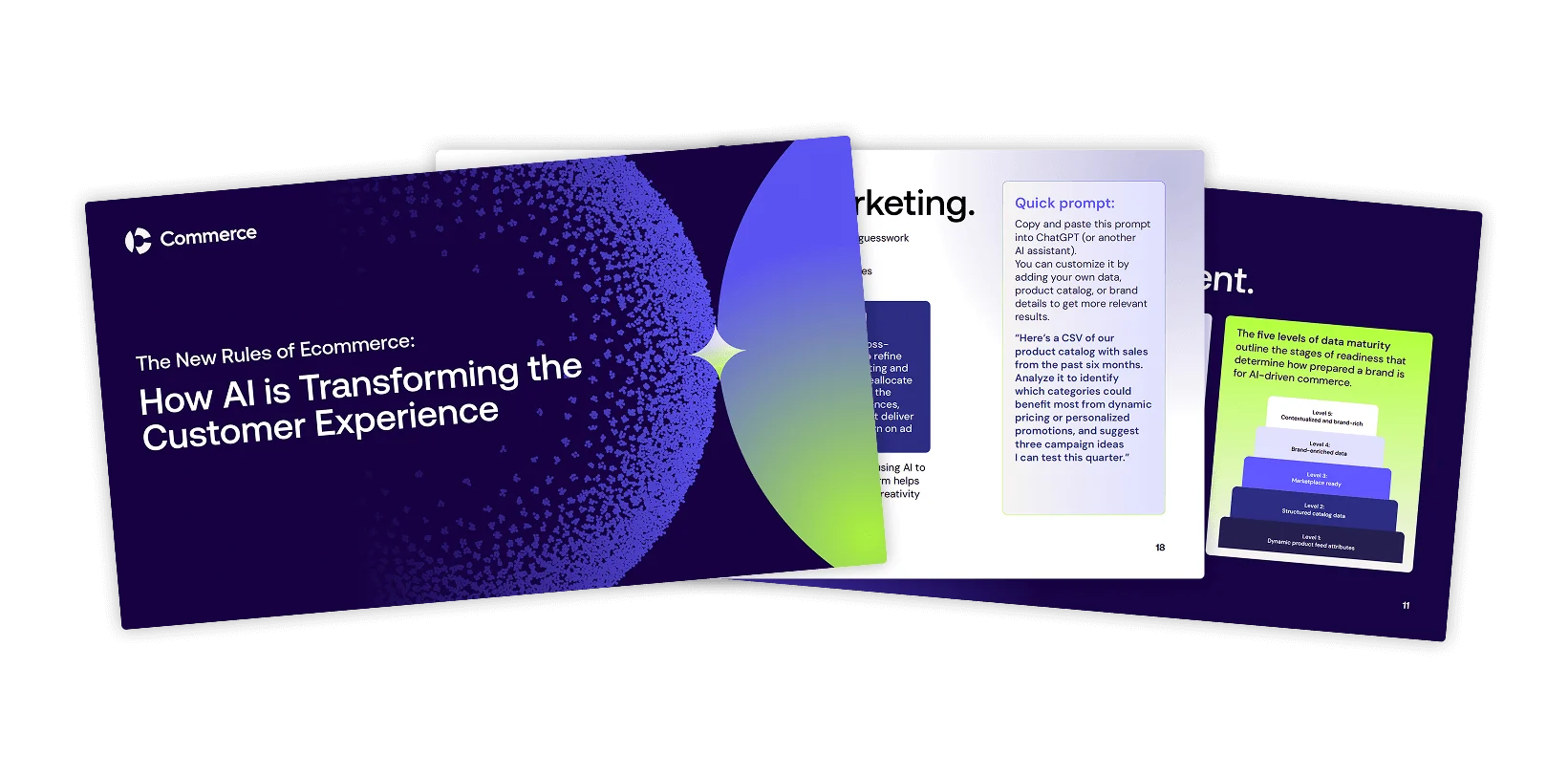
Discover How AI is Transforming the Customer Experience
AI is quickly reshaping the landscape of ecommerce. Learn how you can prepare for the next wave of AI commerce.