- Start & Build

Product Overview
What you can do with BigCommerce.
Agentic Commerce
 AI-powered solutions for growth.
Design Your Store
Build your store with or without code.
Apps & Integrations
Over 1,200 apps to help you grow.
Migrate to BigCommerce
Switch from Shopify, Woocommerce, Salesforce, Magento, and more.
- Launch Services
Overview
Chart your path to success with specialized services.Implementation Project Management
Experts to ensure you launch on time and under budget.Solution Architecture
Seasoned advisors to help you best design your store.Data Migration & Optimization
Expertise on a clean and clear path to migrating your data.Enterprise Launch Package
Personal training on how to set up and launch your BigCommerce Store.

Professional Services Blog Series
Get to know our teams and how they support your success in this Q&A series.

The Global B2B Buyer Behavior Report
This in-depth report provides actionable strategies to help you sell more online.
Unified Commerce Strategies for Multi-Channel Growth
Create your store and start selling today.
Create your new website.
See if the BigCommerce platform is a good fit for your business.
No credit card required.

Written by
Ramanathan Ramakrishnamurthy07/09/2026
Unified Commerce Strategies for Multi-Channel Growth
Get The Print Version
Tired of scrolling? Download a PDF version for easier offline reading and sharing with coworkers.
A link to download the PDF will arrive in your inbox shortly.
Key highlights:
Unified commerce connects your systems behind the scenes so customers experience one consistent brand across every channel.
Customers don't shop in channels. They move between social media, marketplaces, search and your website as part of a single buying journey.
Small moments of friction — inconsistent pricing, empty carts, and inaccurate inventory — quietly erode trust and drive shoppers to competitors.
Brands that unify storefronts, product data, and customer experiences are better positioned to increase conversions, customer loyalty, and long-term growth.
Building a connected commerce strategy starts by identifying where your customer journey breaks down and fixing those moments first.
The customer experience is only as strong as the systems behind it
Jamie had no issue with your product.
She spotted the jacket on TikTok and clicked through. It was in stock. She added it to her cart and opened her laptop to finish the purchase. But when she tried to buy it, the jacket was out of stock, even though the TikTok post was still up.
She looked for the same jacket on Amazon, but found a different price and no size guide. When she called the store, the representative couldn’t find her information and told her to start again.
Jamie bought from a competitor that afternoon. No complaint. No email. She just never came back.
Here is what most brands do after losing a customer like Jamie. They launch on another channel. Add Pinterest. Test YouTube Shopping. Hire someone to manage the TikTok account full-time.
That is exactly the wrong response.
Jamie did not need you on more channels. She needed the ones you had to work. Adding TikTok Shop and Pinterest and YouTube Shopping on top of a broken experience does not fix anything. It just gives more shoppers more ways to hit the same wall.
The brands winning in 2026 are not the ones with the most channels. They are the ones where every channel feels like the same brand to the same customer at the same moment.
That is the only multi-channel growth strategy worth building.
What does a broken customer experience actually cost you?
You see the sale that happened. You never see the customer who got halfway there and quietly disappeared. No abandoned cart notification. No complaint ticket. Just someone who decided your brand was more trouble than it was worth.
Brands measure channel performance in isolation. Conversion rate on the website. ROAS on paid social. Units sold on Amazon. Clean numbers. Tidy reports.
But Jamie was not moving in isolation. She was moving across all of it in a single buying decision. And the brand had no idea it was happening until she was already gone.
The Manhattan Associates Unified Commerce Benchmark found that inventory accuracy and order fulfillment remain among the top challenges for retailers across the industry. Jamie didn't need to read the report to know it was true. She experienced it herself, three clicks and a competitor's checkout later.
The cost is not one lost sale. It is every purchase Jamie would have made over the next four years. And it shows up nowhere in your reporting.
What is unified commerce and why does the definition matter to your customer?
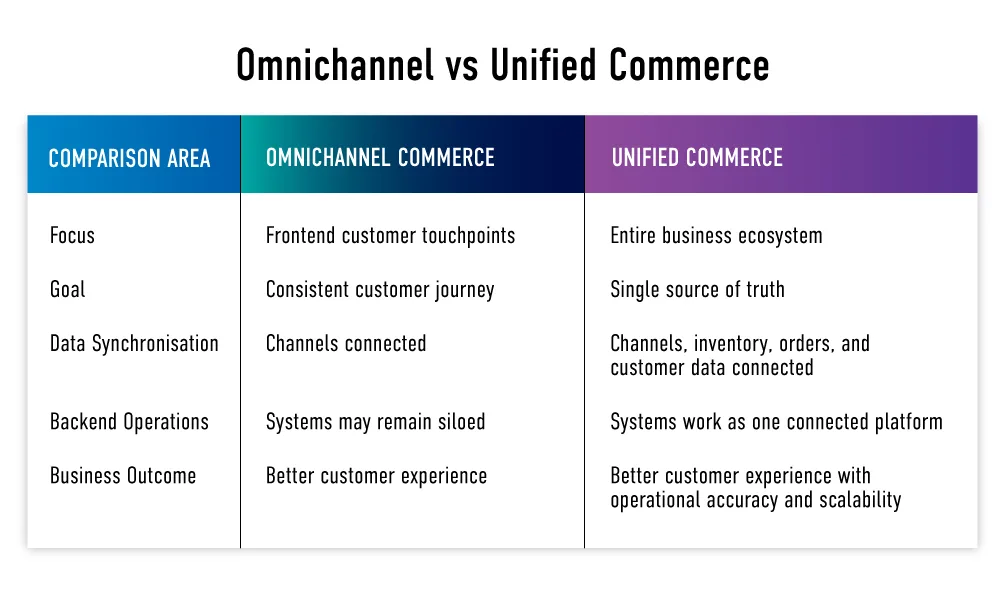
Unified commerce is not a platform category. It is the operational commitment to ensure your customer never notices that your business runs on multiple systems. When it works, shoppers simply feel like the brand knows them. When it doesn't, they feel exactly what Jamie felt.
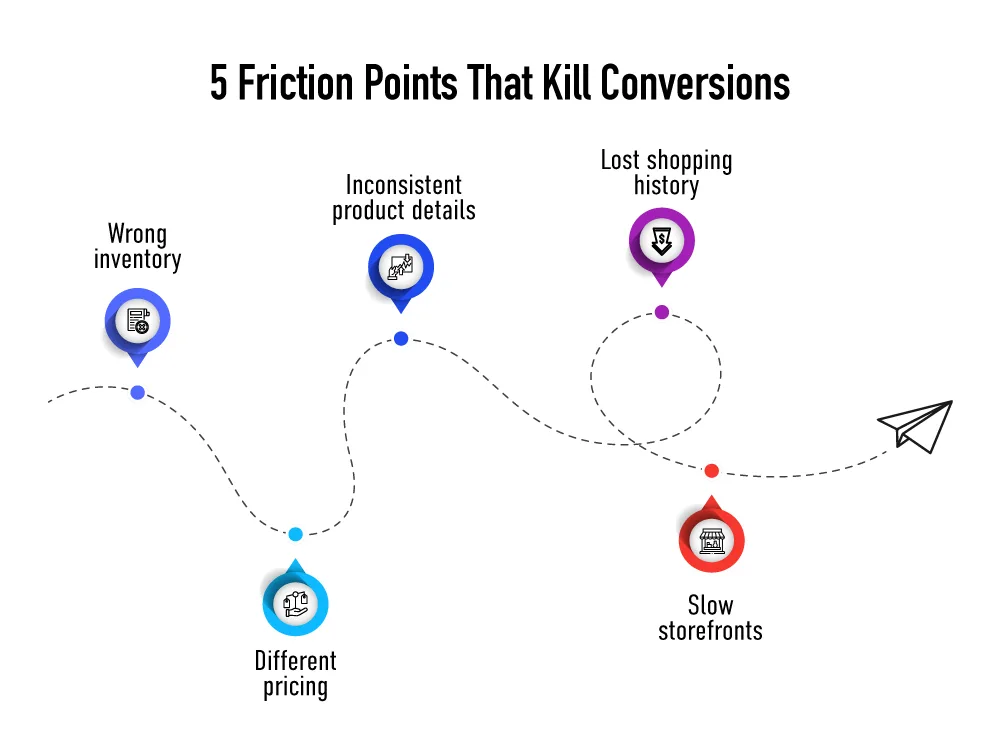
Your operations team sees green lights across every platform. Your customer sees a price that doesn't match, an item that isn't actually available, or a loyalty reward that never appears. That gap between those two realities is where businesses lose customers.
Unified commerce connects customer interactions, product information, inventory, pricing, and orders across business systems, helping keep data synchronized across channels with minimal delay. The goal isn't simply to integrate technology. It's to create a consistent experience, no matter where or how a customer chooses to shop.
For brands evaluating BigCommerce implementation services, building this connected foundation is one of the primary objectives. The right implementation ensures the systems behind your storefront work together so customers experience a single, consistent brand rather than a collection of disconnected applications.
Why does the frontend experience keep breaking across channels?
Because most brands are still organized around their org chart instead of their customer's journey. Marketing owns social. Ecommerce owns the website. Operations owns inventory. No one owns the moment when all three touch the same customer at the same time.
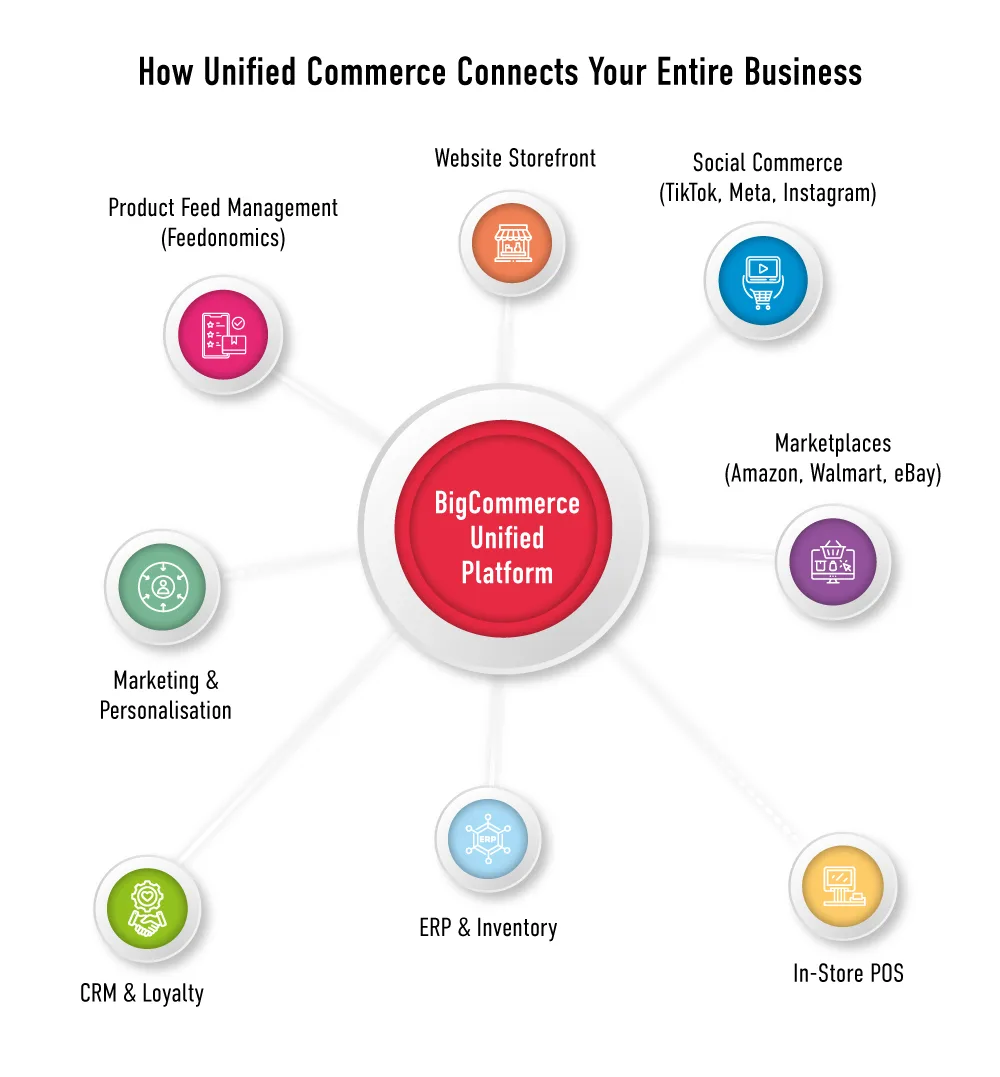
Nobody walks away thinking "their inventory system must be out of sync." They just see a price that changed and a cart that vanished. That is enough. They close the tab and you never hear from them again.
This is the gap that enterprise BigCommerce Development Services is built to close. By connecting the systems that marketing, ecommerce, and operations teams often manage independently, businesses can deliver a single, consistent customer experience across every touchpoint.
That matters because customers don't think in channels. A BigCommerce survey of more than 3,000 U.S. home furnishings shoppers found that consumers naturally blend online and in-store shopping as part of the same buying journey, moving between channels based on convenience rather than treating them as separate experiences. Brands that create consistent experiences across those touchpoints are better positioned to keep shoppers engaged. In fact, BigCommerce and Feedonomics research found that marketing across three or more channels generates 250% higher engagement.
The brands losing customers today are rarely losing them because of inferior products. They're losing them to competitors that deliver a more consistent, friction-free experience across the channels customers already use.
What does a unified frontend customer experience actually feel like?
It feels like nothing. That is the point. When unified commerce works, the shopper never notices the inventory sync, the feed management, or the API architecture behind it. They just move through your brand without hitting a wall.
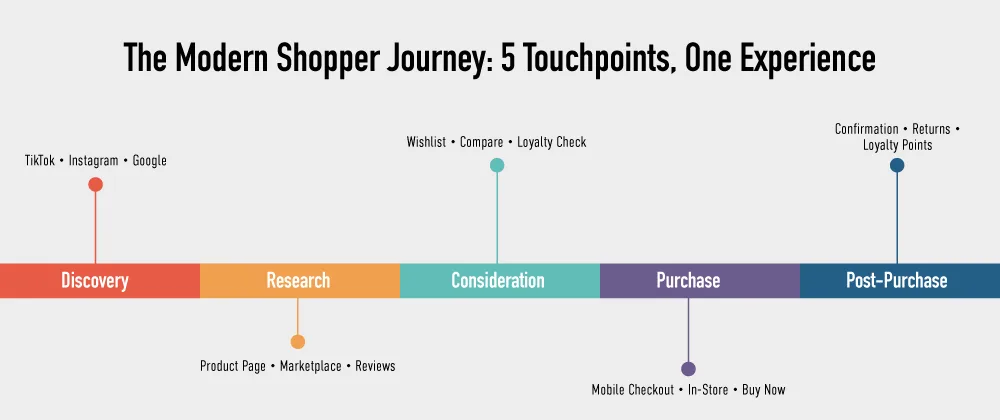
Here is what that looks like across the five moments where most brands lose the customer today.
Does seeing the same product everywhere actually change whether someone buys?
Yes. The brands that understand this stop thinking about channel consistency as an operations problem and start treating it as a conversion lever.
A shopper finds your product on Google in the morning. They found your website at lunch, and by evening, they are on your Amazon listing. One person and one buying decision spread across a full day. A price that shifted somewhere in that journey is all it takes to lose them.
Feedonomics, part of the Commerce ecosystem, helps businesses optimize, transform, and syndicate product data across marketplaces, advertising channels, and social commerce platforms.
It syndicates accurate and enriched product data to more than 150 marketplaces and advertising platforms, including Google, Meta, TikTok, Amazon, Walmart, and eBay.
Kitchen sink and faucet manufacturer Houzer needed to launch a direct-to-consumer business while maintaining a growing marketplace presence. By combining BigCommerce with Feedonomics, the company was able to:
Launch a new direct-to-consumer storefront in less than 60 days.
Centralize and syndicate product data across marketplaces and sales channels from a single source of truth.
Simplify its technology stack, giving its team more time to focus on growth instead of manual feed management.
Those operational improvements translated into measurable business results: a 150% increase in transactions, 47% increase in conversion rate and 118% increase in revenue.
Beyond feed management, Feedonomics also offers AI-powered capabilities through Feedonomics Surface, which enriches catalog content to improve product quality and search relevance across supported commerce channels.
What happens to a shopper whose cart does not follow them across devices?
They start over or they leave. Most leave. And they leave with a specific feeling about your brand that no retargeting ad will fix.
Think about what that moment actually feels like. A shopper spent ten minutes finding the right product on their phone. They saved it mentally. They were commuting or browsing during a break so they decided to complete the purchase later on their laptop where they could compare details more comfortably and enter payment information more easily. They came back on their laptop ready to buy. The cart is empty. The product is no longer in their history. They have to start the whole process again.
That friction is not neutral. It signals that your brand does not know who they are. And a brand that does not know who you are is a brand you do not feel loyal to.
BigCommerce integrates with personalization platforms such as Bloomreach, Dynamic Yield, and Klaviyo through native integrations, partner applications, or APIs, depending on the implementation.
Sleep Country Canada used Dynamic Yield for A/B testing and Google AI for smarter search and recommendations. Shoppers spent more time on site and conversion improved across every digital channel.
A shopper whose experience follows them across devices does not just convert once. They come back because the brand felt like it was paying attention.
Why do out-of-stock errors at checkout destroy trust faster than anything else?
Because you let the shopper get all the way to yes and then took it back. That reversal at the final moment is the single most damaging experience in retail. It does not just cost you the sale. It rewrites how the shopper remembers every interaction they had with you before that moment.
Jamie got that experience. She never came back.
Customers expect inventory availability to accurately reflect current stock levels. Reducing synchronization delays between commerce, ERP, and fulfillment systems helps minimize inventory inconsistencies during checkout.
BigCommerce's API-first architecture enables inventory synchronization through ERP, OMS, and integration platforms. Using open APIs, businesses can keep inventory data consistent across connected sales channels and back-office systems, improving inventory visibility throughout the customer journey.
Your customer never thinks about the API. They just know the brand did not let them down. That is the only version of this story worth telling.
Is social commerce where you win customers or where you quietly lose them?
Both. And which one it is depends entirely on what happens in the ten seconds after a shopper taps “Buy Now.”
TikTok alone attracts more than one billion monthly active users. Those numbers make social commerce feel like an opportunity. But it is also the most unforgiving touchpoint you have.
A shopper in discovery mode on TikTok is in a high-intent fragile moment. They saw something they wanted. They acted on it immediately. If the experience that follows that tap is broken, slow, or inconsistent with what they saw in the video, that fragile moment collapses. And they associate that collapse with your brand.
BigCommerce's TikTok integration offers one-click setup through Channel Manager for merchants in the US, UK, Australia, and Canada. Native integrations for Meta, Google, Amazon, and Walmart keep inventory and pricing in sync across every social channel.
The experience a customer gets on TikTok should be identical to the experience they get on your website. When it is, social commerce earns you a customer. When it is not, it loses you one you will never get back.
Why does a slow website undo everything every other channel just built?
Because every channel you run eventually points back to it. Paid social, email, marketplaces, and search all drive traffic to one place. If that place is slow, hard to navigate, or impossible for your marketing team to update, it becomes the hole in the bucket that everything else pours into.
A shopper who had a great experience on TikTok, clicked through, and landed on a page that took four seconds to load has already lost the feeling that made them click. Speed is not a technical metric. It is the last impression your brand makes before the shopper decides to stay or leave.
BigCommerce's Catalyst storefront framework is built on Next.js and React. It gives brands full creative control over design and performance while BigCommerce handles core ecommerce services, such as catalog management, cart, checkout and order processing, with integrations to ERP, warehouse and fulfillment systems.
Catalyst provides the foundation for building high-performance storefronts without sacrificing flexibility. Combined with Makeswift, marketing teams can update pages, launch campaigns, and publish content without waiting on a developer, while developers retain complete control over the storefront experience.
A storefront that loads fast and updates without friction does not just improve conversion. It protects every dollar you spent getting the shopper there in the first place.
How do real brands get the frontend experience right?
Most brands look at a growth problem and immediately ask what to add. A new channel. A new platform. A new hire to manage it. The brands in this section asked a different question. They asked where their current customer was walking away. That question led somewhere useful.
Sleep Country Canada had a mobile problem. Shoppers were landing on the site and not finishing what they came to do. In 2024 the team rebuilt around that specific failure. Dynamic Yield, Bazaarvoice, and Google AI went in and people started finding what they needed. More of them checked out. Same products. Fewer reasons to leave.
Norsland Lefse depended on Amazon and a basic Wix website. The site did not work well on mobile devices. After moving to BigCommerce, the brand improved its online store and expanded to more sales channels. Mobile conversion rates increased by 62%, revenue grew by 40% year over year, and customers could shop faster and with fewer issues.
These are not technology success stories. They are customer experience stories. The technology just made them possible.
Where do you start when your customer experience is already broken?
Start with the moment your customer falls through most often. Not the channel with the lowest ROAS. Not the platform your competitor just launched on. The specific moment in your current customer journey where a real shopper hits a wall and leaves.
That one moment points directly to the system gap behind it. Fix that first. Everything else follows.
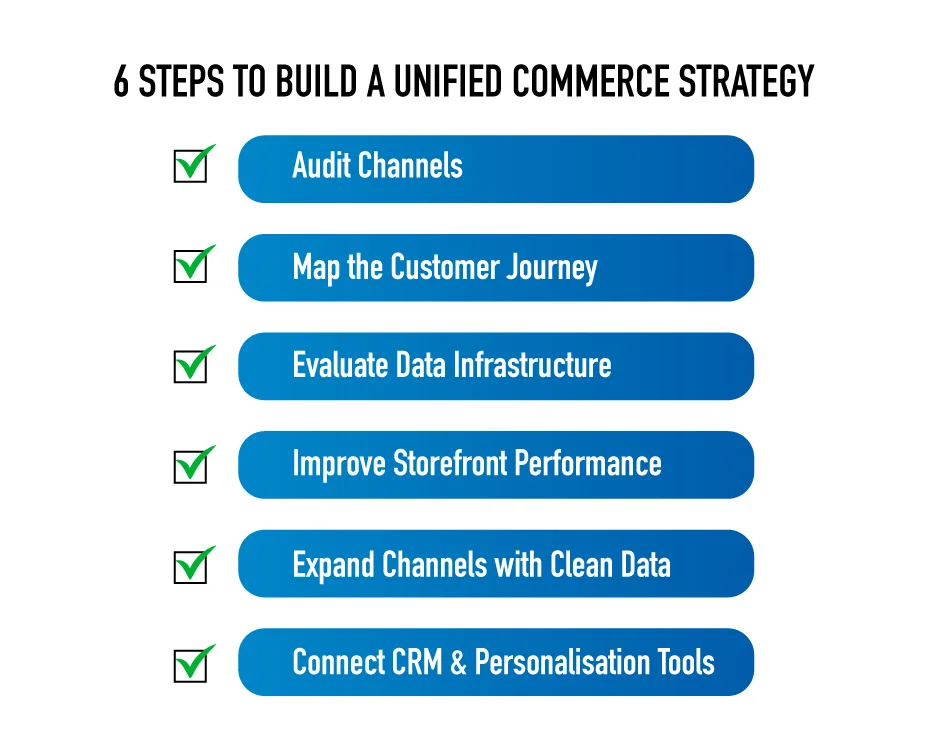
Five questions to ask your team today:
Where does your data break down across channels? That is your inventory sync problem and it is the first thing to fix.
Does your product information look identical on Google, your website, and Amazon? If not, inconsistent product data could be costing you sales you never see.
Does your customer's cart and profile follow them across devices? If not, you are asking loyal shoppers to start over every time.
Can your marketing team update your website without a developer? If not, your storefront is slowing down every campaign you run.
Does buying on TikTok feel the same as buying on your website? If not, you are losing customers at the moment of highest intent.
If more than one of these questions made you pause, you're not dealing with isolated problems. You're seeing the symptoms of disconnected commerce systems. BigCommerce helps unify those experiences with capabilities like Channel Manager, which simplifies selling across channels from a single dashboard, and Feedonomics, which helps brands expand to new channels while keeping product data consistent. In fact, the average Feedonomics customer adds nearly two new sales channels after getting started — without adding operational complexity.
The final word
Your customer does not experience your technology. They experience your brand. Every broken moment across your channels quietly chips away at the trust you've worked so hard to build.
Most loyalty programmes try to encourage repeat purchases. Unified commerce earns it. A shopper who never hits a wrong price, a missing cart, or a broken checkout does not need a discount to come back. The experience itself becomes the reason.
BigCommerce provides the system that makes this possible. From Catalyst and Makeswift for the storefront to Feedonomics for consistent product data to Multi-Storefront for managing multiple brands or regions, the platform is built to make a seamless customer experience the default outcome — not the exception.
Jamie is shopping right now.
She is on TikTok. She is switching devices. She is checking three channels before she decides. She is moving fast and she is paying attention to every small signal your brand sends her.
The jacket she wants is already in your inventory. The price is right. Her size is available.
The only question is whether your brand delivers the experience she expects — or whether another brand will.
Ready to stop losing customers like Jamie?
Every broken cart, inconsistent price, and out-of-stock message is another opportunity for a customer to choose a competitor instead.
A unified commerce strategy helps you deliver the consistent, connected experiences shoppers expect across every channel. From discovery to checkout, every interaction reinforces trust in your brand.
Talk to a BigCommerce expert to see how you can unify your commerce experience and identify the friction that's costing you customers today.
There's a lot to love ❤️
Watch a demo to see the BigCommerce platform in action.