- Start & Build

Product Overview
What you can do with BigCommerce.
Agentic Commerce
 AI-powered solutions for growth.
Design Your Store
Build your store with or without code.
Apps & Integrations
Over 1,200 apps to help you grow.
Migrate to BigCommerce
Switch from Shopify, Woocommerce, Salesforce, Magento, and more.
- Launch Services
Overview
Chart your path to success with specialized services.Implementation Project Management
Experts to ensure you launch on time and under budget.Solution Architecture
Seasoned advisors to help you best design your store.Data Migration & Optimization
Expertise on a clean and clear path to migrating your data.Enterprise Launch Package
Personal training on how to set up and launch your BigCommerce Store.

Professional Services Blog Series
Get to know our teams and how they support your success in this Q&A series.

The Global B2B Buyer Behavior Report
This in-depth report provides actionable strategies to help you sell more online.
Create your new website.
See if the BigCommerce platform is a good fit for your business.
No credit card required.

Written by
John Shieldsmith07/02/2026

The Woes of Ecommerce Replatforming
Get The Print Version
Tired of scrolling? Download a PDF version for easier offline reading and sharing with coworkers.
A link to download the PDF will arrive in your inbox shortly.
Key highlights:
Many brands hesitate to change ecommerce platforms, as migration is often seen as a large undertaking that results in significant downtime.
Common reasons for hesitation to replatform include difficulty finding the right features, concerns around downtime, and potential developer requirements.
BigCommerce offers both self-service and premium guided migration services, making it easier to replatform.
Overcoming ecommerce migration hesitation
Ecommerce replatforming is a big deal. So much so, the ecommerce replatforming industry itself is worth roughly $445 million.
Ecommerce replatforming is much like any data migration, in that you’re moving your data and operations from one place to another. Because of this, there’s often a lot of fear around it.
Even where data migration is concerned, almost 70% say they’ve delayed hosting migrations over fears around cost, complexity, and site downtime.
A little hesitation can be a good thing, especially if you’re on the verge of having that extra slice of pizza before bedtime. But, it shouldn’t keep you from healthy growth, especially where your ecommerce business is concerned.
Let’s take a look at why some companies hesitated to change ecommerce platforms, and how things worked out after they did. (Spoiler alert: Way better than that late night slice of pepperoni did.)
Why companies hesitate to change ecommerce platforms
Moving from one ecommerce platform to another is a big decision. This isn’t a mere shirt change, but an entire architectural repositioning of your online business.
It’s only natural that companies hesitate, whether on account of prior experience, tales of fellow business owners, or a simple gut feeling. To put things in perspective, let’s look at a few reasons real companies pumped the brakes, and why they moved forward.
Trouble striking the right balance of features, usability, and compliance.
Every business has unique needs. Sometimes finding an ecommerce platform that meets those needs can feel impossible. Few companies know this better than the team at The Crab Place.
“Believe it or not, we were replatforming for 10 years.”
— Greg Cain, CEO, The Crab Place
The Crab Place, provider of high quality crab and other seafood, can only succeed when deliveries are made in a timely manner. Otherwise, customers are bound to get spoiled goods and wind up crabby themselves.
For ten years, the team behind The Crab Place struggled to find a platform that could get things right. Their in-house, custom solution was unwieldy. Magento and Shopify both fell short of their expectations. Meanwhile, further attempts at coding only exacerbated concerns around security.
“We launched Magento and rolled it back,” Cain said. “We tried building it ourselves, but you can’t write code fast enough, and then you’re worried about security and compliance. Shopify controlled checkout too tightly. We couldn’t get what we needed.”
Finding Goldilocks.
After ten years of being stuck in replatforming purgatory, the team found the security, customizability, and features they needed.
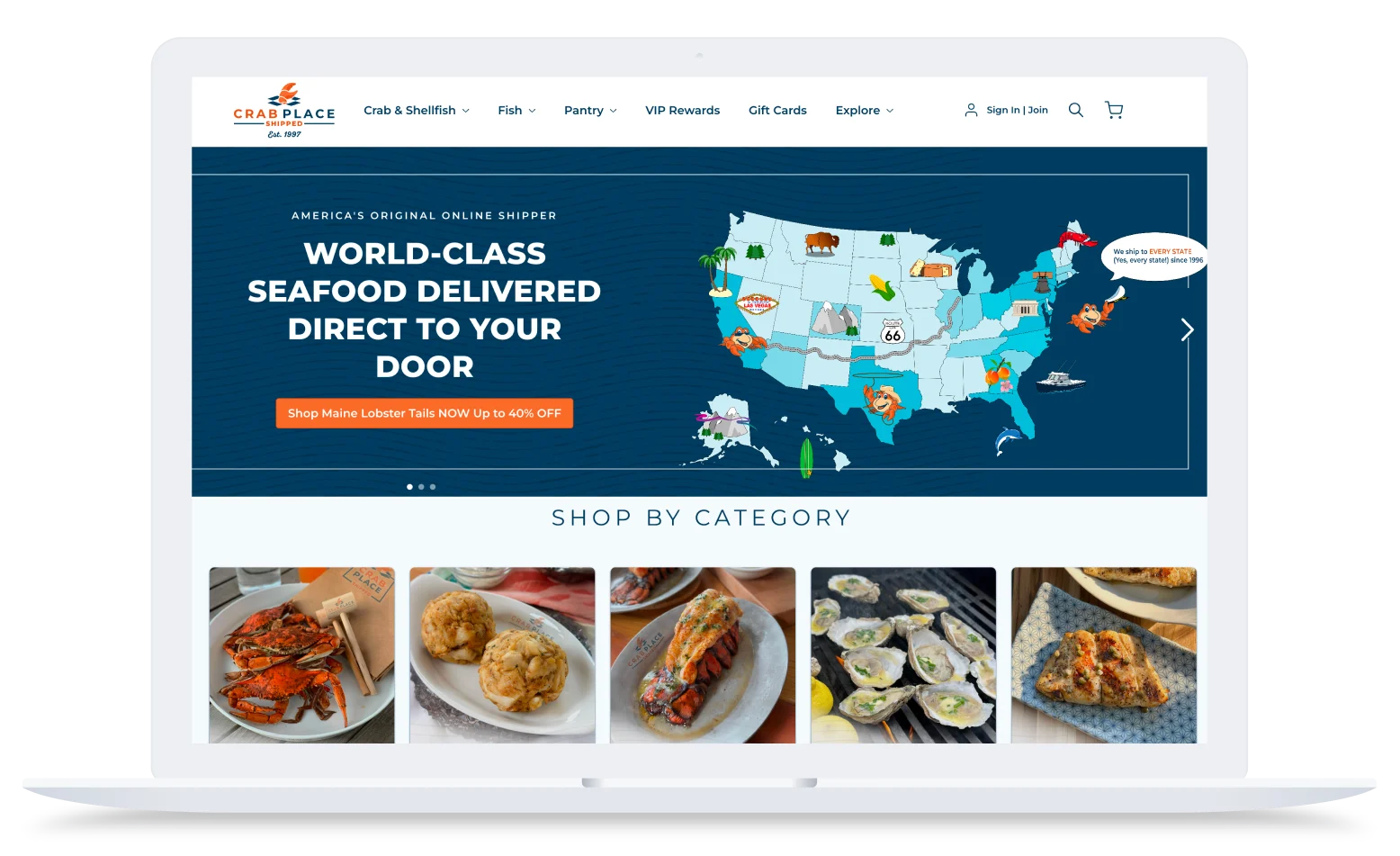
With the API-first architecture of BigCommerce, the team at The Crab Place were able to build the checkout flows they needed, and deliver them in a mobile-friendly format.
In the end, they achieved:
60% increase in checkout speed
12% decrease in customer shipping errors
40 hours of operational time saved each month
“We finally got a successful launch,” Cain said. “After 10 years of trying to replatform, BigCommerce gave us the flexibility we needed, and now we’re positioned to grow.”
A costly interruption to business.
When you’re selling online, anytime offline is money left on the table. It’s understandable that potential downtime causes hesitation for businesses contemplating any type of migration. But, as WNC CBD can attest to, sometimes downtime finds you regardless.
WNC CBD had been operating on Shopify for some time. That is, until Shopify implemented new THC regulations, which saw WNC CBD’s ecommerce site go down without warning.
“It was really critical — for us, our business, and our staff — to get back online as quickly as possible.”
— Sav Jack, Technical Operations Manager, WNC CBD
As a high-risk brand, the team at WNC CBD was well aware of the challenges in their space. This already limited which platforms they could use. They also needed a solution that could serve both their retail and wholesale operations.
Low-risk, high rewards with BigCommerce.
The team at WNC CBD quickly found BigCommerce during their scramble. They worked hand-in-hand with the BigCommerce team, ensuring the platform could:
Support more than 400+ complex SKUs.
Scale across DTC and B2B verticals.
Offer a self-serve portal for B2B customers.
Comply with shifting THC regulations.
In the end, the team was able to rebuild their entire ecommerce experience on BigCommerce in only two weeks. Now, they have a consistent platform to call home, and a solution that scales right along with their business.

Within a year they saw a 19.47% increase in DTC revenue and added 200 wholesale accounts.
Developer demands required for replatforming.
Every ecommerce platform comes with its own learning curve and potential developer requirements. Depending on your in-house resources, this can make replatforming intimidating, especially if you consider the potential costs and downtime that come with it.
For some companies, like Ship It Appliances, a kitchen appliance supplier, this hesitation comes from personal experience.
Ship It Appliances first ran on Advansys, and then WooCommerce. The team soon realized they often needed developer support to manage everything from updates to tackling ongoing speed issues. Magento 2 looked appealing, but even that had the team wondering if they’d still need extensive developer support.
They were at a standstill.
Finding long-term growth, sans developer pitfalls.
Despite prior ecommerce experiences requiring extensive developer support, the team at Ship It Appliances knew they needed to make the move to a new platform.
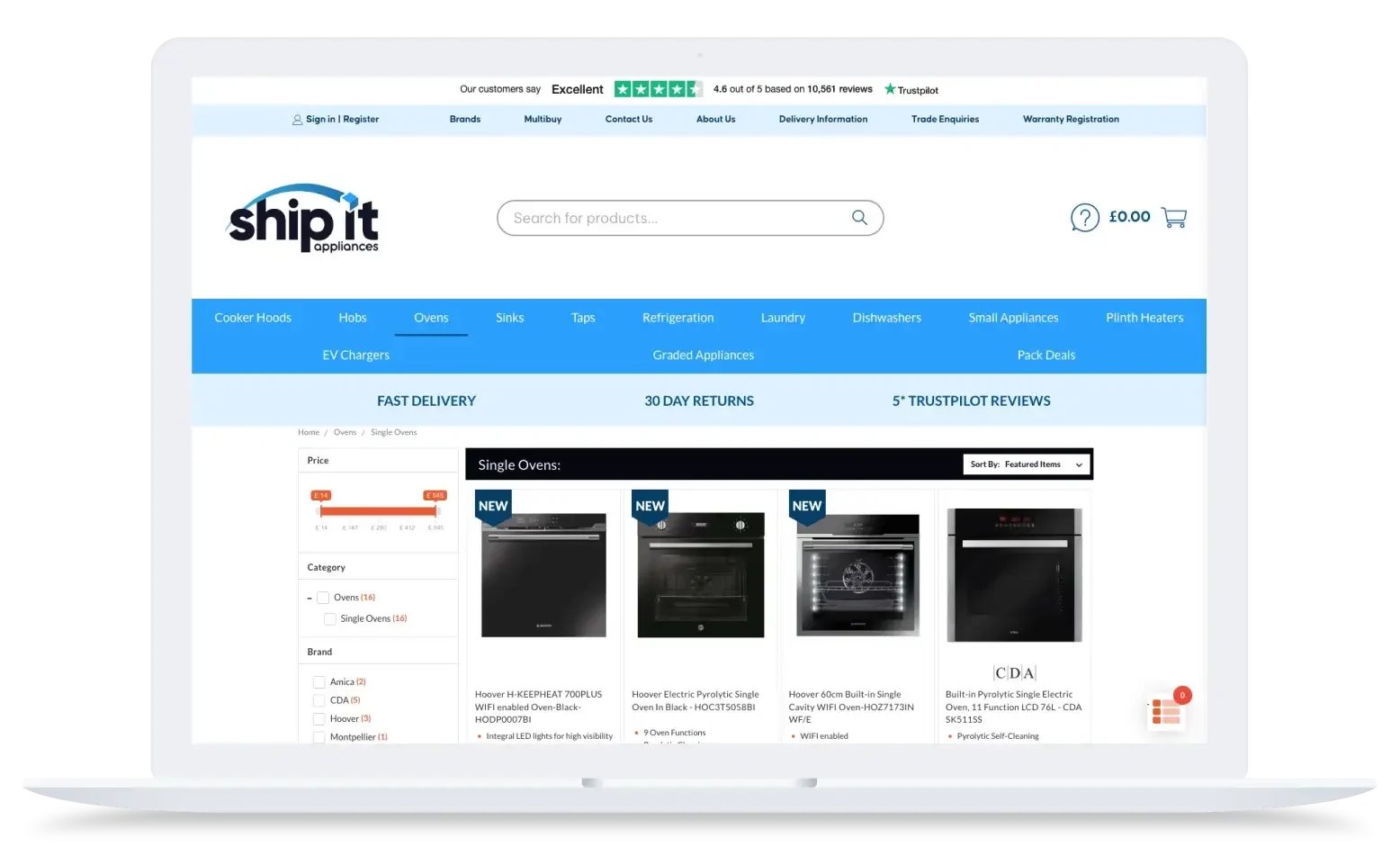
A few factors went into helping the team at Ship It Appliances overcome any hesitations, all of them stemming from the capabilities of BigCommerce:
API connectivity with their customer data platform
End-to-end tech stack support
Enterprise-grade architecture
A comprehensive roadmap from the BigCommerce team
Following their migration to BigCommerce, the Ship It Appliances team have taken full advantage of the headless approach offered by our platform. This allows them to use the tools they’re comfortable with, while still uniting them on the backend. A developer-driven endeavor they’ve found well worthwhile.
“From the actual back-end system side of BigCommerce, we saw an increase in productivity. Because of the architecture we were able to automate our book-out process. Our warehouse is now a fully operational warehouse management system with scanners.”
— Nick Eaton, Managing Director, Ship It Appliances
Why migrate to BigCommerce?
Whether you’re coming from WooCommerce or Magento or any other ecommerce platform, there are a number of reasons to migrate to BigCommerce.
Less reliance on plugins.
Plugins are a great way to expand the capabilities of a platform. Even BigCommerce has a library of more than 1,200 apps and integrations. But, plugins shouldn’t be essential to doing the things you want to do:
Cart abandonment emails?
Robust catalog management functionality?
Product reviews?
Visual store editor?
No plugins, just BigCommerce.
GourmetFuel was using 67 plugins when they were on WooCommerce. After migration to BigCommerce? They’re using barely any.
More predictable pricing.
Many platforms will tout being free or get you hooked with a low price. This can quickly turn into higher-priced plans or a costly reliance on premium plugins, a need for further developer support, or expensive hosting.
BigCommerce comes with a clear pricing plan, ensuring you have no ugly surprises at the end of each billing cycle. Not only does this make for a happier pocketbook, but it also enables you to plan ahead.
Scalable and consistent performance.
A need for countless plugins can make for a messy, inconsistent experience. When one needs an update, it might stop playing well with others, too. Not to mention, having to rely on a third-party host leaves you at their mercy.
BigCommerce provides a platform that’s as consistent as it is scalable. Traffic needs increasing? Fear not. BigCommerce can handle it.
“On BigCommerce, our platform downtime has gone from what could have been as high as 10%, down to less than 1%.”
— Rob Buckley, Managing Director, GourmetFuel
Growth-ready capabilities, right out of the box.
Whether you’re new on your ecommerce journey or operating at an enterprise level, BigCommerce is here to foster growth — not inhibit it.
How? With native support for:
Multi-storefront management
Omnichannel selling and syncing
International currencies and languages
Headless commerce and low/no-code development
Robust analytics
BigCommerce isn’t just here to host your store, it’s here to help you grow it.
24/7/365 support.
If a brick-and-mortar store loses power, you can call for utility support in an instant. Why should ecommerce be any different?
BigCommerce provides around-the-clock support for everything from technical issues to billing support to growth support.
With a thriving community support base of more than 177,000 members and an in-depth knowledge center full of helpful content, there’s plenty of self-guided support, too.
Expert migration support.
Not everyone is a fan of the DIY approach, especially where ecommerce migration is concerned. Don’t worry, we’ve got plenty of premium migration support available for those who want it.
With our migration services, you can breathe easy knowing a trusted professional is handling the process for you, based on agreed upon specs you determine.
The final word
Migration IS a big deal. But that doesn’t have to mean big stress. With support at the ready and premium migration services available, BigCommerce makes migration as stress-free as possible.
Migration can be especially intimidating for those running on a plugin-based platform, like WooCommerce. With so many moving parts and features to shift, it’s a lot to handle. If you’re one of the four-million businesses running on WooCommerce, fear not.
With our WooCommerce to BigCommerce step-by-step migration guide, you can see how other WooCommerce customers found big wins with BigCommerce. Download it today to get a detailed breakdown of every single step, including tips on getting the most out of our platform after migration.
Today’s the perfect day to make the big move.
Ebook: Migrating Your Ecommerce Store
In this ebook, you'll get a step-by-step guide for successfully migrating to a new ecommerce platform.