




Written by
John Shieldsmith11/18/2026
How To Sell Coffee Online: From Roaster to DTC (and Wholesale) in 2026
Get The Print Version
Tired of scrolling? Download a PDF version for easier offline reading and sharing with coworkers.
A link to download the PDF will arrive in your inbox shortly.
Key highlights
Selling coffee online means choosing a business model, sourcing beans, building a store with grind and size variants, and selling through DTC, subscriptions, and wholesale.
Roasting your own coffee earns the highest margin and control, while private label and dropshipping trade margin for a lower cost of entry.
Freshness is the constraint that shapes your inventory, fulfillment, and subscription cadence, so plan around roast dates from day one.
Subscriptions turn coffee’s natural reorder cycle into recurring revenue, while flexibility does more for retention than lock-in.
Running DTC and wholesale from one catalog with separate price lists lets you serve shoppers and cafés without a second system.
How to sell coffee online via DTC and wholesale
If you’re wondering how to sell coffee online, you might be surprised to learn it isn’t quite the grind you think it is. With a flavor profile that carries notes of direct-to-consumer (DTC) and wholesale, selling coffee online is both doable and profitable in 2026.
The core path to selling coffee online is quite straightforward: pick your business model, source your beans, build a store, and sell via DTC, subscriptions, and wholesale.
The best part? The above path is true whether you’re a first-time founder just brewing up an online coffee business or a working roaster adding DTC retail and wholesale to an operation you’ve been running for years.
No matter which camp you fall in, read on for a step-by-step look at how you can launch or grow an online coffee business of your own.
Why sell coffee online in 2026
If you don’t drink coffee, you likely know someone who does. And if not, you need new friends.
Coffee is one of the most consistent daily purchases in the US, with a demand that keeps leaning toward the specialty end of the market where independent brands compete best.
The proof is in the beans (and this boatload of 2026 data):
Coffee is the most popular beverage in the United States, with almost 195 million American adults drinking coffee each week.
47% of American adults had specialty coffee in the past day, ahead of traditional coffee at 42%.
Those in the 25-39 age group are the biggest consumers of specialty coffee, with 69% having had it within the past week.
The global coffee market is estimated at $263.5 billion in 2026 and projected to reach $375.5 billion by 2033.
While market-size estimates can vary widely, combining them with the consumption data above paints a clear picture: Most Americans are daily consumers of coffee, with more and more wanting specialty roasts.
Choose your coffee business model
Like many products in the beverage ecommerce space, there are a few business models you can take with coffee: roast your own, sell private label coffee roasted by a partner, or dropship coffee from a supplier who also ships your orders.
Each model offers different levels of margin and control, paired against startup costs and launch speed. For a better look, count the beans in the table below.
Business model | Margin profile | Startup cost | Quality control | Speed to launch | Best for |
Roast your own | Highest | Highest | Full control | Slowest | Experienced roasters or well-funded founders |
Private/white label | Moderate | Low to moderate | Shared control | Weeks | Brand builders without equipment |
Dropshipping | Thinnest | Lowest | Least control | Fastest | Testing demand on a small budget |
Roast your own.
Roasting your own coffee allows you to deliver something truly unique to the market, which plays well into the increasing desire for more specialized coffee.
Roasting in-house also gives you the highest margin per pound, along with full control over sourcing, roast profiles, and freshness.
The downside? Roasting carries the highest upfront cost on account of needing:
A commercial roaster
Ventilation
A permitted space
Time to learn the craft
If you’re already a coffee roaster, you’ve cleared the biggest hurdles, as you have the knowledge and likely the space and equipment. This means your largest hurdle left is putting your capacity to work in new online channels.
Private label and white label coffee.
Private label coffee allows you to offer the next best thing to roasting your own: coffee that’s roasted and packed by a third-party roaster and sold under your brand.
This isn’t to be confused with white label coffee, which is ready-made and sold by a supplier to many brands. Private label gives you more control over the blend or roast profile, and gives you the edge of exclusivity.
In either event, you own the brand and customer relationship without having to buy equipment or learn the skill. The biggest caveat is that you need to ensure minimum order quantities keep things profitable, while lead times allow for timely delivery.
For more information, see our guide to private label products for how the model works across categories.
Coffee dropshipping.
Coffee dropshipping follows a similar route as other dropshipping ventures: a supplier roasts, packs, and ships your orders under your brand name. As is the case with typical dropshipping companies, you never hold any inventory nor do you deal with coffee roasting equipment, in this case.
Coffee dropshipping is typically the fastest and cheapest way you can start selling coffee online. But, profitability is hit and miss, as margins are thin. This is due to the supplier’s roasting, packing, and shipping costs coming out of each order.
You also lose a lot of control with coffee dropshipping. Freshness, packaging, and delivery are all in the hands of your supplier, while your brand is the one on the line with customers.
In general, coffee dropshipping is best used as a low-risk way to determine if there’s demand, and to build an audience before you invest in your own roasting operation, or a private label.
How to choose: margin, control and startup cost.
All three coffee business models have their uses, but the best part is that you’re not locked in to any single one of them. Instead, many coffee brands move through each one or some combination of them, using them to explore and grow.
For illustrative purposes, consider the following journey:
Start with dropshipping: Test demand with little capital while accepting thinner margins
Move to private label: When seeing steady repeat orders (a few hundred bags a month, for example) and the supplier’s markup outweighs the convenience
Invest in roasting: Your volume and margin is capable of paying back equipment on a timeline you’re comfortable with
Again, none of the above is concrete guidance, but illustrates a journey many coffee roasters have taken.
Source your coffee
How you source your coffee plays a big role in both the quality of your product and your profit margins. Unlike wholesale, how you source your coffee is how you actually buy your coffee or the beans. And, the right sourcing approach depends largely on your business model.
Green beans vs. pre-roasted.
Where beans are concerned, you can buy either green beans (not those kinds of green beans, but unroasted coffee beans) or pre-roasted beans.
If you plan on roasting beans yourself, you’ll want to buy green coffee beans, usually via an importer or direct-trade partner. (It’s not typical to grow and farm them yourself.) Green beans are often cheaper per pound, and you’ll have full control over the roast and flavor.
If you’re going the route of private label or dropship seller, you’ll be buying pre-roasted coffee. This will cost most per pound, but you’ll be able to avoid the equipment costs and skip having to learn about bean roasting.
How to vet suppliers and toll roasters.
No matter your business model, you’ll have to get your beans from somewhere. This entails vetting a supplier, or a toll roaster — a company that agrees to rent out time with their roasting equipment to roast your beans.
Whichever route you choose, you need to vet your supplier or toll roaster by:
Ordering samples and cupping them side by side with at least one other supplier.
Confirming certifications, such as organic or Fair Trade, if you plan to put them on your label.
Asking about minimum order quantities and lead times, especially for custom blends.
Finding out how quickly orders ship after roasting.
Inspecting their space to determine if it’s clean and whether quality control is observed.
The biggest gamble comes with a supplier, hence why most of the above list applies more to them. But, even a toll roaster needs to provide the right equipment and a space that’s clean and secure, otherwise your own operation will fall apart.
Freshness, roast dates and quality control.
If you’re ordering from a supplier or dropshipper, you want to ensure things are consistent. This means checking for freshness, roast dates, and overall quality control.
Freshness comes first, as it influences everything else downstream. Roast dates being far enough out allow you to store more inventory, determine shipping speeds, and how your subscription model can function.
Lastly, quality control is simply a must. If one out of every five shipments you receive is fresh and roasted well, and the other four are like old, burnt tires? You won’t be able to reliably deliver much of anything.
Build your coffee brand
Catering to both general and specialty coffee markets requires a coffee that stands out. But, a great roast is only the first step. You need a brand that encourages buyers to choose your roast over every other Joe.
Building your coffee brand ultimately comes down to four steps:
Position it: pick one story to own, such as an origin relationship, a roast style, or a set of values.
Name it: choose a name that fits that story and is available as a domain and trademark.
Package it: design a bag that tells the story and shows the essentials at a glance.
Launch it: start with a focused lineup of a few coffees rather than a full menu.
Sounds pretty quick and easy, right? Like a good roast, building your coffee brand does take some time. Let’s grind this bean.
Positioning: origin, roast philosophy or lifestyle.
“Premium roast” doesn’t set you apart, because every coffee brand claims it. Anchor your positioning in something specific:
The farms you buy from: Do you source locally? From an eco-friendly farm? Is it family owned? Lean in on this.
A light roast philosophy: Do you follow the light roast philosophy of delicate roasting and balancing flavor? Drive this home in your messaging and really highlight your roaster’s technique.
A lifestyle your customers recognize: Are you going for a beachy blend that’s light and fruity? Something bold for campers? Make this the focal point of your imagery and messaging.
For more detail on positioning, see our ecommerce branding framework.
Naming, packaging and label design.
You shouldn’t judge a book by its cover, but people will certainly judge your brand by its label, package, and name.
In the coffee world, the bag is the main canvas on which your brand can make its mark. And, a clear label doubles as conversion copy on your product page, utilizing:
Coffee name
Origin and process
Roast level
Tasting notes
Roast date
Again, all of the above can go on both the package, and the product page.
Sustainability and certifications as brand assets.
Coffee drinkers have a large, large cup of companies from which they can sip. Showcasing certifications and making sourcing details transparent can give a reason to trust you, and another reason to choose your brew.
Clearly list out farm names, prices paid for beans, and certification details anywhere you can document them. Just remember: never claim more than you can back up.
Set up your online coffee store
So, you’ve decided where your beans are coming from or if you’re roasting them yourself. You’ve got the right branding in place, a killer bag for those beans, and the right details being called out. Now, it’s time to set up your online store.
To set up an online coffee store, choose a platform that handles deep variants, subscriptions, and wholesale pricing, then build product pages that sell freshness.
This is easiest when you follow this process:
Choose an ecommerce platform based on variant depth, subscription support, and wholesale readiness.
Create products with variants for whole bean, grind size, and bag size.
Write product pages that show roast date, tasting notes, origin, and brew guidance.
Configure payments, sales tax, and shipping rates.
Add a subscription option and, if you sell wholesale, a gated wholesale catalog.
Test checkout end to end on desktop and mobile before you launch.
If this sounds overwhelming, fear not. Here are a bunch of words that further break down each of the above points.
Choose your ecommerce platform.
When judging ecommerce platforms, don’t get hung up on flashy themes. Instead, look at whether they offer the most important criteria for selling beans:
Variant depth: grind, bag size, and roast options on a single product without workarounds
Subscription support: recurring orders with pause, skip, and swap controls
Wholesale readiness: B2B pricing and buyer accounts on the same catalog as your retail store
Integrations: shipping, accounting, and email tools that connect without custom code
Ideally you find a platform that checks all of the above. For example, BigCommerce supports multi-option variants, connects to subscription apps in its marketplace, and offers B2B features for wholesale buyers on the same catalog.
Build product pages that sell freshness.
Coffee shoppers buy on freshness and flavor, so put that information where they’ll see it before they add to cart:
Roast date or roast schedule
Tasting notes in plain language
Origin, variety, and process
Brew-method guidance
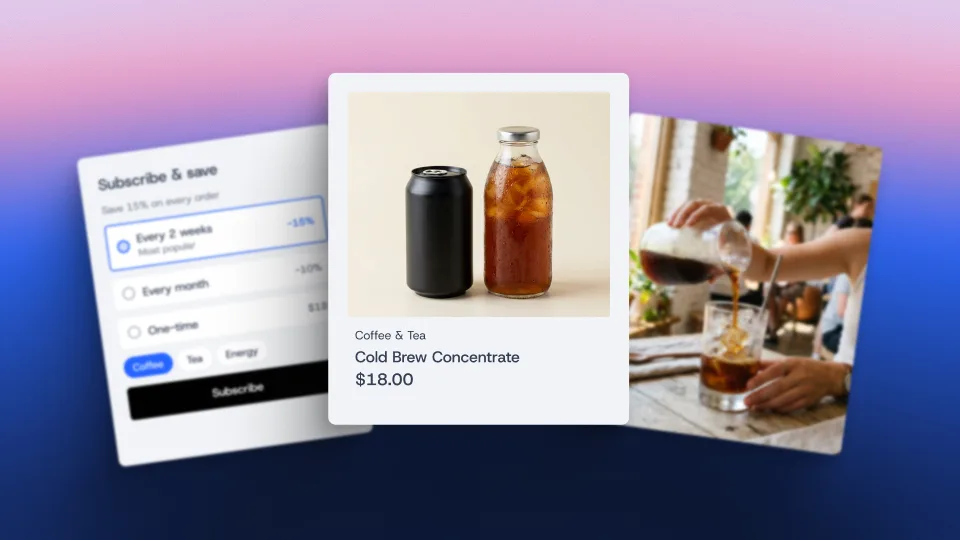
A grind selector and a subscribe option near the add-to-cart button
Put yourself in the customer’s shoes and walk through the thought process you have when shopping for beans. All of the above likely goes through your mind. By putting it in an accessible spot, and adding subscribe and grind selection near add-to-cart, you’re streamlining the entire process.
Variants: whole bean, grind sizes and bag sizes.
Every coffee can quickly come with 15 variants, even with just three bag sizes and five grind options. Add additional grind options? It only gets worse.
Keep variants under control and limit grind options to the ones customers most frequently use, like: whole bean, drip, pour over, French press, and espresso.
If you offer anything but whole bean, there’s a chance you’ll be grinding to order. (Unless you have a dropshipper or supplier that sends pre-ground.) If you grind to order, make sure you track inventory at the roasted-bean level to start, that way every grind option pulls from the same stock.
Payments, taxes and checkout.
The best coffee in the world won’t sell if people can’t buy it. Keep your checkout process short and accept major cards and digital wallets, for starters.
Worth noting that sales taxes are handled differently by state. Confirm the rules in every state in which you have tax obligations before you start selling.
Price your coffee for DTC and wholesale
If you plan on only selling DTC or wholesale, you can focus on that specific section. Otherwise, you’ll want to make sure you understand how to price the same coffee two different ways.
Price your retail (DTC) coffee.
Start with your landed cost per bag: green coffee, roast loss (coffee loses weight as it roasts), packaging, labor, and overhead. Next, add payment fees and any shipping you absorb.
Lastly, price to your positioning and what comparable specialty roasters charge, not just to a target markup.
Price your wholesale tiers.
Wholesale buyers expect a lower price per pound, larger formats, and better rates as their volume grows. To further incentivize big purchases, tiering by weekly or monthly volume rewards your best accounts while protecting margin on small ones.
Line item | 12-oz retail bag | 5-lb wholesale bag |
Roasted coffee cost | $6.30 | $42.00 |
Packaging | $1.00 | $2.50 |
Labor and overhead | $1.50 | $4.00 |
Landed cost | $8.80 | $48.50 |
DTC price | $20.00 | n/a |
Wholesale Tier 1 (under 20 lb per week) | n/a | $70.00 ($14 per lb) |
Wholesale Tier 2 (20–50 lb per week) | n/a | $65.00 ($13 per lb) |
Wholesale Tier 3 (50+ lb per week) | n/a | $60.00 ($12 per lb) |
Gross margin | About 56% | About 31%, 25%, and 19% by tier |
In the illustrative example above, the retail bag earns a much higher margin per pound. The wholesale bag earns less, but cafés reorder on a predictable schedule and move far more volume.
For more on tiered and contract pricing models, see our guide to B2B pricing strategy.
One catalog, two price lists.
Because this is the internet and everything is digital, you can keep things clean and offer a single catalog that simply displays different pricing depending on whether someone is DTC or wholesale.
You can accomplish this by requiring someone to be logged in and have an approved wholesale account, otherwise they get the DTC pricing. This avoids two common failure modes:
Price leakage: wholesale prices show up for retail shoppers, which trains customers to expect the lower price
Channel conflict: deep DTC discounts undercut the shelf price your café and retail partners charge for your bags
Strike a balance by sharing a suggested retail price with wholesale partners, and keeping public promotions modest enough that partners can still compete.
Turn coffee subscriptions into a retention engine
A coffee subscription business delivers coffee to customers on a recurring schedule, usually every one to four weeks, with automatic billing.
Most coffee subscriptions fall into two types: replenishment and discovery.
Replenishment vs. discovery subscriptions.
Coffee subscriptions aren’t like a magazine subscription (remember those?) where you receive it at a set interval. You can go that route via replenishment, but there’s also the discovery route.
Knowing the difference between these two subscription types is crucial:
Replenishment: the same coffee on a set cadence. It’s the easiest to plan roasting around and the most common model.
Discovery: a rotating selection of coffees. It drives engagement, but it takes more sourcing and roast planning.
Many roasters offer both, with replenishment as the default. Check out our guide to ecommerce subscriptions for other subscription types and what makes them work.
Cadence, pause and swap options.
Coffee is a natural replenishment product, as people are prone to drinking a lot of it, and often.
A 12-oz bag makes roughly 17 cups, so a person drinking one or two cups a day finishes a bag every one to two weeks. Great news for you, right?
The above cadence makes subscribing an easy choice for a lot of people. But, it’s still important you offer the right options around your subscription, especially if you want long-term retention.
Drive subscriptions for the long haul and give subscribers easy ways to adjust:
Pause the subscription instead of canceling it
Skip a single shipment
Swap grind, roast, or coffee
Change delivery frequency
Odds are, you’ve thought about canceling one of your many subscriptions and been hooked back in. Any of the above can be the thing that writes a similar story for someone else.
Subscription economics: LTV, churn and AOV.
Subscriptions aren’t just a great way to drive recurring revenue for your coffee business, but also a way to make roasting schedules or ordering more predictable. And that alone can help you save more money and pad margins. But, what about customer lifetime value (LTV)?
You can determine LTV by looking at average order value (AOV), order frequency, and how long a subscriber stays. For instance, a $20 bag every two weeks is 26 orders and $520 a year for every subscriber you keep.
Reducing churn will help keep that number high, while add-ons, like a second bag or brewing gear, will raise AOV.
The right platform will help here, making it easy to manage subscriptions and monitor performance. For instance, on BigCommerce, subscription billing runs through marketplace apps.
Read how to bring subscriptions to your online store for setup options.
Sell wholesale to cafés, offices and retailers
To sell coffee wholesale, set up a gated catalog with account-specific pricing, then pitch cafés, offices, and retailers with samples and clear terms. Once again, the most efficient approach is to run wholesale from the same catalog and inventory as your DTC store, using access gates to prevent showing the wrong prices.
Who buys wholesale coffee: cafés, offices, retailers.
Wholesale is a different beast from DTC, with larger order values and the potential for big, recurring revenue streams.
If you want to tap into wholesale, take note of these primary wholesale drivers:
Cafés: order weekly, often in 5-lb bags, and may expect training or equipment support
Offices: order on a steady schedule and value reliability and easy reordering
Retailers and grocers: buy retail bags at wholesale prices and give your brand shelf presence
Again, it’s important you have the aforementioned access guardrails in place, otherwise you’ll display the wrong prices to the wrong people.
Set up a wholesale storefront or buyer portal.
Speaking of having the right guardrails in place, a wholesale storefront gives approved buyers their own view of your catalog after they log in.
To make this happen, you need the right core pieces:
A gated catalog that only approved accounts can see
Account-specific or tiered pricing
Order minimums by weight or dollar value
Fast reorder from past orders
Running both channels from one product catalog and one inventory pool beats managing wholesale through spreadsheets and email on the side. Stock stays accurate across channels, and you update each product once, rather than twice.
Our wholesale ecommerce guide covers the full B2B build-out.
Net terms, minimums, and repeat ordering.
When offering wholesale, it’s important you have the right net terms in place. Established accounts will often expect net terms, like payment due in 15 or 30 days, or the option to pay by purchase order. Many roasters will accommodate this, but require a card payment for new accounts, extending terms once a buyer has a great track record.
Meanwhile, order minimums keep small orders profitable, as you don’t want to offer wholesale pricing and wind up losing out on shipping and labor. And for cafes, fast reorder flows are a must, as they’ll often need to restock coffee every week.
Ship and fulfill coffee orders
There’s more to shipping coffee than just getting the right order to the right customer. Even the best roast will fall flat if shipping takes too long, so timeliness and preserving freshness are key.
Protect freshness: packaging and roast-to-ship windows.
First, it’s important to protect the freshness of the coffee. This requires a multi-faceted approach, beginning with the packaging:
One-way degassing valves: let carbon dioxide escape the package without letting oxygen in
Heat-sealed bags: protect the coffee in transit and show the bag hasn’t been opened
Lightweight mailers: keep dimensional weight, and shipping costs, down
At scale, batch-roast against your order and subscription schedule rather than roasting each order individually.
Rates: flat, free-threshold or calculated.
Balancing shipping costs is the next step, as it’s important you keep costs down for customers while ensuring shipping doesn’t eat into your margins.
This is accomplished by using three different shipping methods:
Flat rate: simple for shoppers and easy to predict for one- or two-bag orders
Free shipping threshold: encourages a second bag and raises AOV
Calculated rates: accurate for heavy wholesale orders and long distances
The best part is that you don’t have to choose just one shipping method. Instead, offer each where it makes sense.
In-house vs. 3PL.
Again, freshness is crucial to the quality of coffee, especially if you’re wanting to appeal to the specialty drinkers with a more refined palate. This makes freshness a constraint for many, which results in a lot of roasters fulfilling in-house for a long period of time, as the wrong shipping partner can result in delays that harm the quality of the product.
When your order volume outgrows your space and staff, but your SKU count is manageable and your subscription shares make demand predictable, a third-party logistics (3PL) partner can be the right move to make.
You can’t just choose any 3PL however, as they need to understand the coffee business, rotate coffee by roast date, and so on. For more information, see our guide to ecommerce shipping and fulfillment for carrier and rate breakdowns.
Market your coffee brand
Once you have the right foundational pieces in place, it’s time to market your brand and attract a larger audience. To do this, think of the typical replenishment cycle: content to earn discovery, email and SMS to promote reorders, and subscriptions to keep things in motion. Wholesale, on the other hand, requires its own approach.
Content and SEO: brew guides and origin stories.
Content and search engine optimization (SEO) are right at home in the coffee world, and should be a core part of your ecommerce marketing strategy.
There are a few types of content you can incorporate here:
Brew guides: answer the questions shoppers search, like pour-over ratios, and bring buyers to your products
Origin stories: show what makes each coffee different and support higher prices
A content hub: a small library of linked guides builds search visibility faster than one-off posts
And of course, you can think outside the box. Infographics, videos, and so much more can be a part of your strategy, just make sure they’re a part of your overall brand strategy and stick to your usual messaging.
Email and SMS for replenishment.
Encouraging customers to replenish their coffee is a great way to drive ongoing sales, especially when coupled with subscriptions. And, best of all, email and SMS are both prime channels for encouraging replenishment orders, especially via:
Reorder reminders: time them to bag size, so a 12-oz buyer hears from you in about two weeks
Subscription offers: invite repeat buyers to subscribe after their second or third order
New release alerts: limited coffees give subscribers and past buyers a reason to open your emails
For more inspiration, be sure to read up on SMS marketing best practices and inspiration.
Wholesale lead generation.
Wholesale is a different beast from D2C, so if you’re equipped to handle it, it’s a great idea to get it into your mix of customers.
Just like driving replenishment orders, there are a number of ways you can help drive wholesale leads, too:
Line sheets: give buyers coffees, formats, and tier pricing on one page
Sample kits: let café owners taste before they commit
Local outreach: visiting nearby cafés and offices builds accounts faster than ads
While something like a sample kit can feel like a risky expense, keep in mind it can turn into a large customer that continues to order from again and again.
Licenses and legal requirements for selling coffee online
Coffee isn’t all fun and beans. There are legal requirements and licenses to consider, as is the case with most ecommerce businesses.
Selling coffee online generally requires a business license. If you’re roasting or repackaging coffee, you usually have state or local food-business registration to handle on top of the business license.
Requirements vary by state, so confirm them with your state and local agencies before launch.
Business licenses and food-business registration.
Most sellers need a business registration and a sales tax permit. If you roast or pack coffee, your state or local health department may require a food establishment permit and inspection, and you may need to register your facility with the FDA.
Selling coffee from home: cottage food rules.
If you want to start with a smaller operation, selling coffee from home isn’t totally out of the question, depending on your state’s cottage food law. Some states will allow roasted coffee sales from home, while others exclude it, while some limit online or out-of-state sales.
To be certain, check with your state’s agriculture or health department to see what the latest cottage food rules are.
FDA labeling requirements for coffee.
Packaged coffee generally needs a statement of identity, net weight, an ingredient list for flavored or blended products, and the name and place of business of the responsible company. Keep in mind these are all things called out earlier as great to have on your coffee package anyway, so this shouldn’t be an issue.
For more details, see the FDA’s Food Labeling Guide and the NCA’s coffee labeling resources.
The final word
Selling coffee online can be lucrative and fun, and ultimately boils down to making a few decisions in the right order. With a little planning, you can be roasting and grinding in no time.
To get started, do the following:
Pick a business model using the thresholds in the business model section above.
Order and cup samples from at least two suppliers before you commit.
Map your launch catalog with both a DTC price list and a wholesale tier before you build your store.
When you’re ready to build, explore how BigCommerce can run your DTC store, subscriptions, and wholesale accounts from one catalog. And for broader guidance on general sales, see our overview of how to sell online.
How to Sell Coffee Online FAQs
Selling coffee online can be profitable, especially when you roast your own and build repeat purchases through subscriptions. Margins depend on your business model: roasting earns the most per bag, private label sits in the middle, and dropshipping earns the least.
Yes, you’ll generally need a business license, while roasting or repackaging coffee usually adds state or local food-business registration. Rules vary by state, so check with your local agencies before you start selling.
Costs depend on your business model. Dropshipping has the lowest startup cost because you hold no inventory, private label adds minimum orders and packaging, and roasting your own requires equipment, the right knowledge, a permitted space, and green coffee.
Yes. Coffee dropshipping suppliers roast, pack, and ship orders under your brand, so you never hold inventory. It’s a low-risk way to test demand, but margins are thin and you have less control over freshness.
The best platform to sell coffee online handles deep product variants, supports subscriptions, and lets you sell wholesale from the same catalog. BigCommerce covers all three, with subscription billing available through marketplace apps.
Possibly. Some states allow roasted coffee under cottage food laws, but others exclude it or restrict online and out-of-state sales. Check your state’s current rules before you start selling from home.
⏰ Isn't about time that you evaluated your ecommerce platform?
Request a demo to see how the BigCommerce platform is different.