- Start & Build

Product Overview
What you can do with BigCommerce.
Agentic Commerce
 AI-powered solutions for growth.
Design Your Store
Build your store with or without code.
Apps & Integrations
Over 1,200 apps to help you grow.
Migrate to BigCommerce
Switch from Shopify, Woocommerce, Salesforce, Magento, and more.
- Launch Services
Overview
Chart your path to success with specialized services.Implementation Project Management
Experts to ensure you launch on time and under budget.Solution Architecture
Seasoned advisors to help you best design your store.Data Migration & Optimization
Expertise on a clean and clear path to migrating your data.Enterprise Launch Package
Personal training on how to set up and launch your BigCommerce Store.

Professional Services Blog Series
Get to know our teams and how they support your success in this Q&A series.

The Global B2B Buyer Behavior Report
This in-depth report provides actionable strategies to help you sell more online.
Commerce Unplugged: Five Takeaways From New York

Create your store and start selling today.
Create your new website.
See if the BigCommerce platform is a good fit for your business.
No credit card required.

Written by
Carmen Marxuach10/16/2026
Commerce Unplugged: Five Takeaways From New York
Get The Print Version
Tired of scrolling? Download a PDF version for easier offline reading and sharing with coworkers.
A link to download the PDF will arrive in your inbox shortly.
Key highlights:
Better product data brings together accurate specifications and the expertise that helps shoppers choose.
AI visibility means knowing what AI says about your brand, where it gets that information, and whether it’s correct.
Your own storefront offers a practical place to test conversational shopping and make product knowledge easier to access.
Clear permissions, identity verification, and fraud prevention help shoppers feel confident about agent-assisted purchases.
Start with a customer problem, bring the right teams together, and use a focused test to learn what works.
What can your best employee tell a shopper about your products that isn't included in your catalog?
It’s a useful question for a world where more shopping journeys begin with a conversation. It also captures one of the biggest themes from Commerce Unplugged in New York: businesses already have experiential knowledge about their products and customers. The opportunity is to put more of it to work.
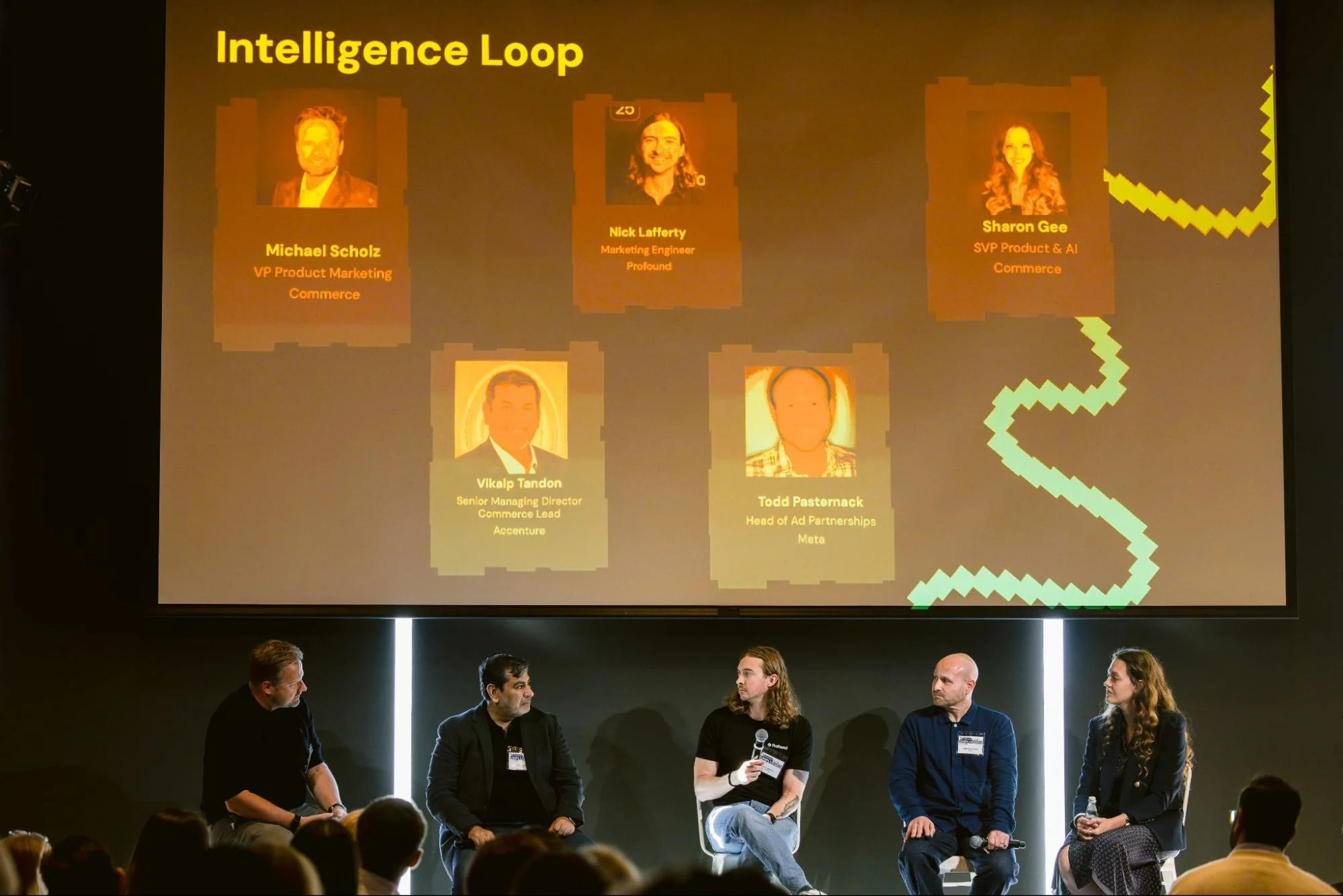
On October 13, commerce leaders, customers, and partners gathered at The Standard High Line for the latest stop in the PayPal-sponsored series. With perspectives from Commerce and Feedonomics, Accenture, Meta, Profound, PayPal, Chief Digital Agency, and Conair, the afternoon connected the possibilities of agentic commerce with practical steps businesses can take today.
The conversation kept coming back to familiar goals: help people find the right product, answer their questions, and make it easy to buy with confidence. Here are five takeaways for anyone who couldn’t join us.
1. Your product expertise deserves a bigger audience
Imagine a shopper asking an AI assistant for a linen dress for a summer wedding in Tuscany. They’ve supplied an occasion, a setting, and a few clues about what matters to them. A useful recommendation needs to connect those details to the right product.
That example, shared by Sharon Gee, Commerce’s SVP of Product and AI, shows why context matters. Information about materials, fit, and comfort helps explain why a particular dress might work. A catalog that captures all of that gives an AI assistant more to work with than a title and a price.
In the panel with Meta’s Todd Pasternack and Accenture’s Vikalp Tandon, that challenge connected two priorities: giving AI systems the detail they need to evaluate a request and capturing the expertise already inside a business. Merchandising and sales teams already know which features matter for different situations, how products compare, and what customers tend to ask before buying. Bringing that expertise into product data makes it available wherever a shopper encounters the brand.
This gives merchants a practical place to begin. Choose a category and ask the people who know it best: What helps a customer make a good decision? Then look at how much of that information appears in the catalog.
The knowledge is often already there. Making it accessible is the next step.
2. Getting into the answer is only part of the story
When an AI assistant recommends a product, it’s also telling a story about the brand. Understanding that story gives merchants a new way to learn how customers encounter their business.
The conversation with Profound’s Nick Lafferty offered four useful things to watch:
Visibility. Does your brand appear?
Citations. Which sources inform the answer?
Sentiment. How is the brand described?
Accuracy. Are the details correct?
Together, those questions provide a fuller picture than mentions alone. A product could appear in an answer with an outdated specification. A recommendation might sound positive but miss the feature that makes the product a good fit.
For Conair, monitoring its presence in AI answers is already part of the work. Umair Shabbir, the company’s Senior Director of Digital Technology, brought that perspective to the discussion, connecting AI visibility with the information shoppers use to make decisions. Reviewing what shoppers might see can reveal opportunities to improve the information available about a brand.
Try starting with a handful of questions customers regularly ask. Review the answers across AI tools and look at which products appear, what gets cited, and where the details need attention. Those findings can guide useful improvements to product pages, catalog content, and supporting information.
3. Your storefront can put conversational shopping to work today
Shopping through third-party AI tools is one part of the opportunity. A brand’s own storefront also offers room to help customers ask questions, compare options, and find useful answers.
Conair’s fireside chat showed what that can look like in practice. Natural language search can help shoppers describe what they need in their own words, while access to deeper product information can help them evaluate the options.
Some of that knowledge already lives in manuals, technical documentation, and warranty PDFs. Bringing it into a conversational experience makes it easier for shoppers to use without opening and searching through separate documents.
That can support questions before and after a purchase. Does this product meet a particular requirement? How do I use it? What support is available? Making those answers easier to find gives customers more reasons to feel confident in their choice.
Conair also shared early observations of stronger conversion among AI-referred visitors and shoppers using natural language search. For other merchants, that offers an encouraging reason to explore what these experiences could do for their own customers.
A category where shoppers often need help choosing is a useful starting point. Bring the relevant information together, test the experience, and see whether people find answers and move forward more easily.

4. Confidence belongs in every step of checkout
Once an assistant helps someone find the right product, the next step needs to feel just as clear. As agents take on more shopping tasks, customers need to understand what they’re approving and what control they retain.
The panel with PayPal’s Judy Reeves and Chief Digital Agency’s Jenna Posner connected that customer experience with the work behind it. Spending limits, permission boundaries, identity verification, and fraud prevention all help support a trustworthy transaction.
behalf? How much can it spend? When does that permission end? The experience needs to make those answers easy to understand.
Emerging standards, including the Universal Commerce Protocol, are part of the effort to connect discovery, checkout, and payments across systems. As those connections develop, merchants have an opportunity to help shape experiences that feel both useful and reassuring. That makes trust something to test alongside the transaction itself.

5. Give the first experiment a clear job to do
With so many possibilities in play, choosing where to start can feel like a project of its own. The afternoon offered several manageable options: enrich one product category, review your presence in AI answers, test conversational search, or explore a supported agentic checkout experience.
Start with a problem customers or teams already encounter, like shoppers struggling to compare similar products or find important specifications buried in documents.
A clear problem gives the experiment a purpose. It also helps identify who needs to be involved.
Marketing, ecommerce, merchandising, and technology each bring part of the picture. Agreeing on who maintains the information, manages the experience, and measures the results gives the work a foundation to grow.
The same thinking applies to partners. As AI experiences and protocols evolve, consider how a new capability will connect with the systems and workflows the business already uses.
Choose a useful question, bring the right people together, and define what progress would look like. The results can help make the next decision clearer.
The final word
Commerce Unplugged New York brought the opportunity back to the people doing the work: teams who know their products, understand their customers, and want to make shopping easier.
There’s plenty to build on. Capture more of that expertise. Make answers easier to find. Give shoppers confidence in the next step. Then use what you learn to keep improving.
Commerce Unplugged heads to the Dallas area on October 26 at The Star in Frisco. Explore the upcoming event and register your interest to join the conversation. Attendance is invitation-only and subject to approval.

Commerce built for momentum.
Get up to speed with new features that drive your business forward — from core capabilities to agentic commerce (and beyond).