- Start & Build

Product Overview
What you can do with BigCommerce.
Agentic Commerce
 AI-powered solutions for growth.
Design Your Store
Build your store with or without code.
Apps & Integrations
Over 1,200 apps to help you grow.
Migrate to BigCommerce
Switch from Shopify, Woocommerce, Salesforce, Magento, and more.
- Launch Services
Overview
Chart your path to success with specialized services.Implementation Project Management
Experts to ensure you launch on time and under budget.Solution Architecture
Seasoned advisors to help you best design your store.Data Migration & Optimization
Expertise on a clean and clear path to migrating your data.Enterprise Launch Package
Personal training on how to set up and launch your BigCommerce Store.

Professional Services Blog Series
Get to know our teams and how they support your success in this Q&A series.

The Global B2B Buyer Behavior Report
This in-depth report provides actionable strategies to help you sell more online.
Pre-BFCM Promotions: 6 Ways to Build Sales and Stay in Control
Create your store and start selling today.
Create your new website.
See if the BigCommerce platform is a good fit for your business.
No credit card required.

Written by
Ramanathan Ramakrishnamurthy10/07/2026
Pre-BFCM Promotions: 6 Ways to Build Sales and Stay in Control
Get The Print Version
Tired of scrolling? Download a PDF version for easier offline reading and sharing with coworkers.
A link to download the PDF will arrive in your inbox shortly.
Key highlights:
Early access turns existing interest into early sales. Offer select BFCM deals to loyal customers, subscribers, and rewards members first, and use their response to test offers before the main event.
Promotions work best where shoppers decide. Featured promotion callouts on product pages make offers easier to notice and can help convert more traffic.
Bundles and spending thresholds raise order value. Set thresholds based on your current average order value, and test the margin impact before scaling.
Unique codes and archiving keep campaigns manageable. Separate codes by audience and channel, and archive completed promotions so active ones are easy to identify.
A promotion calendar prevents overlapping offers. Stage your offers in the weeks before BFCM, document eligibility for each, and test the full customer journey.
Early BFCM sales start with a plan
Your Black Friday Cyber Monday (BFCM) promotions don't have to wait for Black Friday. But running them without a plan can cost you margin.
That matters because shoppers aren't waiting. According to eMarketer, 65% of U.S. adults planned to begin their holiday shopping before Black Friday in 2025, so the weeks leading up to BFCM are already part of the selling season.
Brands that use that time well can bring in early revenue, win back past customers, and learn which offers work before the biggest days arrive. Brands that don't often end up with overlapping offers, thinner margins, and a promotion list no one can keep straight.
The goal isn't to offer the biggest discount as early as possible. It's to give shoppers a relevant reason to buy while keeping control of your margin and your promotions.
Here are six ways to build early sales and keep control, from early-access offers and product-page promotions to unique codes, archiving, and a promotion calendar. For a broader look at getting your store ready, see BigCommerce's Black Friday prep guide and holiday playbook.
1. How can early-access promotions attract high-intent shoppers?
Some shoppers do not need much convincing to make a purchase. They may already know the products they want or have bought from your brand before. Giving these customers early access to select BFCM offers can turn existing interest into sales before the main shopping rush begins.
Early access can work well for loyal customers, email subscribers, and members of a rewards program. You can give these groups access to an offer before it becomes available to everyone else. This creates a sense of exclusivity while helping you bring revenue forward.
The offer does not always need to be a large discount. You could offer free shipping, a product bundle, or early access to a popular product. The important part is giving shoppers a clear reason to buy now instead of waiting for Black Friday.
Which shoppers should receive early access?
Start with customers who have already shown buying intent. This could include repeat buyers, recent customers, or subscribers who regularly engage with your emails. You can also create different offers for different customer groups.
For example, loyal customers could receive an exclusive discount and new subscribers could receive an introductory offer. High-value customers could receive early access to selected products. This makes your promotions more relevant instead of giving every shopper the same deal.
Timing also matters. It’s essential to launch the campaign early enough to build momentum. At the same time, keep the offer limited so shoppers still feel a reason to act.
Early access can also act as an early test. If a segment responds strongly to an offer, you have useful insight before the main BFCM campaign begins. If the response is weak, you still have time to adjust the offer.
Ways to make early access more effective:
Choose a clear customer segment
Give that group a specific reason to buy early
Set a firm start and end date
Use email or other owned channels to announce the offer
Keep the offer simple enough to understand at a glance
BigCommerce’s promotion capabilities can support different promotion rules and customer-focused campaigns. The exact setup will depend on your store and the type of promotion you want to run.
Takeaway: Turn early-access promotions into a pre-BFCM test. Use customer response to refine your offers before the peak sales period.
2. How can product-page promotions help shoppers make faster decisions?
Shoppers should not have to search your website to find out whether a product is part of a promotion. If an offer applies to a product, make that information visible where the customer is already deciding whether to buy.
Product pages are an important place to communicate promotional value. A clear offer can reinforce the value of a product and give shoppers another reason to continue toward checkout.
This matters even more during BFCM. Shoppers often compare products and prices across several stores. If your promotion is difficult to find, it may not have much impact. If the offer appears next to an eligible product, the value is easier to understand.
For business teams, this is also a campaign-performance issue. A promotion can drive traffic to the store, but poor visibility on the product page can weaken its ability to convert that traffic.
What should a product-page promotion include?
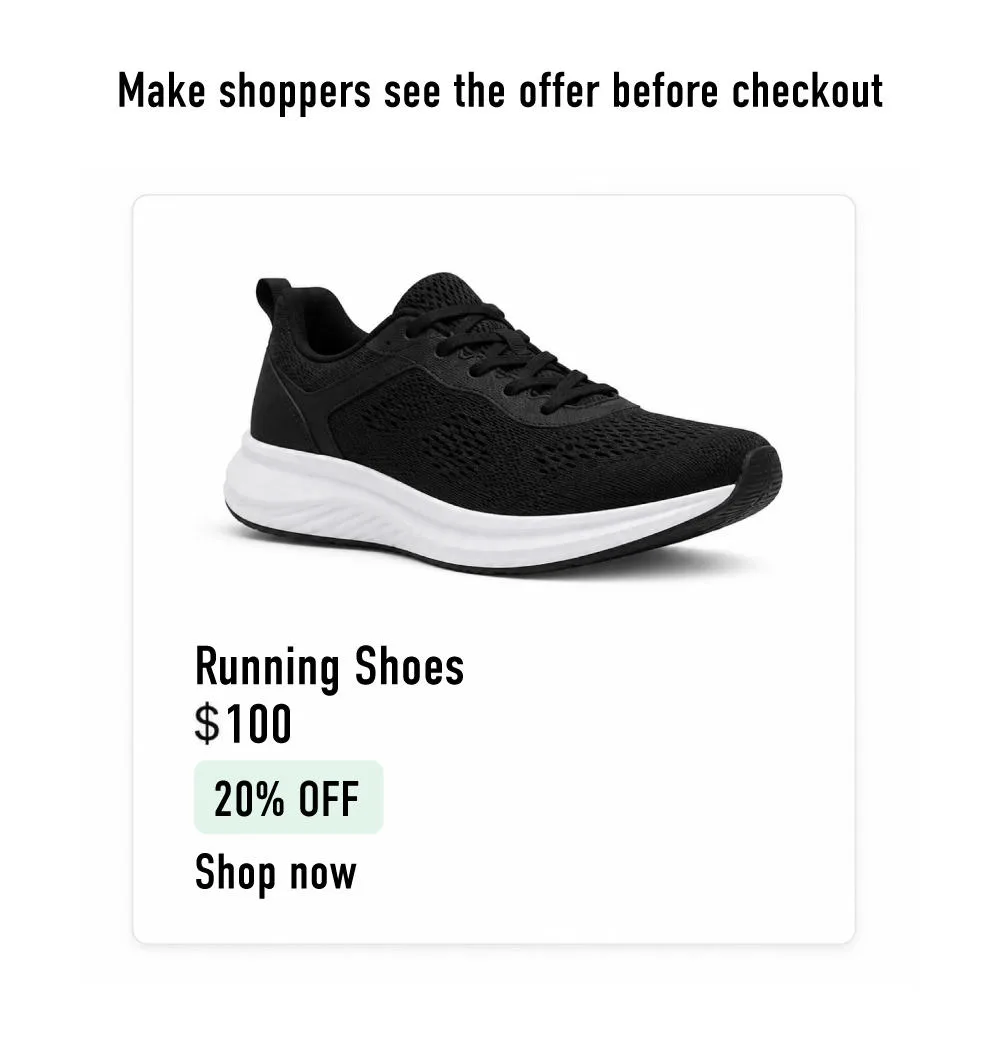
Keep the message short and specific. For example, you could show “20% off for a limited time” or “Buy two and save 15%.” The shopper should understand the offer without having to visit another page.
The promotion should also be clearly connected to the product because vague messages can make shoppers wonder whether they qualify. Clear eligibility information can help customers move toward purchase.
BigCommerce’s Featured Promotions capability is built around this idea. It allows featured promotion callouts to appear on product listing pages and product pages. The current Cornerstone release includes these callouts on product cards, list views, and the product page.
In simple terms, shoppers can see relevant offers while browsing a product, making the promotion easier to notice at the point of purchase.
That gives brands another way to put promotions closer to the buying decision. Instead of relying only on a homepage banner or cart message, shoppers can see relevant promotion information while they browse products.
Keep product-page promotions focused on:
The offer itself
Which products qualify
Any important conditions
The promotion period
A clear next step such as “Shop now” or “Add to cart”
Takeaway: Put promotions where purchase decisions happen to make offers easier to notice and improve conversion.
3. How can bundles and threshold-based offers increase order value?
A promotion does not always have to focus on reducing the price of one product. You can also use promotions to encourage shoppers to buy more. Bundles and spending thresholds can help increase the value of each order while still giving customers a clear incentive. For more offer ideas, see BigCommerce's Black Friday prep guide.
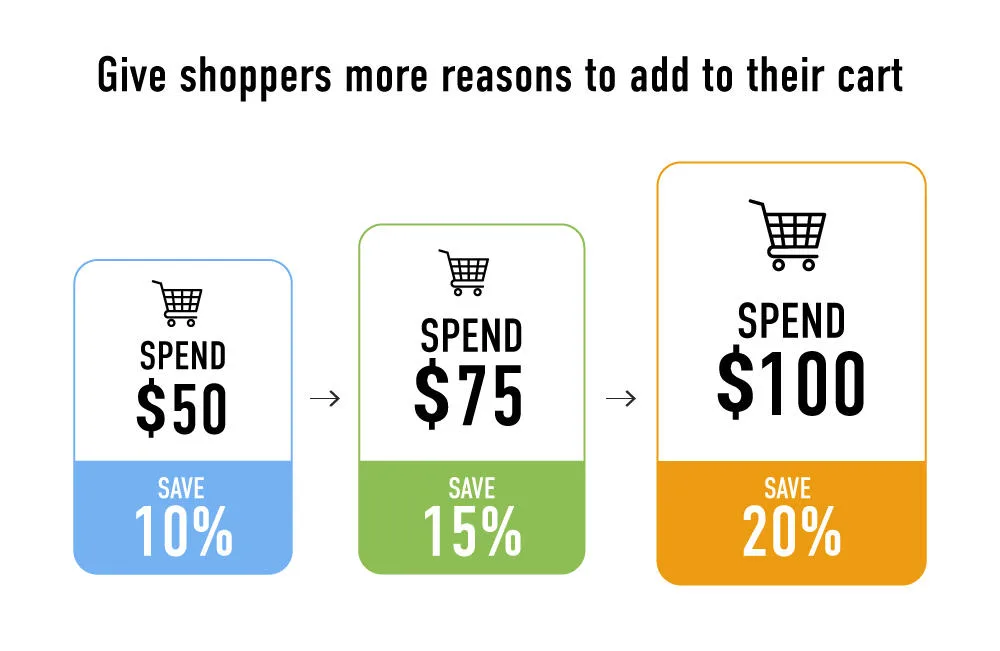
For example, a store could offer 10% off orders above $50 and 15% off orders above $75. Another option is a product bundle that combines complementary products at a special price.
The idea is simple. Give shoppers a reason to add another item to their cart. Instead of asking only how much you can discount, ask what buying behavior you want the promotion to encourage.
This shift is important when the goal is to grow AOV without unnecessarily giving up margin. A threshold or bundle can make the customer spend more before receiving the benefit.
How should you set spending thresholds?
Start with your current average order value. If shoppers usually spend around $45, a $50 threshold may feel achievable, but a $150 threshold could be too far away for many customers.
You can also use products that naturally work together. A clothing store could bundle a jacket with a shirt. A home goods brand could combine cookware with accessories. A beauty brand could create a routine using several related products.
The offer should feel useful rather than forced. Customers should be able to understand why the products belong together and why buying them as a bundle offers better value.
Before launching a bundle or threshold offer:
Review your current average order value
Choose a realistic spending threshold
Pair products that naturally complement each other
Keep the offer easy to understand
Test how the promotion affects your margins
To increase average order value (AOV) without depending solely on deeper discounts, design offers that prompt a bigger purchase while giving you more control over how much you discount.
You should also look at how the promotions work together. If a product discount is used alongside a cart-level discount, it can reduce your margin by more than you would expect. Before launching the campaign, make sure you test the entire customer journey.
Early testing is useful here. If a bundle increases AOV but reduces margin too much, you can change the offer before BFCM instead of discovering the problem during the busiest sales period.
Takeaway: Use bundles and spending thresholds to increase order value without relying on deeper discounts. Test the impact on AOV and margin before scaling the offer for BFCM.
4. How can unique promotion codes improve BFCM campaign management?
Using one promotion code for every marketing channel can make campaign management harder. If the same code appears in email, social media, affiliate campaigns, and influencer content, it becomes difficult to understand where the code is being used.
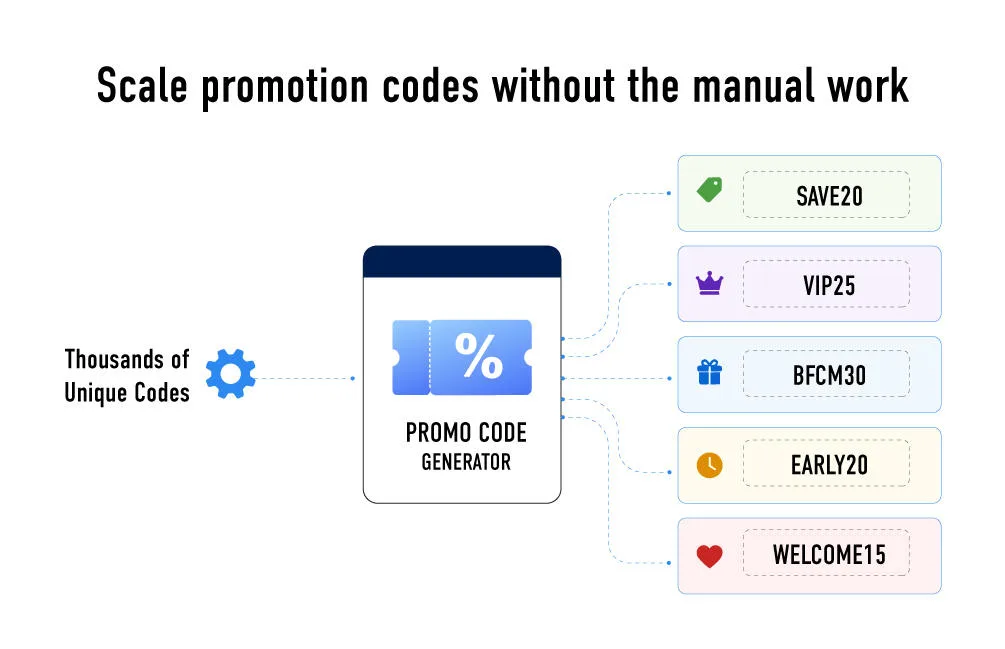
Unique promotion codes give campaigns more structure. You could create one code for email subscribers and another for VIP customers. An affiliate partner could have a separate code. An influencer campaign could use another.
This approach can also help you manage campaign rules. Different codes can have different usage limits or expiration dates based on the needs of each campaign.
For larger BFCM programs, this becomes a question of campaign control. The more audiences and channels you manage, the more difficult it becomes to track performance and maintain consistent promotion rules.
When do you need promotion codes at scale?
A small campaign may only need a few codes. A larger BFCM program can require hundreds or thousands of unique codes. This can happen when brands work with many affiliates, influencers, customer groups, or personalized campaigns.
Creating and managing those codes manually can take significant time. It can also increase the chance of errors when teams are working under tight BFCM deadlines.
That operational workload can grow quickly when marketing, merchandising, partnerships, and ecommerce teams are running campaigns at the same time.
BigCommerce’s Promotion Code Manager is designed to help brands generate, import, export, and manage thousands of unique promotion codes at scale. The app is available through the BigCommerce marketplace.
That makes the capability especially relevant for large promotional programs. Instead of treating every code as a separate manual task, teams can manage larger groups of codes through a more centralized process.
A simple promotion-code system can help you:
Separate codes by audience
Create codes for specific campaigns
Set appropriate usage limits
Manage expiration dates
Keep campaign codes easier to identify
Reduce repetitive manual work
Use a naming structure your team can understand. A code such as VIP25 is easier to recognize than a random string when someone is reviewing campaign activity.
Takeaway: Give each campaign a clear way to measure performance and control offer usage at scale.
5. How can archiving promotions make BFCM management easier?
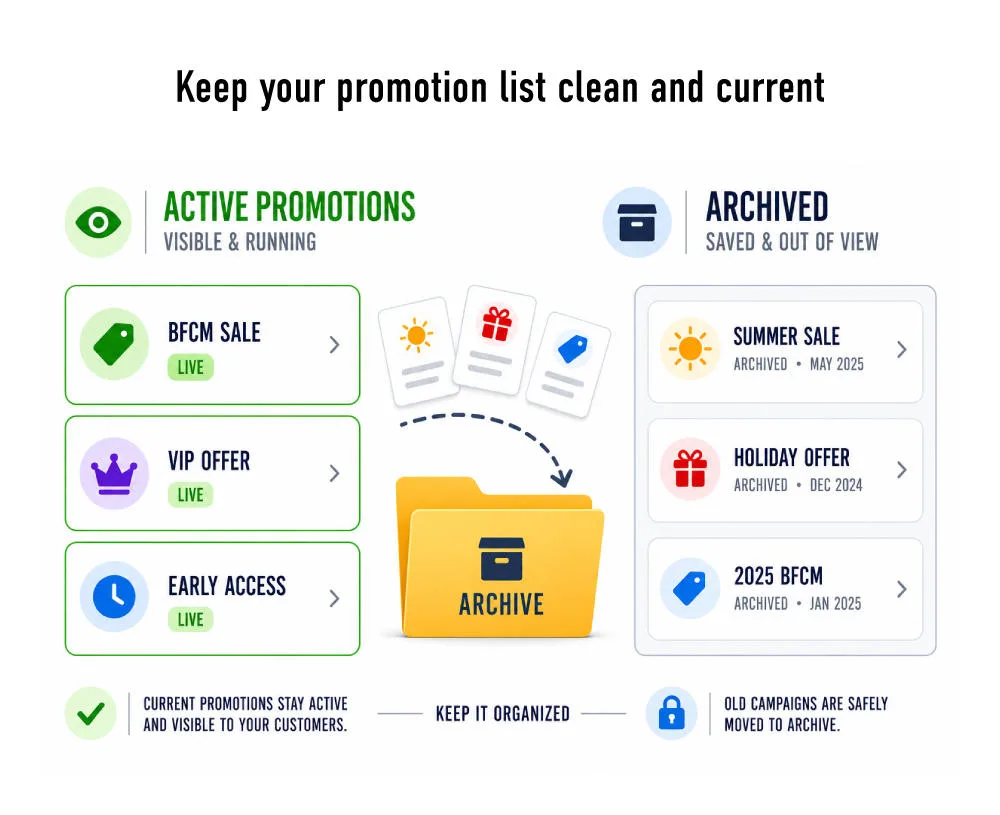
Promotion lists can become crowded as campaigns accumulate. A store may have promotions for summer sales, holiday campaigns, product launches, VIP customers, and previous BFCM events. Keeping all of these in the active workflow can make current campaigns harder to manage.
This matters even more during BFCM when teams are handling multiple offers and tight deadlines. An overcrowded promotion workflow can make it harder to identify which campaigns are active and increase the risk of mistakes.
Archiving gives teams a way to move completed promotions out of the active workflow while keeping them available for future management. This can make it easier to focus on the offers that matter now.
A cleaner promotion list can also reduce mistakes. When teams are managing several offers at once, outdated campaigns can make it harder to see which promotions are current.
When should you archive a promotion?
Archive a promotion when the campaign has ended and you no longer need it in your active workflow. This could include an early-access campaign, a seasonal promotion, or a completed BFCM offer.
Before archiving, review the campaign and record any useful results. Look at sales, usage, and customer response. That information can help you decide which ideas are worth testing again.
This turns your past promotions into a source of useful campaign insight. Instead of simply removing old offers, teams can review what worked and use those results when planning the next campaign.
BigCommerce has also added bulk archive and unarchive capabilities to its Promotions API. This allows multiple promotions to be archived or restored in a single request.
This can be useful for larger retailers that manage many promotions. Teams can handle groups of campaigns instead of treating every promotion as a separate manual task.
A simple promotion cleanup process can include:
Review completed campaigns
Confirm that their end dates have passed
Record useful performance information
Archive promotions that are no longer active
Keep current promotions easy to identify
One important point is to treat archived campaigns as a reference. A successful past promotion does not automatically need to be repeated in the same form. Review why it worked first. The audience, timing and product mix may have played a bigger role than the discount itself.
Takeaway: Use promotion results to identify what worked, keep active campaigns focused, and make informed decisions about which offers to repeat for BFCM.
6. How can a BFCM promotion calendar prevent random discounting?
Running promotions without a clear schedule can put pressure on your marketing and ecommerce teams. It can also lead to too many offers running at the same time.
A promotion calendar gives every campaign a clear place in the BFCM journey. You can decide when to build awareness, when to introduce early offers and when to increase urgency.
More importantly, it stops BFCM from becoming one large promotion launch. Brands can spread campaigns across several weeks, give each offer a clear purpose, and use early results to shape what comes next.
The calendar does not need to be complicated. A simple plan can divide the weeks before BFCM into a few stages. Each stage should have a clear goal and a specific offer.
What should a pre-BFCM promotion calendar include?
Start now with Halloween-themed or seasonal promotions, an early opportunity to engage shoppers and build momentum ahead of BFCM. Next, run early-access or teaser campaigns. These can build awareness without using your strongest offer. You can then move into targeted promotions for selected customer groups.
As BFCM approaches, you can increase urgency. Email, website promotions, paid campaigns, and social content should support the same overall promotion strategy.
A simple calendar could look like this:
Timing | Promotion goal | Example |
|---|---|---|
Now through late October (around Halloween) | Build early interest | Halloween-themed promotions or seasonal offers |
3 weeks before BFCM | Build awareness | Teaser or early access |
2 weeks before BFCM | Drive early sales | Limited-time offer |
1 week before BFCM | Increase urgency | Selected product promotions |
BFCM period | Maximize conversions | Core BFCM offers |
The exact timing will depend on your products and audience. The important point is to avoid treating every day as a discount day. For more on mapping your wider holiday marketing calendar, see BigCommerce's holiday playbook.
This staged approach also gives leaders room to make decisions. If an early offer performs well, it can inform the next campaign. If it underperforms, there is still time to adjust the offer, audience, or message.
How can you avoid promotion conflicts?
Document the start date, end date, eligible products and customer groups for every promotion. Make sure the teams involved understand which offer applies in each situation.
Test every promotion before it goes live. Check the experience from the product page through the cart and checkout. Confirm that the final price matches the promotion message shown to the shopper.
You should also review your margins. A promotion that looks strong from a conversion perspective may not be profitable when combined with another offer.
For decision-makers, the calendar is more than a marketing schedule. It provides a way to control when discounts go live, how offers interact, and where the business is willing to trade margin for sales.
Before launching your BFCM promotion calendar:
Define the goal for every promotion
Set start and end dates
Identify eligible products and customers
Check for overlapping offers
Test the complete customer journey
Review expected margin impact
Takeaway: Build one shared promotion calendar that shows the offer, audience, timing and eligibility for every BFCM campaign. Use early campaigns to learn what works, then use those insights to shape your main BFCM offers.
What should your team do before BFCM?
Start by reviewing your current promotions. Identify which offers are still relevant and which should be archived. Then look at your best-selling products and decide where stronger promotion visibility could help.
Next, identify your high-intent customer groups. Create an early-access offer for one or more of these groups. Then plan bundles, thresholds and promotion codes around specific business goals.
Finally, put every campaign on a shared calendar. Give each offer a clear owner, start date, end date and eligibility rule. This gives marketing, merchandising and ecommerce teams one source of truth.
If your store needs more advanced customization to support these campaigns, experienced BigCommerce development services can help. A development partner can support storefront changes, custom functionality, integrations, and other technical requirements.
For brands that need ongoing technical support, BigCommerce managed services can help maintain the store as campaigns and business requirements change. This can be especially useful during high-volume periods when teams need reliable technical support.
Working with BigCommerce experts can also help your team make better use of the platform while keeping the focus on business goals. The right partner can support implementation, integrations, custom development, and ongoing optimization.
The final word
The weeks before BFCM can do more than warm up your audience. With a clear plan, they can build demand, bring existing customers back, and increase order value.
The strongest approach is not to run more discounts but to make each promotion serve a clear purpose. Early access rewards high-intent shoppers, product-page promotions make offers easier to find, bundles encourage larger orders, and unique codes make campaigns easier to track. Archiving keeps active promotions clear, and a shared calendar keeps everything coordinated.
BFCM is a major sales opportunity, but the strongest strategy does not always depend on the biggest discount. A clear plan for which offers go to which customers, and when, can make the weeks before BFCM as valuable as the event itself. To put that plan on paper, use a BFCM promotion planning checklist to map your offers, audiences, timelines, eligibility rules, and margin considerations before launch.
There's a lot to love ❤️
Watch a demo to see the BigCommerce platform in action.