




Written by
John Shieldsmith
The 2026 Ecommerce Tools Survival Guide
Get The Print Version
Tired of scrolling? Download a PDF version for easier offline reading and sharing with coworkers.
A link to download the PDF will arrive in your inbox shortly.
Key highlights:
Ecommerce marketing tools can help your company streamline workflows, market to customers more effectively, optimize product catalogs and shipping, and more.
Ecommerce tools fall into numerous categories, including ecommerce platforms themselves, marketing tools, payment gateways, shipping tools, tax support, and social media management.
Determining which ecommerce tools your business needs entails looking at your current business needs or challenges, examining competitors and gaps, and considering your own budget and in-house resources to support more complex tools.
There’s a lot of freedom that comes with running an ecommerce store. Your potential customer base is huge, you can work from anywhere, and you have an overwhelming number of ecommerce tools to choose from. (Wait, that last one didn’t sound entirely positive.)
Every ecommerce business encounters growing pains, whether that business is a seedling or sapling or sagely oak. The best ecommerce tools can alleviate these growing pains, and better yet — prevent future pains from causing you any headaches at all.
Ecommerce tools are available in more flavors than ice cream, so it’s important to understand what they are, what they can do, and then, which flavor your business craves right now.
What are ecommerce tools?
Simply put: ecommerce tools are any platforms, solutions, or plugins that enable ecommerce businesses to do something.
Some ecommerce tools are all-in-one solutions, capable of delivering just about everything a small business needs to grow. Others are more specialized, helping streamline a particular process or overcome one giant hurdle.
As an ecommerce business owner, you’ve already encountered a number of ecommerce tools, whether you knew it or not. Your ecommerce website runs on a platform, which is a tool, while another tool might power your email marketing efforts.
Get a free 15-day trial of BigCommerce.
No credit cards. No commitment. Explore at your own pace.
Types of ecommerce tools
There are countless types of ecommerce tools, with categories varying depending on who you ask. Regardless of the title one uses for a category, there are numerous types, each one with a different core responsibility or goal.
Ecommerce platform.
Ecommerce platforms are a tool the same way a Swiss army knife is a knife. They often serve as more than a glorified website builder, but enable the functionality of the ecommerce model itself.
An ecommerce platform isn’t to be confused with a marketplace, like Amazon, which allows vendors to sell rather than manage their own store.
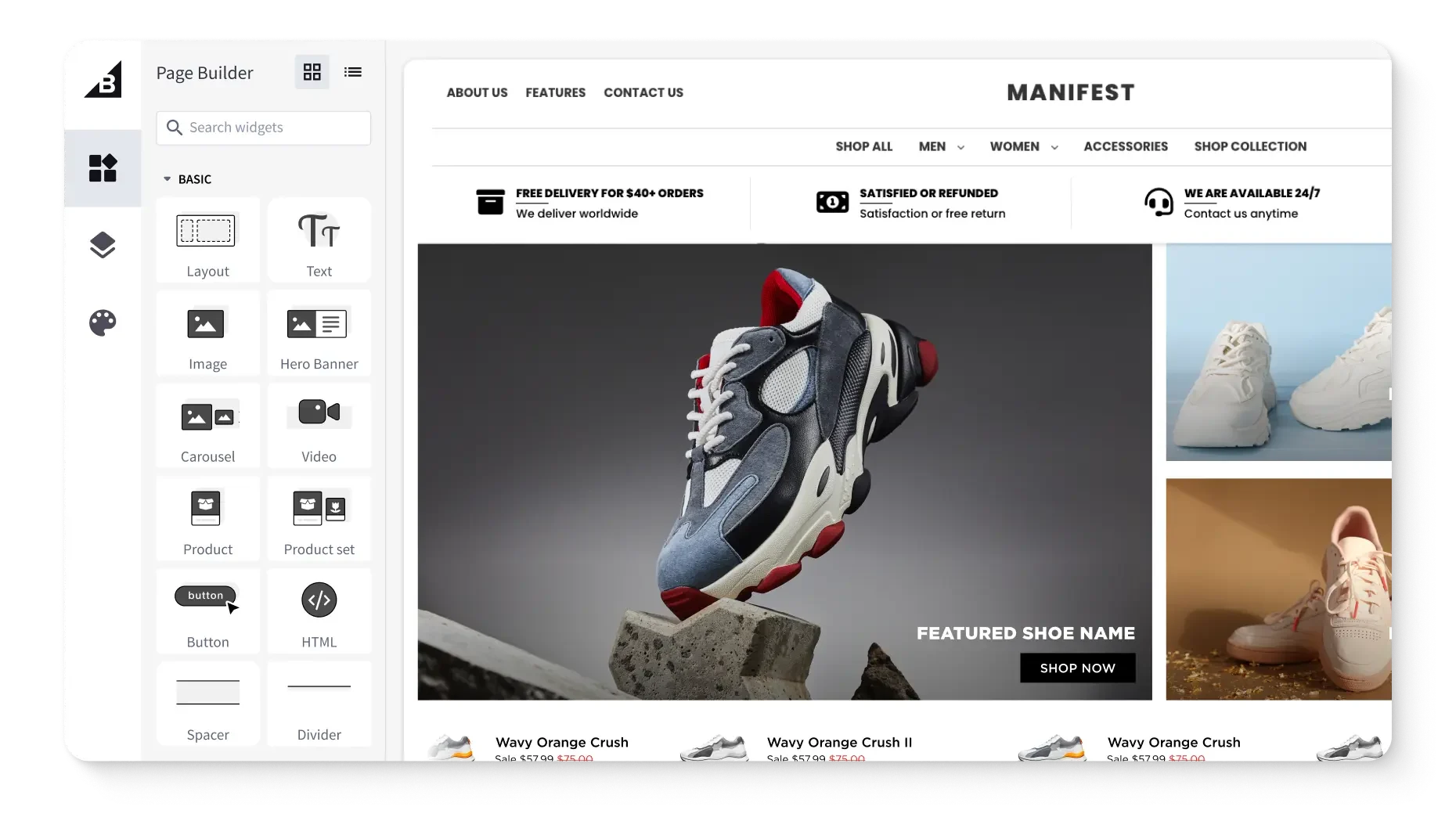
An ecommerce platform, like BigCommerce, provides ownership of the store, allowing more control, while delivering a drag-and-drop site builder, payment processing support, and more.
Examples of ecommerce platforms:
BigCommerce: A comprehensive ecommerce platform for small, medium, and enterprise, with a website builder, headless commerce features, integrations with automated product recommendation platforms, low/no code design, API support, and beyond.
Shopify: A large ecommerce platform that makes it simple for small businesses to get off the ground with customizable sites, proprietary POS, and more.
WooCommerce: A popular free plugin that makes it easy for those with a Wordpress site to set up an ecommerce site, provided they have developer support.
Adobe Commerce: A large SaaS ecommerce platform that’s tailored toward enterprise businesses and those with complex operations.
Magento: An open-source offshoot of Adobe Commerce that provides an extreme degree of customization to those with developer know-how.
Wix: Originally a streamlined website builder, Wix now features some ecommerce platform functionality that caters toward small businesses and beginners.
Salesforce Commerce Cloud: This cloud-based ecommerce platform caters to both B2B and B2C enterprise-size clients, supporting complex workflows and business operations.
Commercetools: A largely AI-powered platform that caters to enterprises and high-volume businesses in need of extreme customizations.
Ecommerce marketing tools.
Marketing is a must if you want people to find your online storefront. This is easier said than done, as ecommerce marketing requires an ongoing effort and the right data. This is where ecommerce marketing tools can come in.
Some offer all-in-one marketing support, giving you the tools you need to manage entire campaigns and optimize your funnel. Other marketing tools are specialized, providing marketing automation, email and content templates, and support that falls in numerous sub categories:
Email marketing
Social media marketing
Content marketing
SEO tools
Keyword research
With so many types of ecommerce marketing tools, it’s important to know what you’re looking for. Some ecommerce platforms, like BigCommerce, include marketing functionality as well, which can reduce reliance on third-party tools.
Examples of ecommerce marketing tools:
Mailchimp: Mailchimp can help you manage email campaigns, simplify A/B testing, track engagement analytics, and see where people are clicking with heatmaps.
Hubspot: This comprehensive marketing platform offers real-time insights, keyword ranking information, customizable dashboards and analytics tracking, marketing workflow automations, and more.
Klaviyo: An automation platform that assists with both SMS marketing, as well as email campaigns. (Automation made even easier with the BigCommerce integration.)
Google Analytics: This free tool is familiar to many online businesses, and for good reason. Google Analytics enables free tracking of web traffic, with insights on bounce rate, conversions, clicks, and so much more.
Canva: Canva isn’t an all-encompassing ecommerce marketing tool, but it does offer a number of templates that make it easy to stand up a professional ecommerce site. You can also utilize these templates for general content creation and marketing assets, like one-pagers, articles, or infographics.
BigCommerce: Okay, BigCommerce isn’t a marketing tool itself, but offers numerous marketing features, including automated abandoned cart sends, customer segmentation support, SEO and analytics tools, extensive product description control, and numerous marketing automation tools.
Payment gateway.
Every ecommerce business needs a way to take payments, and every customer needs a way to make them. Payment gateways provide exactly that, bridging the gap between the store and the payment processor itself.
The right payment gateway can help you accept payments from audiences around the globe, keep payment information secure, and ultimately make the payment process as painless as possible for you and your shoppers.
Examples of payment gateways:
Stripe: This well-known payment gateway offers a high-degree of customization to those with developer resources available, and supports more than135 currencies.
PayPal: PayPal is a well-known payment gateway with support for Buy Now, Pay Later functionality, cross-border payments, and acceptance of currencies across more than 200 countries.
Square: Square is known for offering a physical POS system, and offers seamless support for in-person and online payments.
Adyen: Adyen enables global payments, catering primarily to enterprises with more complex payment requirements than a typical ecommerce business.
PayCompass: This payment gateway supports international payments, with chargeback protection and additional features tailored toward higher-risk businesses.
Shipping.
Unless you’re strictly selling digital assets, shipping is a core part of your ecommerce business. It’s also increasingly important in the age of faster shipping and real-time tracking, with 92% of shoppers factoring in delivery timelines before finalizing a purchase.
Shipping tools for ecommerce can not only streamline the shipping process for your online store, but provide further functionality that benefits you and your customers:
Accurate shipping costs before checkout
Automated shipping label generation
Real-time rates from carriers
Delivery metrics, like average transportation time, order accuracy, and more
AI tools for analyzing shipping routes on the fly
Automated order fulfillment
The above benefits can not only help you meet modern customer expectations, but also make it easier to partner with dropshipping companies, as you’ll have more accurate fulfillment and less busywork clogging up the gears.
As your business grows, shipping tools can help you grow, stay competitive, improve overall profitability, and ultimately deliver the best experience possible. (And, on time.)
Examples of shipping tools:
Easyship: This global shipping tool enables cross-border deliveries, has partnerships with more than 250 couriers, and is ideal for larger companies selling into numerous markets.
ShipStation: ShipStation is known for being quick and easy to set up and use, with lower-priced starter plans and numerous automations to streamline shipping. With the BigCommerce integration, you can quickly take advantage of these features, too.
Sendcloud: This shipping platform is tailored for the European market, providing VAT compliance and a clean interface that makes it user-friendly for the newest of newcomers.
ShipperHQ: ShipperHQ offers numerous pre-purchase features and supports complex rate configurations, making it a great fit for those with multi-origin products or complicated shipping routes. It’s an especially great fit for those on BigCommerce, thanks to our integration.
Tax.
While the ecommerce model frees you from the confines of a brick-and-mortar tomb, it unfortunately can’t rid you of any tax burdens.
Fortunately, ecommerce tax tools can alleviate some of this inevitable work by providing any combination of the following:
Automated tax filing
Simplified compliance across industries and business sizes
Real-time tax calculations
Product-specific tax support
State-specific tax thresholds for those distributing to sellers
Keep in mind the above features are going to vary depending on the tax tool provider you go with. Some tax tools will offer more comprehensive support, while others are more niche. Think about your industry and general needs to determine which is the best fit for you.
Examples of tax tools for ecommerce:
Kintsugi: An AI-powered tax platform that specializes in nexus tracking, which can benefit both growing businesses, and those who already have a larger, more distributed market.
Avalara: This tax platform is built with enterprises in mind, supporting those with complex tax situations, broad compliance needs, and customers in international markets. With the international growth enabled by BigCommerce, the Avalara integration is a natural pairing.
TaxJar: TaxJar offers an intuitive, streamlined tax platform tailored to fit small and mid-sized businesses, with a reputation for great support and multi-channel optimizations. As an added bonus, the BigCommerce TaxJar integration makes it easier than ever to launch.
Quaderno: Quaderno is ideal for startups with European roots or customers, with many praising the platform’s intuitive interface and general ease of use while benefitting from VAT compliance.
TaxCloud: This platform provides an affordable platform for startups, delivering easy-to-use automation across basic tax functionalities and needs. Furthering this usability is a BigCommerce integration, making it a breeze to launch.
Social media management.
Social media is more than just cat and food pictures. It’s cat and food pictures, and a great way to promote your business while selling products in an organic way. In fact, 6.6% of ecommerce sales in the U.S. can be attributed to social media commerce.
Social media management tools can help you get in on this action, making it easier to promote your business, schedule and optimize posts, and even learn from customer behavior.
It’s worth noting, many social media management tools offer functionality that’s also found in the aforementioned marketing section. But, pricing can vary between the two categories.
Depending on your needs and budget, platforms that strictly focus on social media could be the better choice for your business.
Examples of social media management tools:
Hootsuite: This well-known platform supports up to 10 different social media accounts, making it easy to schedule posts in advance, automate replies, track brand mentions, and automatically create hashtags based on popularity.
Buffer: With a free plan and straightforward content scheduling, Buffer is an ideal starting point for those just engaging with social media, or smaller businesses.
SocialBee: SocialBee offers a rich scheduling platform with a customizable category system, allowing businesses to schedule single or repeat posts based on the type of content. This makes SocialBee a great fit for companies focusing heavily on content.
Sprout Social: Sprout Social offers advanced analytics and larger team support, making it an ideal choice for bigger companies needing multi-channel tracking, employee advocacy features, influencer marketing support, and more.
CRO (conversion rate optimization).
Marketing tools help you draw the eye — conversion rate optimization (CRO) tools help you keep it there.
A CRO ecommerce tool can help you refine existing pages, emails, mobile apps, and beyond, with:
Heatmaps that illustrate where visitors gravitate or bounce
A/B testing analytics and features for running multiple versions of a page
Recording functionality that provides an animated visual of a customer’s journey
Pop-up survey support, opening the door to qualitative feedback
Funnel analysis support, making it easier to identify which stages are struggling
Some marketing tools will provide varying degrees of CRO functionality. Again, think about your budget, resources, and business needs when determining if you need a stand-alone solution or something more comprehensive, albeit more limited in functionality.
Examples of ecommerce CRO tools:
Hotjar: One of the most well-known CRO tools, Hotjar offers in-depth heatmaps and visitor recording functionality, making it easy for businesses of any size to determine how pages are performing with customers.
Crazy Egg: Crazy Egg offers five different heatmap types, CTA performance analytics, no-code A/B testing, and more, with plans that cater to small-to-medium businesses.
Unbounce: For those focusing primarily on landing pages, Unbounce is a great solution, providing in-depth analytics, A/B testing tools, AI-powered copy generation, and numerous additional features that require no developer support.
Fullstory: Fullstory aims to deliver on its name, with comprehensive heatmaps and automated tracking, AI summaries of site sessions, funnel analytics and drop off reports, and more.
Microsoft Clarity: This free CRO tool offers streamlined heatmaps and recordings, making it a great starting point — but, keep in mind it doesn’t have any advanced features.
Customer feedback and reviews.
In-depth data and analytics can go a long way where optimizing your customer experience is concerned. But, data can only do so much. With the right customer feedback and review tools, you can gather insights straight from the people supporting your business.
Customer feedback tools for ecommerce can provide numerous outlets for customers and benefits for your business, including:
Pop-up surveys for those leaving your site
Review aggregation across third-party review sites
Customer loyalty management
Customer segmentation based on feedback and company perception
Support for customer product reviews, including photos and videos
When shopping around for customer feedback tools, don’t underestimate the importance of showcasing customer reviews, either. In fact, 96% of shoppers take a gander at reviews before they checkout.
Examples of customer feedback and review tools:
Yotpo: Yotpo simplifies the feedback process, giving customers a quick and easy way to leave feedback on a recent purchase. With the Yotpo Product Reviews plugin for BigCommerce, you can even simplify your setup process.
Okendo: This platform offers in-depth feedback forms, allowing for the collection of specific feedback, like whether a piece of clothing fits properly. For businesses with specific feedback needs, Okendo is a solid choice.
Zigpoll: Zigpoll is a versatile feedback platform, letting you gather feedback via email, website, or even through SMS, making it great for those with multiple channels.
Stamped.io: Stamped.io is a more comprehensive feedback platform, with support for customer feedback collection, loyalty program functionality, VIP programs, and even referral systems, making a great choice for those wanting to emphasize retention.
CRM.
As an ecommerce business, you’ve likely got more customer data than you know what to do with. A customer relationship management (CRM) tool for ecommerce acts as a single source of customer truth, giving this endless data a place to call home.
Without the right container, customer data is loose and hard to maintain, like a barrel of monkeys. A CRM can contain this data and give it purpose by way of:
Centralized data storage for contact info, correspondences, and orders
Lead scoring based on interactions, job titles, and more
Automated customer sentiment reporting
Automated personalization for campaign messaging and segmentation
On the surface, a CRM may not look like it does as much as other tools. But, the value of a CRM isn’t just in its functionality, but in the capabilities it unlocks.
With a CRM in place, you open the door to more personalized and effective campaigns, improved sales forecasting, better use of your inventory and storage spaces, and beyond.
Examples of ecommerce CRM tools:
Zoho: Zoho provides a CRM that can support complex workflows, configurable forms that capture specific info, AI-powered sales predictions, and access to a host of non-CRM tools as well.
Salesforce: Salesforce is geared toward enterprise-level businesses, supporting vast customer datasets, customized onboarding training for employees, and more — all with a BigCommerce integration, too.
ActiveCampaign: This cost-effective CRM includes in-depth reporting, comprehensive marketing automation, a library of AI prompts for supporting automation, and an introductory price suited toward smaller businesses.
Pipedrive: As the name implies, Pipedrive is all about optimizing your sales pipeline, with a visualization tool, automated suggestions to improve performance, and more.
Customer support.
Great ecommerce customer support can make or break a shopping experience, whether someone is a first-timer or loyal shopper. As your business scales, managing support becomes more difficult, requiring more attention and effort. Customer support tools for ecommerce can provide just the thing.
Customer support tools come in many forms, including:
Agentic AI-powered chatbots that guide customers to the right resource
Automated support ticket management and routing
Customer behavior analytics and insights
Unified communications with customers regardless of platform
Even if your business is just starting out, think about how any of the above functionality can help you stay on top of any support matters. As an added bonus, you’ll be learning the platforms early on, before your business grows and time is even scarcer.
Examples of customer support tools for ecommerce:
Tidio: This chat platform integrates with ecommerce stores, giving customers a way to connect with your team in real-time, and receive AI-powered support during non-business hours.
LiveChat: LiveChat integrates with your CRM, allowing it to personalize interactions based on previous customer interactions and engagement. With pre-chat surveys, it also helps you improve the customer experience in the long haul.
Zendesk: Zendesk blurs the lines between CRM and support platform, pulling in purchase history and customer data to enable accurate engagements and make real-time support easier for your team to deliver.
Hiver: With a heavy emphasis on AI, Hiver makes it possible to help customers around the clock with AI chatbots, while also offering insights on how you can improve future engagements.

There's a lot to love ❤️
Watch a demo to see the BigCommerce platform in action.
How to determine the tools needed for your ecommerce business
With so many types of ecommerce tools available, and further options in each category, choosing which tools to add to your belt first can be overwhelming.
Before you start shopping around, there are a few things to consider that will help you narrow down your search.
What are your business needs?
First and foremost, think about your business needs. Is there something you feel is holding back scalability? Where are you struggling?
When in doubt, turn to any metrics you have. If your conversion rates are low, you could likely benefit from optimization and/or marketing tools. If you have little-to-no data at all, a CRM platform is a good place to start.
Look at competitors as well if you’re struggling to determine your own needs. What are they doing better than you? What common customer complaints do you see in reviews for their business? This is your chance to sweep the leg and get the edge.
What’s your budget?
It’s a sad reality that money can and will be a limiting factor at some point.
When going through your business needs, make a wish list of tools, who is offering them, and average prices. From there, determine what’s in your budget. This can quickly rule out certain tools, for the time being, and help you decide on which solutions to implement in the present.
What in-house resources do you have?
Ideally, any tools you find will be accessible regardless of technical know-how or developer support. Still, you should check to determine what kind of developer resources are required to make full use of a tool.
On top of this, think about your team size and if a particular offering makes sense for you right now. For example, many companies make very useful ecommerce tools, BUT they’re aimed at enterprise organizations. If you’re a smaller business, these tools will likely cost too much and best support larger, more complex workflows.
The final word
Your ecommerce business is full of potential. The right ecommerce tools can help you unlock this potential, taking busy work off your plate while improving the customer experience or wrangling in shipping logistics.
With the ecommerce model, and all this potential, comes a need to evolve and adapt. Be mindful of the fact that any tools you start using this year may not be the ones your company or industry calls for in the years to come.
Constantly look for ways to improve. To work smarter, not harder. To ensure your toolbelt isn’t full of rust, but the sharpest, most useful tools for your business today.
Success doesn’t depend on just the right tools, but also having the right platform on which to build. BigCommerce offers just that, with numerous tools available right out of the box — built-in SEO tools, customer segmentation support, multi-storefront management, and more.
While the built-in features of BigCommerce can be a boon to your business, so too can the platform’s broad integrations and compatibility with the best in CRM, SEO, CRO, and beyond. You find the right tool, and we’ll provide just the spot on your belt.
FAQs about ecommerce tools
When it comes down to it, there is no one-size-fits-all platform. Uncovering the best ecommerce platform is generally dependent on your business and business goals.
However, with all of the advantages of a SaaS platform and the flexibility of an open-source platform, BigCommerce can meet a variety of business needs — no matter what type of business you operate or your ultimate goal.
With out-of-the-box features such as cart abandonment recovery, order notifications and single-page checkout, as well as a mobile app, BigCommerce is undoubtedly a frontrunner across ecommerce solutions.
You can attempt to build your own ecommerce website, but it can be difficult and the total costs can eventually exceed what you would’ve spent on a dedicated ecommerce website builder.
To find the best ecommerce website builder for you, you need to dedicate time and research into your business goals and what you’d want your website to look like.
Anyone can build a website — making it successful is another story.
Most ecommerce website builders offer limited free trials, free plans or even a free-to-build option. However, most will require a subscription for long-term use.
The total cost to build an ecommerce store is largely dependent on several factors. Building an ecommerce store is an investment, but if you’re using a store builder — you have the best chance to keep pricing down significantly.
Building a scalable ecommerce marketing tech stack takes a strategic approach, at the heart of which is a flexible ecommerce platform. With an ecommerce platform that integrates with numerous tools, you can then focus on incorporating tools that fit your specific business needs.
Along with a powerful ecommerce platform, it's important to have a capable customer relationship management (CRM) platform, as comprehensive customer data is core to automating workflows, personalizing messaging and support, and understanding your audience.
Data silos are one of the biggest hurdles to clear when managing multiple marketing tools, as failing to choose tools with proper integrations will result in no automated data sharing. On top of this, a complex marketing stack can result in a difficult onboarding experience for new hires, as well as ballooning costs.
Knowing when you upgrade your ecommerce marketing tools requires looking at a few different areas. First, are the tools still up-to-date and competitive with others out there? It's always a good idea to check at regular intervals, as some platforms will become more competitive over time and become the new best choice for your company.
Next, has your company outgrown your current tools or plans? As your company grows, you will likely need tools that support more users or seats, which can entail a higher-priced plan or different tool entirely. Your audience base and product offerings can also grow in complexity, requiring more complex and capable tools.
Get a free 15-day trial of BigCommerce.
No credit cards. No commitment. Explore at your own pace.